“Picking up word meanings through reading is ten times faster than intensive vocabulary instruction.” –
Stephen Krashen
by Noemí Rodríguez (LTL Contributor)
We all know and understand that READING is a fundamental practice to acquire vocabulary in context and understand how target structures function. Our learners need {ACQUIRED} INPUT in order to create OUTPUT. With this in mind, how do we as language teachers also take on the role as “literacy coaches” in our classrooms? How do we navigate through all of the authentic text or texts adapted for L2s and select the ones we feel are most beneficial to our novice, intermediate or advanced learners? And, what types of literacy strategies can we incorporate to make the process of reading meaningful and valuable for ALL of our learners?
*SELECTING THE RIGHT TEXT
-Is the text an appropriate reading level for students? (It should be easy to read! i+1)
-Will the text capture the students’ interest?
-Do students’ need prior/background knowledge to comprehend the text?
-Is the text culturally relevant & engaging?
Text samples can be word clouds, comics, music lyrics, poems, train schedules, tickets, info-graphics, memes, tweets complied (#authres), simple articles, fictional stories, etc.
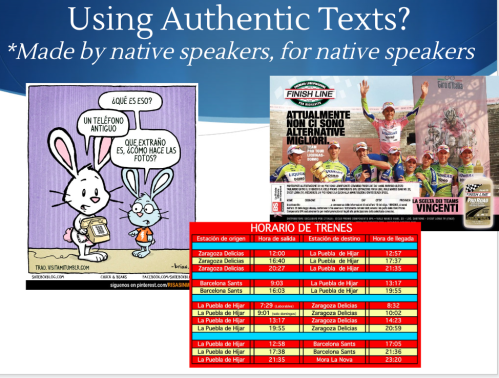
There is SO much out there– you just have to simplify and choose what is best suited & engaging for your learners. Also, you can transform a “high linguistic” level reading to novice level by using the embedded reading technique by Laurie Clarcq & Michelle Waley (Hombre de globo sample*) Ultimately, I feel that units of study CAN be planned around literature and appropriate texts through guiding essential questions and authentic resources, as opposed to isolated vocabulary lists and by drilling grammar points.
Resources:
Close Readings (Non-Fiction/Novice High)
Leslie Grahn’s Authentic Resources
Reading Diversity: A Tool for Selecting Diverse Texts
Command Language Performance Books
In addition to these incredible sources, we now also have Generative Artificial Intelligence tools such as Diffit.me, Briskteaching, MagicSchool.ai that can assist with leveling a text for our students and creating multiple versions, to ensure comprehensibility and to serve as being at that right level for students. These tools also generate guiding questions, open ended prompts and a variety of other activities which measure reading comprehension.
*FREE VOLUNTARY READING (FVR) LIBRARIES
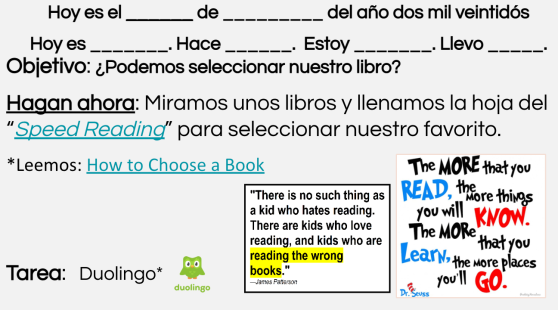
Last year, I set up Free Voluntary Reading every Monday with our Spanish II students beginning in late February. We completed our Do Now, had our partnered chats about our past weekends and dove into our pre-selected (*non-authentic) readers as a class with an independent follow up activity. We read for fifteen minutes quietly and when finished, students used their notebooks to select one of the activities from the Lectura Libre options table to demonstrate their comprehension of what they had read during class time. In order to select which reader was the right one for each student, we completed a “book tasting” in advance.
I was able to order 2-3 copies of the same text (many were ordered from Command Language Performance Books *I do not work for this company) and students were able to pass books around the classroom. I encouraged students to look at the front cover, back cover and open up to the middle of the book to read a few sentences. If the book was too difficult for them to understand/comprehend, they were asked to pass it along and try a different book. They scribed their thoughts on this “speed reading” log and at the end of class, selected which book would be “theirs” for FVR every Monday.
Resources:
¡Lectura Libre! Tabla de opciones
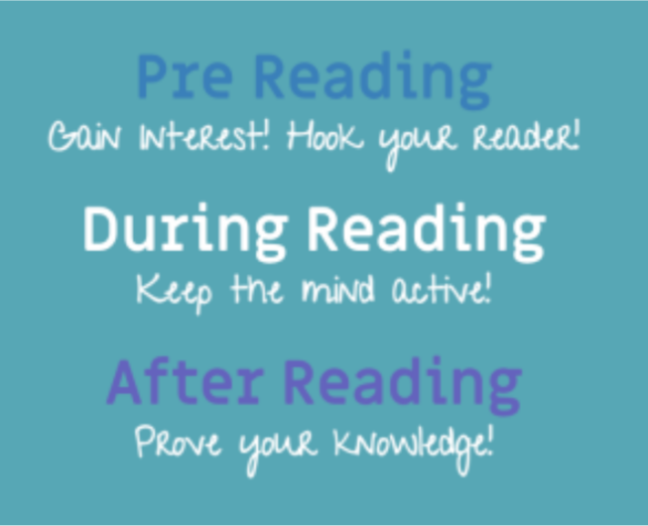
*PRE-DURING-AFTER READING STRATEGIES
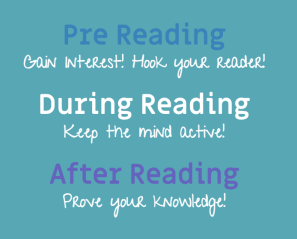
Pre-Reading:
–Building Background Knowledge
*Using images, quotes, infographics, book covers, questions, songs, etc
–Using Visuals & Thought-provoking questions
–Become Familiar with New Vocabulary
*Create a musical jingle with any of the words
*Organize these words in a human chain/web
*Play with the new vocabulary! Find ways to recycle any new vocabulary!
During Reading:
–Demonstrating Understanding While Reading/Listening
*Graphic organizer (story elements) to organize information
–Connections to Text
*Using post-it notes to make Text to Text, Text to Self or Text to World Connections
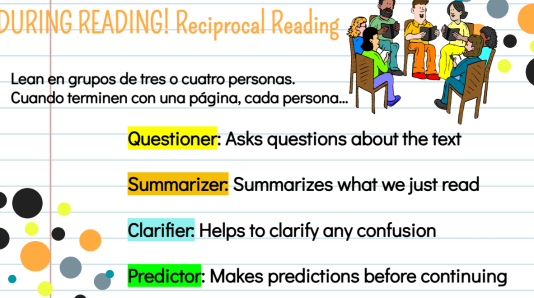
*Reading Role Play (Literature Circles Bundle, Reciprocal Reading (free spinners!) – visual below*)
–Making Predictions
*Select appropriate stopping points to predict what may take place next
After Reading:
–Visualizing Text & Retelling
*Retell the story, create your own story and write/narrate a story
–Comprehension Questions
*Create different questions to measure comprehension
–Demonstrating Knowledge: Presentational/Interpersonal
*Most important words, Sentence-Word-Phrase
*Writing prompts (poetry)
*WRITING STRATEGIES & WRITER’S WORKSHOP
(1) MORE READING = BETTER WRITERS – Which texts, readers, realia, poems, songs, infographics, novels are you using with students? STUDENTS SHOULD READ EVERY DAY!
(2) STRENGTHENING SENTENCES – Using question words: Who, what, where, why, when, how to help students revise their own writing and create powerful, descriptive sentences.
¿Qué? – What? ¿Cómo? – How? ¿Quién? – Who? ¿Dónde? – Where? ¿Por qué? – Why?
(3) PROVIDE OPPORTUNITIES & SUPPORT FOR REFLECTION – It is important to remember that writing is a PROCESS and it will likely take multiple attempts & revisions for student empowerment. Don’t rush the process, allow students to reflect, revise and refine writing multiple times! Use self-reflection rubrics to help students self-evaluate and monitor their progress. Use peer & teacher conferencing to strengthen their original writing sample.
Below are the steps to have students engage in a Writer’s Workshop:
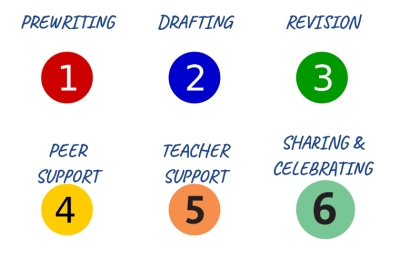
I’d like to highlight 4: Peer Support with a station rotation activity in class. Students can work together in small groups to assist one another at each station. Here are the signs that match each station, directions are posted below to help clarify what the expectations are for students. They can also use a self-reflection rubric, here is a sample for the writing prompt: Who Am I?
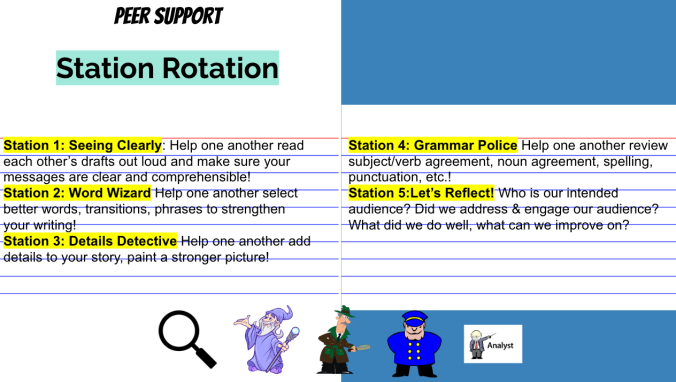
I created this comprehensive slideshow (which you can copy/paste/edit) for any reading activity and to also assist with implementing Writer’s Workshop in the future.
Exploring the world through literacy can serve an enriching experience for our students! By integrating reading into the daily routine of the language classroom, students not only expand their vocabulary but also improve their acquisition of the target language and gain a deeper cultural perspective with authentic sources. There are SO many wonderful ways to infuse literacy strategies in your language classroom! I do hope that reading is part of your future daily practice!
LoLogramos – Get a $5 off discount when you use the code LTL5 at checkout, exceptions may apply