How to Bring Real-World Context into Your Curriculum

real-world

by Carmen Reyes (LTL Contributor)

This article is based on one section of my presentation Embedding Real-World Context in Curricular Design, delivered at the Back to School ’25 Conference for Klett World Languages.

World language teachers everywhere share the same challenge: how do we make language authentic, relevant, and motivating for our students? While grammar drills and vocabulary lists may help students memorize forms, they rarely inspire them to use the language beyond the classroom walls.

One powerful solution is teaching through real-world contexts—placing students in situations where language is a tool for solving problems, connecting with others, and creating meaning. Instead of approaching language from the outside as a system of forms and rules, learners experience it from the inside out. 

Based on my own experience designing curriculum, I have found that bringing real-world context into the classroom works best when I follow a clear process. Over time, I have designed six practical steps that help connect language learning to authentic situations while keeping lessons structured, engaging, and aligned with proficiency goals.

Let’s explore these six steps for bringing real-world context into your curriculum, using a concrete example: planning and shopping for a party at a grocery store.
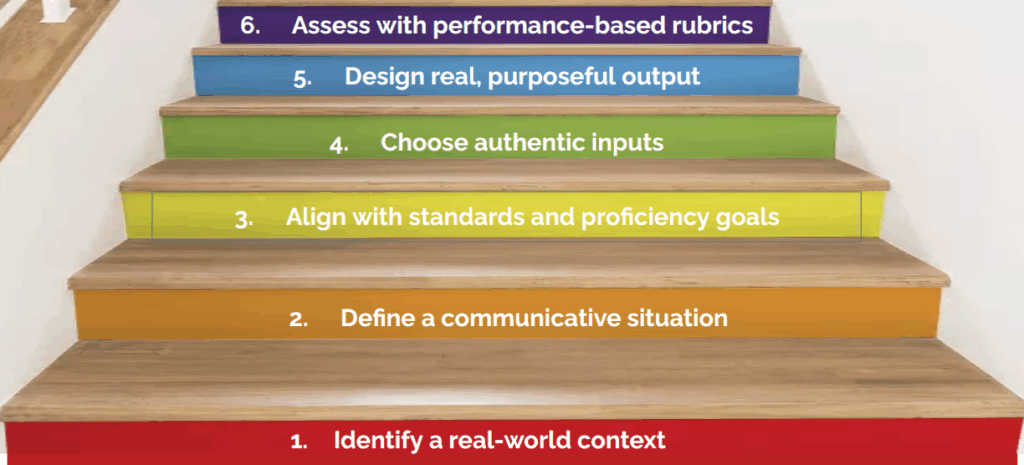
Step 1. Identify a Real-World Context

Choose contexts that mirror life beyond school walls. A grocery store is a perfect fit: it’s universally familiar, culturally rich, and loaded with communicative possibilities.

Leverage authentic materials such as supermarket websites:

By working with authentic grocery websites, students see real products, real prices, and even cultural differences in shopping habits and food choices

Step 2. Define the Communicative Situation for a Real-World Context

Rather than passively learning vocabulary, students are placed inside a real-world problem:

“You and your classmates are planning a party. Using a budget, you must buy groceries in Spanish. What will you buy? How much can you spend? How do you ask for help at the store?”

This transforms the classroom into a simulation of real life where students:

  • Ask and answer questions about prices, quantities, and items.
  • Negotiate choices in pairs or small groups.
  • Use polite expressions (por favor, gracias, quisiera, necesito) to interact respectfully.
  • Manage a budget, reinforcing numbers and currency vocabulary.

The task is social, practical, and full of meaningful opportunities for language use.

Step 3. Align with Standards and Proficiency Goals

ACTFL Proficiency Guidelines (Novice–Intermediate):

  • Interpersonal Communication: Requesting grocery items, asking about prices.
  • Presentational Speaking: Performing a role-play or presenting a shopping plan.
  • Interpretive Reading/Listening: Understanding flyers, labels, or website content.
  • Grammar/Vocabulary in Context: Food, numbers, currency, verbs like querer and necesitar, and polite requests.

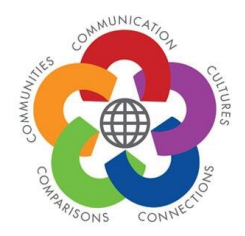
World-Readiness Standards for Learning Languages:

  • Communication: Real exchanges of needs and information.
  • Cultures: Understanding cultural practices of grocery shopping and celebrations.
  • Connections: Using authentic websites and media to link the classroom with the real world.
  • Comparisons: Seeing how shopping practices in the target culture differ from the students’ own.

Step 4. Choose Authentic Inputs for Real-World Context

Students thrive on real input because it shows them the living language, not a textbook version. Some ideas include:

  • Grocery websites with product images and prices.
  • Flyers or supermarket ads.
  • Photos/videos of open-air markets.
  • Party menus or packaging from authentic products.

These resources not only build vocabulary but also expose students to cultural perspectives—like why Peruvian markets might sell dozens of potato varieties or why French stores feature cheeses and wines.

Step 5. Design Real, Purposeful Output

Language acquisition sticks when learners produce something with meaning. In this case, students can:

  • Create a grocery list with items for a chosen type of party (birthday, picnic, holiday).
  • Write a short dialogue simulating a shopping interaction.
  • Role-play buying groceries, practicing questions and polite requests.
  • Present their “party plan” orally or in writing, justifying food choices.

Example:
“Para la fiesta de cumpleaños necesitamos un pastel, tres refrescos, y frutas. Compramos en Wong porque los precios son buenos.”

This output is purposeful, contextual, and fun—students are not just learning words, they’re planning a celebration in another language.

Step 6. Assess with Performance-Based Rubrics

Rather than focusing on grammar accuracy alone, measure success through communicative effectiveness. Criteria may include:

  • Use of target vocabulary (food, numbers, polite expressions).
  • Ability to ask/answer basic questions.
  • Collaboration and participation in the role-play.
  • Clarity in presenting their shopping plan.

A simple rubric with categories like Interpersonal Communication, Vocabulary Use, and Cultural Understanding keeps assessment meaningful and aligned with ACTFL.

Why This Works

When students learn through real-world contexts, they begin to see the target language as a living, breathing tool for communication. They gain confidence because they know what to say in a situation that feels real. At the same time, they’re exploring cultural practices and making connections to their own lives.

The grocery-store project illustrates how purpose, culture, and communication can come together in one unit:

  • Purpose: Plan and purchase for a real event (a party).
  • Culture: Explore food practices in Spanish- or French-speaking countries.
  • Communication: Use the language actively to solve problems and share ideas.

As teachers, our challenge is to open the classroom door to the world beyond, giving students the gift of authentic communication and the confidence that comes with it.

Diffit: A Teacher’s Partner

diffit

by Victoria Berasaluce Guerra (LTL Contributor)

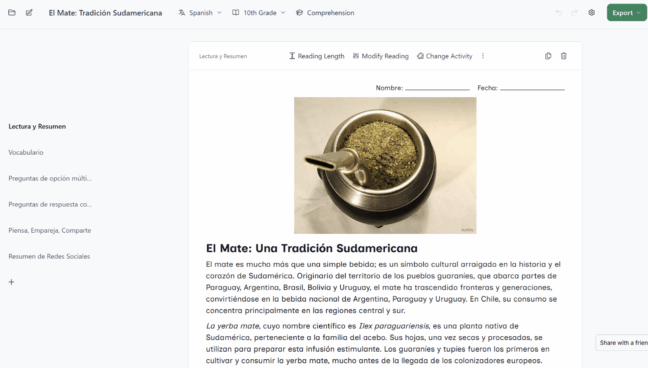
As I prepare for the new school year, I’ve been exploring different teacher tools to save time and boost student learning. After experimenting with both Diffit and QuestionWell, I have to say Diffit has “won me over”. It’s clean layout, intuitive design, and in-depth activity generator make it a powerful resource. While some features are reserved for premium users – like state standards alignment and more complex question sets – the free version still provides high-quality outputs that teachers can test and adapt. 

What I appreciate most about Diffit is how it supports differentiation. I can generate a text on a specific topic and instantly receive leveled versions, summaries, vocabulary lists, and ready-to-use activities. It gives me the flexibility to meet students where they are, without spending hours rewriting material. Plus, everything is editable – teachers can add, adjust, or replace activities and vocabulary as needed. To top it off, Diffit makes sharing easy by allowing exports in multiple formats. These types of tools, whether you choose to go with Diffit or QuestionWell, will be especially useful if you do not use a textbook in your class, or you need to find extra material to complement your teaching. 

As the school year kicks off, Diffit is quickly becoming one of my favorite prep assistants. It doesn’t just save time but – it helps me design learning experiences that reach all students.

So don’t miss out on this incredible tool to make Back to School back to focusing on what matters most: your students.


Other articles in LTL to check out

Compasión – Compassion

compassion

by Justa Rebollo Paz (LTL Contributor)

“Si tu compasión no te incluye a vos mismo/a, estás incompleto/a” Jack Kornfield

Y se me vino a la memoria las instrucciones de las azafatas al momento de comenzar a carretear el avión en donde se recomienda ponerse la máscara de oxígeno a uno mismo, antes que a los niños, en caso de despresurización de la cabina. Esto se hace, claro, para garantizar la supervivencia de ambos.

Y si. Claro. Para ayudar a otros, para salvar a otros, para alentar a otros, para amar a otros, primero tengo que haberlo hecho conmigo mismo/a. Solo así y después, voy a poder hacerlo con los demás.

Te la dejo picando…


“If your compassion does not include yourself, it is incomplete” Jack Kornfield

And so I remembered the flight attendants’ instructions as the plane begins to taxi, recommending we put on the oxygen mask on ourselves, before putting them on the children, in case of cabin depressurization. This is done, of course, to ensure the survival of both.

And yes. Of course. To be able to help others, to save others, to encourage others, to love others, I must first take care of myself. Only then, and only then, will I be able to take care of others.

I’ll leave it up to you to consider…


https://www.instagram.com/educaraconsciencia

Juegos reunidos – Intermediate

juegos

by Ramón Clavijo (LTL Contributor)

No siempre es fácil llevar el componente lúdico a clase. Como bien sabes, son muchas las variables que se deben combinar adecuadamente para garantizar el máximo aprovechamiento de los juegos en el aula: el número de estudiantes, los contenidos lingüísticos que se quieren reforzar, las destrezas comunicativas que se pretenden practicar, la propia producción de los alumnos, los contenidos colaterales que puedan ir surgiendo…

Para ayudarte en esta tarea, te presentamos un libro 📚 que tiene ya sus años pero cuya utilidad pedagógica no se ha resentido con el paso del tiempo: ¡Hagan juego! Actividades y recursos lúdicos para la enseñanza del español, de Edinumen.

Uno de los aspectos reseñables del libro es la variedad de propuestas lúdicas, a lo que hay que añadir la introducción de variantes que ofrecen la posibilidad de adaptar el juego a diferentes circunstancias. Igualmente, hemos de destacar el hecho de que las dinámicas aparezcan clasificadas por competencias, así como la existencia de un índice de objetivos gramaticales y otro de objetivos comunicativos, lo cual agiliza la búsqueda. Por último, también debemos reseñar la sencillez de las actividades, lo que reduce el tiempo de explicación y el estrés derivado de la no comprensión de las instrucciones.

Posiblemente ya conozcas un buen número de los juegos incluidos en el libro, y estamos seguros de que ya has llevado varios de ellos al aula, por lo que su novedad no radica en las actividades en sí mismas, sino en su presentación sistematizada y ordenada, lo que hará de él un auténtico vademécum que no debe faltar en tu biblioteca de departamento. 

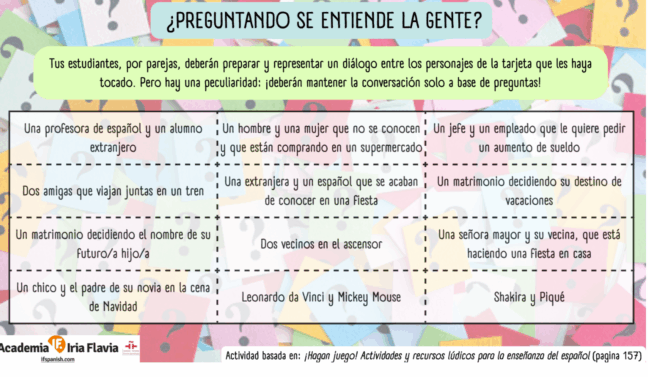
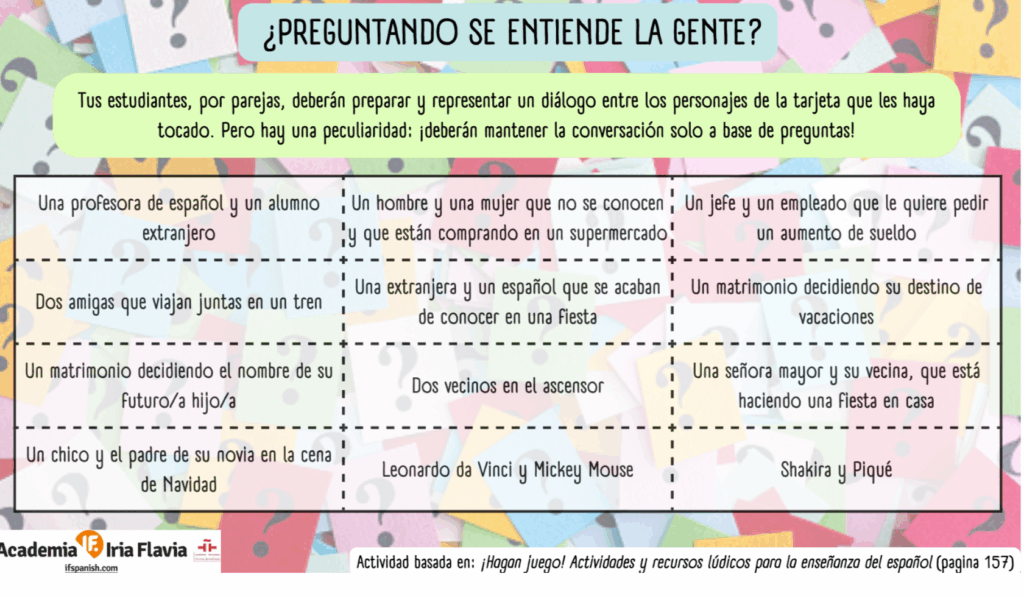
Nota: con esta entrada, te ofrecemos una infografía 👇 en la que hemos adaptado y ampliado uno de los juegos del libro. Se trata de una dinámica divertidísima que sacará a relucir la creatividad de tus alumnos.

juegos

Google Slides Updates You Will LOVE! 

Google

by Noemí Rodríguez (LTL Contributor)

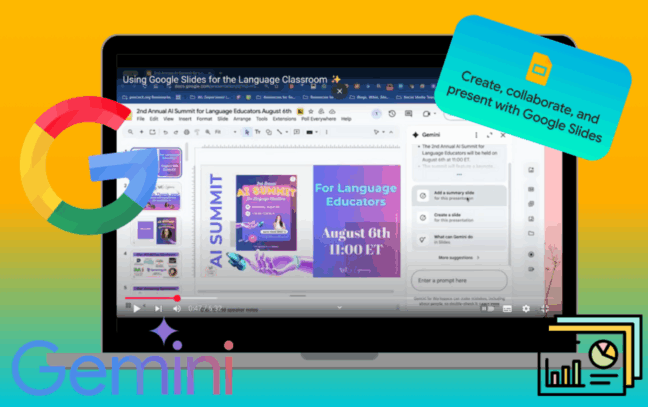
World Language teachers, get ready! I’ve kept hoping for this day within the capabilities to use Generative AI right in Google Slides and it’s finally here! 

Recently, Google Slides just became an even more powerful tool for our language classrooms! These are my top updates to Google Slides and a brief video overview is linked here

#1 – Supports multiple languages

Gemini now understands and works in multiple languages, including Spanish, French, Italian, Portuguese, and much more! I had previously shared about the amazing capabilities of creating podcasts and audio content in multiple languages – one of the platforms was Google’s Notebook LM. To learn more, check out this previous post

#2 – Video Recording

We can record our voices directly onto the slides. We can filter the background, we can use speaker notes. Wow! There are so many awesome capabilities! And, with digital storytelling, students can use their own video to narrate right on the screen to tell their stories. Here is a short workshop about digital storytelling for the language classroom. Anyone can add their voice without leaving the platform! It’s also an easy way to support listening comprehension exercises. Teachers can share a link to force a copy of the slideshow and students can record themselves replying to questions based on what they hear. 

#3 – Generative AI

Gemini is now built into Slides, which means you can generate entire slide layouts—complete with questions, vocabulary, images, and even video—just by asking aka prompting well! If you are not sure how to prompt well, check out my online library of Generative AI courses for language teachers – one is specific to prompting! So, if you need a slide with five comprehension questions in Italian and an image of a piazza in Florence? Type it in, and Gemini gets to work! It’s like having a creative assistant co-create alongside you! Of course you still need to check the language accuracy and ensure there are no hallucinations – but what an incredible time saver! 

As generative tools continue to evolve, they’re becoming more intuitive, more multilingual, and more supportive of our creativity in the classroom. If you haven’t explored these new features yet, now is the perfect time to dive in and see what’s possible! And if you are looking to explore more about Generative AI as a language teacher, I invite you to consider joining our upcoming 2nd annual AI Summit for Language Educators that is a donation-based virtual event and consider becoming part of our AI Innovator Community for the 2025-2026 school year. 

Take advantage of LTL discount options with LoLogramos!

  • Get a $5 off each month for the LoLogramos AI Innovator Monthly Subscription by using code: ltl5month
  • Get a $5 off of ANY of the LoLogramos online courses, including the latest: Canva, Your One Stop Shop! by using code: team5