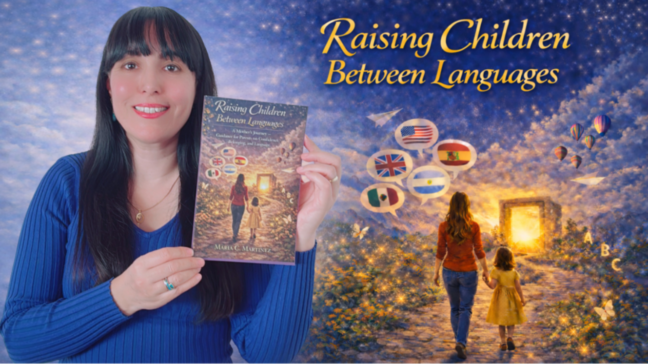
by María Martínez (LTL Contributor)
Many families raising bilingual or multilingual children quietly ask themselves the same questions: Are we doing enough? Are we doing it right? In this reflection, I share what I have learned as both a language teacher and a mother raising a child between languages — and why connection matters more than perfection.
The Questions Many Families Carry
One of the most common things I hear from parents raising children between languages is not a complaint or a request for strategies. It is usually a question. Sometimes it is asked openly. Sometimes it is shared quietly, almost apologetically.
Am I doing enough?
Over the years, I have spoken with many families navigating bilingual or multilingual upbringing. Some are multilingual households from the beginning. Others begin the journey later — after moving countries, changing schools, or deciding they want to maintain a heritage language at home. Despite their different circumstances, many of these families share similar concerns:
Am I doing this the right way?
What happens if my child mixes languages?
What if they prefer one language over another?
These questions rarely come from a lack of commitment. More often, they come from something deeper: the desire to give children the best possible start while navigating more than one language, culture, or identity.
As both a language teacher and a parent, I have encountered these concerns countless times — in classrooms, in conversations with families, and in my own home.
Because raising children between languages is not simply a linguistic experience; it is also an emotional one. It touches belonging, identity, confidence, and family connection.
What I Learned as Both Teacher and Mother about Raising Children Between Languages
For more than two decades I have worked with children, teenagers, and families learning languages in different countries and education systems.
But when it came to raising my own daughter between languages, something interesting happened: professional knowledge suddenly felt less important than observation, patience, and trust.
Like many multilingual families, our journey was not perfectly planned and it certainly wasn’t linear. Languages appeared and disappeared in phases. Some periods felt effortless, others uncertain.
Over time, however, one lesson became very clear: language does not grow through pressure or perfect strategies.
It grows through relationships, emotional safety, and everyday experiences — stories, play, conversations, routines, and shared moments.
And perhaps most importantly, it grows when children feel that their languages are part of who they are, not something they are constantly evaluated on.
Why I Eventually Wrote “Raising Children Between Languages”
After many years of these experiences — both professional and personal — I decided to write a book called Raising Children Between Languages – A Mother’sJourney.
I did not write it because I had discovered a perfect method.
I wrote it because I had seen how many families carry the same worries, often quietly.
The book grew out of that space between lived experience and professional reflection. In it, I explore questions that many parents encounter while raising children between languages, including:
– why bilingual development rarely follows a straight line
– why children sometimes mix languages — and why that is completely normal
– how emotional safety shapes language confidence
– the role of stories, play, music, and everyday routines
– how technology can act as a bridge rather than a distraction
– how language and identity grow together over time
Rather than presenting rigid systems or rules, the book invites parents to approach language development with more trust and perspective.
Because one of the most important things I have learned is this: parents often underestimate how much they are already doing right.
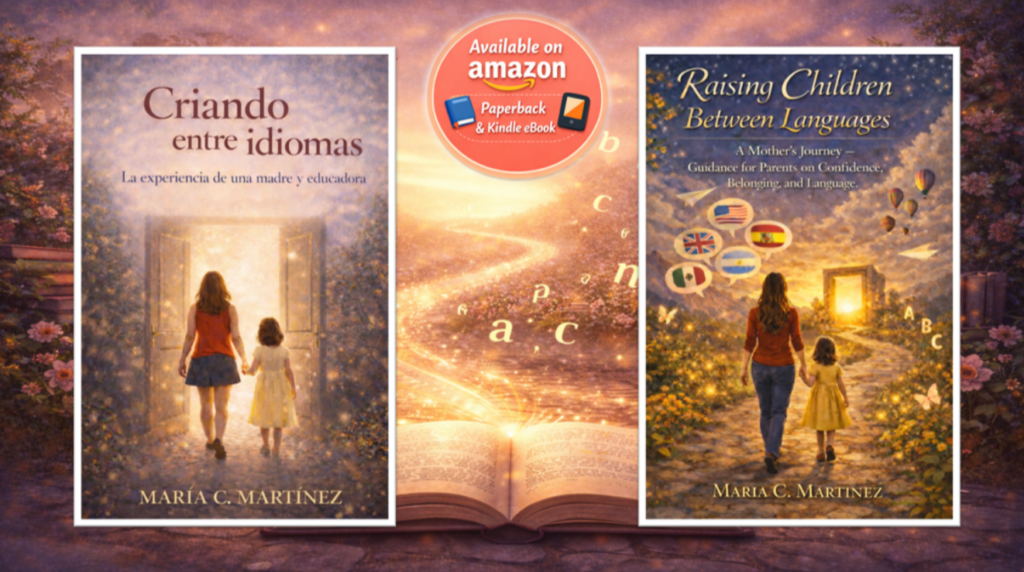
Available in English and Spanish
Since many multilingual families move naturally between languages themselves, the book is available in both English and Spanish.
English version
Raising Children Between Languages – A Mother’s Journey
Spanish version
Criando entre idiomas – La experiencia de una madre y educadora
If You’d Like to Learn More
Introduction to the book in English
Introduction to the book in Spanish
A Shared Journey
Raising children between languages rarely follows a straight path.
There are moments of confidence and moments of doubt, periods when onelanguage dominates and others when another returns.
But over time something remarkable often happens: the languages settle, the child grows into them, and what once felt uncertain becomes part of their identity.
And perhaps the most reassuring truth is this: children do not need perfect language environments.
They need connection, patience, and the freedom to grow into their languages at their own pace.
Criar entre idiomas: lo que he aprendido como madre y educadora
Muchas familias que crían a sus hijos entre dos o más idiomas se hacen, en silencio, las mismas preguntas:
¿Estoy haciendo lo suficiente? ¿Lo estoy haciendo bien?
En esta reflexión comparto lo que he aprendido como profesora de idiomas y también como madre criando a una hija entre lenguas — y por qué la conexión suele ser más importante que la perfección.
Las preguntas que muchas familias se hacen
Una de las cosas que más escucho cuando hablo con familias que crían a sus hijos entre idiomas no suele ser una queja ni una petición de estrategias. Suele ser una pregunta.
A veces se formula de forma abierta.
Otras veces se comparte en voz baja, casi con cierta inseguridad.
¿Estoy haciendo lo suficiente?
A lo largo de los años he hablado con muchas familias que navegan la experiencia de criar a sus hijos entre dos o más lenguas. Algunas viven en hogares multilingües desde el principio.’Otras comienzan este camino más tarde, después de mudarse de país, cambiar de escuela o decidir mantener la lengua de herencia en casa.
A pesar de sus circunstancias diferentes, muchas de estas familias comparten preocupaciones similares:
- ¿Lo estoy haciendo bien?
- ¿Qué pasa si mi hijo mezcla idiomas?
- ¿Y si prefiere un idioma sobre otro?
Estas preguntas rara vez nacen de una falta de compromiso. Más bien surgen de algo mucho más profundo: el deseo de ofrecer a los hijos el mejor comienzo posible mientras crecen entre más de una lengua, más de una cultura o más de una identidad.
Como profesora de idiomas y también como madre, he encontrado estas inquietudes innumerables veces: en el aula, en conversaciones con familias y también en mi propia casa.
Porque criar a un niño entre idiomas no es solo una experiencia lingüística; es también una experiencia profundamente emocional.
Tiene que ver con el sentido de pertenencia, la identidad, la confianza y los vínculos familiares.
Lo que he aprendido como madre y profesora
Durante más de dos décadas he trabajado con niños, adolescentes y familias que aprenden idiomas en distintos países y sistemas educativos.
Sin embargo, cuando se trató de criar a mi propia hija entre lenguas, ocurrió algo interesante: el conocimiento profesional pasó a un segundo plano frente a algo mucho más importante: observar, tener paciencia y confiar en el proceso.
Como ocurre en muchas familias multilingües, nuestro camino no fue perfectamente planificado ni siguió una línea recta. Hubo etapas en las que un idioma aparecía más y otras en las que parecía desaparecer. Algunos momentos fueron sencillos; otros trajeron dudas.
Con el tiempo, sin embargo, comprendí algo muy importante: el lenguaje no crece a través de la presión ni de estrategias perfectas. Crece a través de las relaciones, la seguridad emocional y los pequeños momentos de la vida cotidiana: las historias, el juego, las conversaciones, las rutinas y las experiencias compartidas.
Y quizá lo más importante de todo: crece cuando los niños sienten que sus idiomas forman parte de quienes son, no algo por lo que están siendo evaluados constantemente.
Por qué decidí escribir “Raising Children Between Languages”
Después de muchos años viviendo estas experiencias — tanto profesionales como personales — decidí escribir el libro Raising Children Between Languages – A
Mother’s Journey.
No lo escribí porque hubiera descubierto un método perfecto.
Lo escribí porque había visto cómo muchas familias cargan con las mismas preocupaciones, a menudo en silencio.
El libro nace de ese espacio entre la experiencia vivida y la reflexión profesional. En él exploro algunas de las preguntas que muchas familias se plantean al criar a sus
hijos entre idiomas, como por ejemplo:
- por qué el desarrollo bilingüe rara vez sigue una línea recta
- por qué los niños mezclan idiomas — y por qué eso es completamente normal
- cómo la seguridad emocional influye en la confianza lingüística
- el papel de las historias, el juego, la música y las rutinas cotidianas
- cómo la tecnología puede ser un puente cuando se utiliza con intención
- cómo el lenguaje y la identidad crecen juntos con el tiempo
Más que ofrecer reglas o sistemas rígidos, el libro invita a las familias a mirar el desarrollo del lenguaje con más confianza y perspectiva.
Porque una de las cosas más importantes que he aprendido es esta: muchas veces las familias subestiman todo lo que ya están haciendo bien.
“Raising Children Between Languages” está disponible en inglés y en español
Como muchas familias multilingües se mueven naturalmente entre idiomas, el libro
está disponible tanto en inglés como en español.
Versión en inglés
Raising Children Between Languages – A Mother’s Journey
Versión en español
Criando entre idiomas – La experiencia de una madre y educadora
Si quieres saber más
Vídeo de presentación del libro
Vídeo promocional en español
Un camino compartido
Criar hijos entre idiomas rara vez sigue un camino recto.
Hay momentos de seguridad y momentos de duda; etapas en las que un idioma domina y otras en las que otro vuelve a aparecer.
Pero con el tiempo suele ocurrir algo muy especial: los idiomas encuentran su lugar, los niños crecen dentro de ellos y lo que antes parecía incierto pasa a formar parte de su identidad.
Y quizá la verdad más tranquilizadora sea esta: los niños no necesitan entornos lingüísticos perfectos.
Necesitan conexión, paciencia y la libertad de crecer en sus idiomas a su propio ritmo.