Authentic Resources with the Smithsonian Learning Lab

by Vicky Masson

“Museums Alive” is a column of Language Teaching Lab that aims to connect the authentic resources of museums, art galleries, and other collections to the teaching and learning of World Languages.

Why authentic resources

Authentic resources in World Language such as art and artifacts help explain and understand the people that created and used them, its history, and its culture. They tell stories, are springboards for deeper learning, and leave memorable impressions to those who come in contact with them. Also, they open our minds to new perspectives and make it easier to relate to different points of view.

What is the Smithsonian Learning Lab

The Smithsonian Learning Lab (SLL) is a platform that connects the millions of objects that belong to the Smithsonian institution to anyone in any part of the world who has internet access. The SLL helps you find digital resources, create content using online tools, and share them with the world.

Why use the Smithsonian Learning Lab in a World Language Class

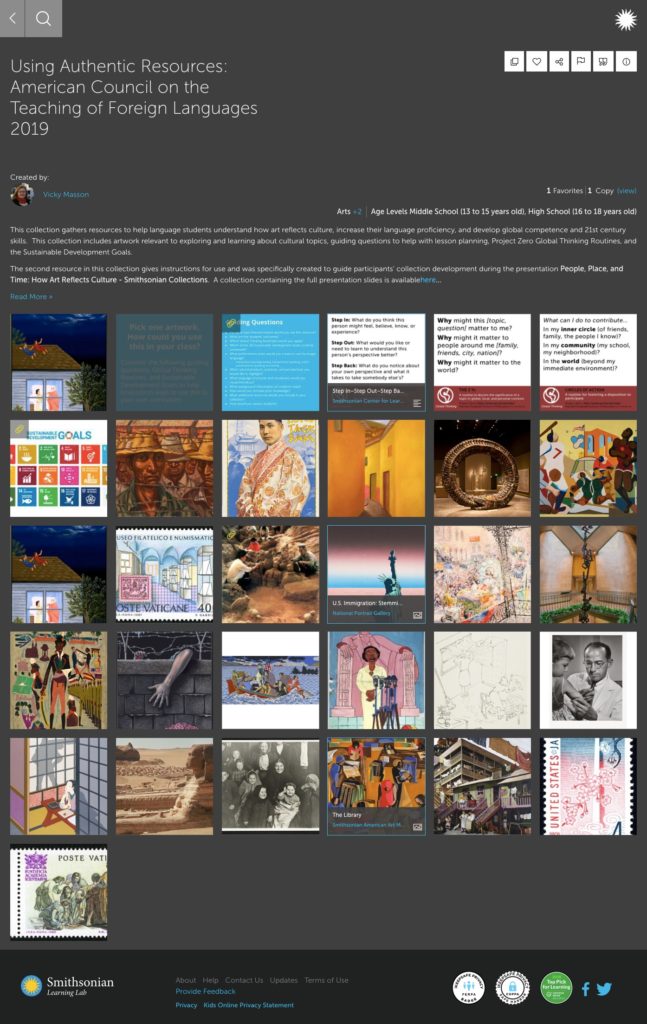
What a better way of learning a language than using the authentic resources from the SLL! The platform has millions of authentic resources at our disposal. The SLL collection that my colleague and I created, “Using Authentic Resources,” can give you ideas on what type of art and artifacts to choose and how to include them in the World Language class.

The artwork included in this collection helps students understand how art reflects culture by exploring and learning about cultural topics. It increases their language proficiency and develop global competence and 21st century skills.

How we Teach with the SLL:  PZ Thinking Routines, SDGs, and EdTech Tools

Creating a collection with the SLL allows you to have all that you need accessible in one place. Most importantly for teachers to consider is how you present the unit for student learning. All while, they use EdTech tools for a purpose: from Flipgrid to EdPuzzle to Teams or Google Docs. The SLL allows you to create collections with interdisciplinary connections.
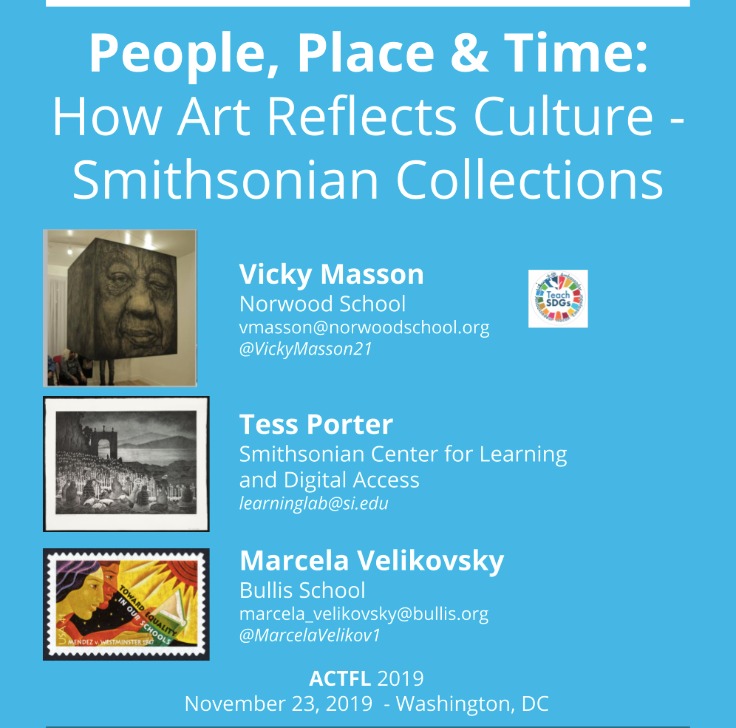
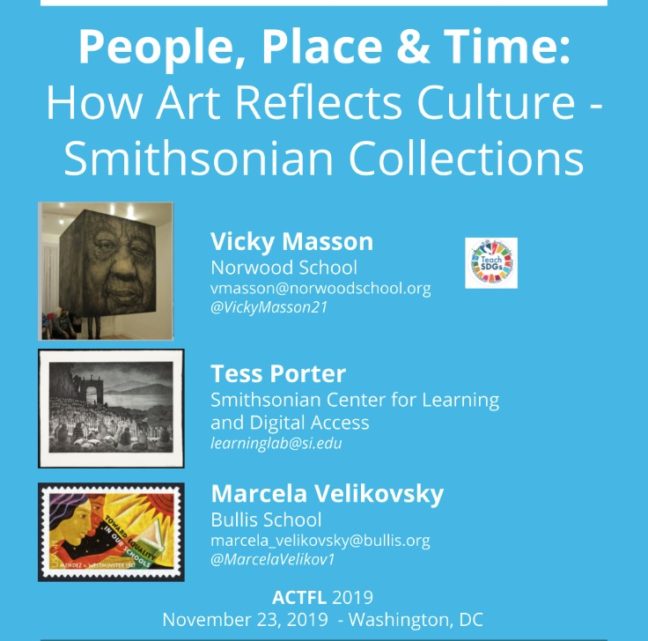
People, Place & Time: How Art Reflects Culture

The collection “People, Place, & Time was presented at the American Council on the Teaching of Foreign Language Conference 2019.” It explores how integrating museum resources, Global Thinking Routines, and the Sustainable Development Goals can help students understand who the people are, when and where they live, and what they do. In the collection teachers will find guiding questions to help with lesson planning, presentation slides, museum resources, examples of student work, and links to the three case-study collections. 

The case-study collections are:

How to use the SLL


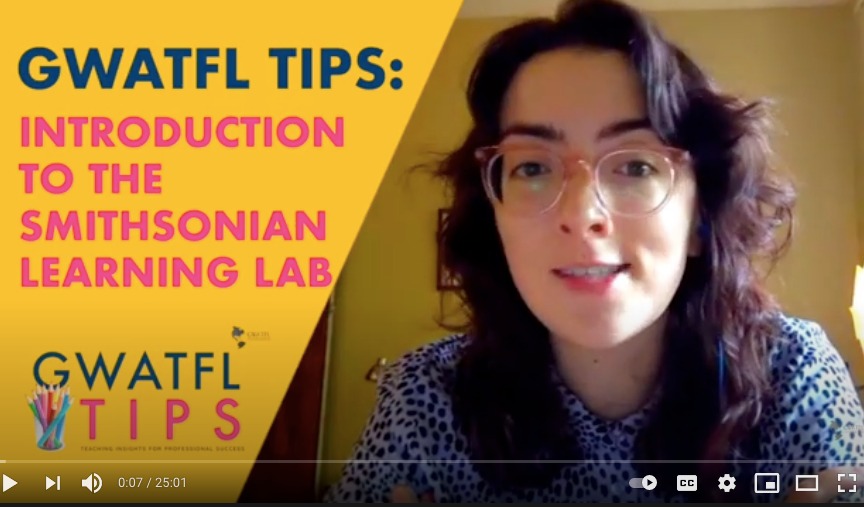
Using the SLL is quite simple. In the following GWATFL TIPS video, “Introduction to the Smithsonian Learning Lab,” Tess Porter, Digital Content Producer at the Smithsonian Center for Learning and Digital Access, explains how to use the SLL. Follow her tips and in no time you will have your own collection to use with your students.

Developing Global Competence

Our aim is to develop globally competent students. We recorded a Webinar and wrote an article on Developing Global Competence in the World Language Classroom using these collections. Review them if you need more details and ideas on how to do it. 

In short, using authentic resources helps develop global competence and prepares students to communicate and interact in the world. It helps our students move beyond their inner circle and familiar contexts to understand people from different cultures with different points of view. 

Using the SLL digital resources combined with Project Zero Thinking Routines and relating what we teach to the Sustainable Development Goals connect students with real-world global issues, all while raising empathy and curiosity. 


How do you teach for Global Competence with Authentic Resources? How would you use the Smithsonian Learning Lab in your teaching?
Building a Culture of Trust in World Language Class

by VIcky Masson

‘Why do we teach…?‘ is a column of Language Teaching Lab. It might help us think deeper on why we teach a certain topic. In addition, it might show a new perspective on how to teach it.

Emotions galore

Why is it important to build a culture of trust in our language class? The beginning of the school year is always one full of emotions for me. I love new beginnings and I know my students love them too. Each new year allows us a fresh start. It is like having a blank page in front of us to draw and write our next chapter. 

Apart from this initial excitement towards a new year, my students also feel the uncertainty of the unknown. They have lots of questions regarding their new teachers, friendships, and also, let’s face it, how they are going to be assessed. Students want to succeed in school and each year brings new challenges.

Building connections

Teachers want to learn about their students. They want to know about students’ strengths and stressors. At the beginning and throughout the year teachers usually plan activities and tasks that will help them get to know their students better. ‘What do they like?’ ‘What is important to them?’ ‘How can I help students overcome obstacles?’ Building those connections takes time and it is absolutely worth it. The more we learn about students’ identities, backgrounds, and of course, how they learn best, the better. I see building these connections at the center of my teaching. But wouldn’t it be important to start concentrating on developing ‘Trust’ first?

HP Teaching Fellow Challenge-Based Learning

I am so lucky to be a Digital Promise #HPTeachingFellow! The fellowship helped me tackle last year’s new distance learning modality with strength and support.

Along with other fellows, we embarked on a Challenge-Based Learning (CBL) Nano-Challenge.


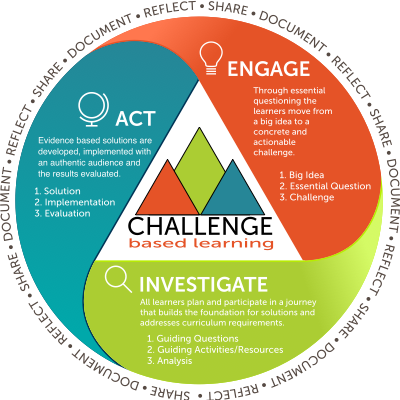
CBL is about engaging, investigating, and acting upon a challenge. The Nano-Challenge (as it was a small challenge) consisted of exploring the idea of building positive relations with students in distance learning. 

The group I belonged to had teachers and instructional coaches. We engaged in the Nano-challenge and investigated different ways of building relations with students in distance learning. After some thought and prompted by questions posed by our facilitators, we came to the conclusion that in order to build positive relationships, students needed to trust us first. Therefore, we shifted our ‘act’ question to answer “How do we build trust for student learning?”

Building a culture of trust

I realized through the Nano-Challenge that by building a culture of trust first, our students would feel safe and supported while in distance learning. Now that I am starting a new school year, I believe that building a culture of trust applies to onsite learning too. 

To develop and build a culture of trust in my language class, I put together some activities into a lesson plan. The following includes one of the activities we did. I used the Harvard Project Zero Thinking Routine, “Root Cause” thus, becoming “Root Cause of Trust.” For this part of the lesson I had students work with assigned partners.

In this routine, to build a culture of trust, I used the tree metaphor. Students write the issue in question, trust in this case, in the middle of the trunk. What makes people trust is identified on the tree roots, and what trust reflects or how it is reflected is in the branches and leaves of the tree.

I was amazed at how much students opened up throughout the lesson but in particular during the ‘Root Cause’ task. Students were also amazed at having someone explicitly asking and talking with them about trust. 

Giving students agency and showing them you care for what they have to say is key in building relationships and trust. It deepens your understanding of who they are and what they care about. Most importantly, my students understood that I really cared about them. This lesson allowed me to emphasize a classroom culture where learning would happen. And all was done virtually and in Spanish!

Begin with a culture of trust and everything else will fall into place

In times of remote learning (or face-to-face learning), it is not only critical getting to know students or building relationships between students and teachers, but primarily it is about building trust. Once trust is present, as fragile as trust might sometimes be, students will surely share more about how they feel, what they think, and how their ‘mindsets’ adapt and change to the new realities. 


We are starting a new year. I should begin having my students talk about what is important to them. I should weave into my curriculum other lessons related to other deep concepts like ‘trust.’ Which concepts would you investigate in your classes?


Credits:

Reading and Writing Teaching with Novellas

by Marcela Velikovsky

Novels in the Centre” is a column of Language Teaching Lab where you will read about why, how and what novellas become meaningful resources for teaching a language

If we learn to walk by walking and to talk by talking, we can also learn to read and write in another language by reading and writing in that language. 

That is why I love teaching Spanish and I love teaching with novellas! 

How is Reading and Writing Teaching with Novellas for me

I start by building the necessary background knowledge to facilitate students’ understanding of the story. Depending on the novella, I focus on the social-economic, historical or geographical aspect. For example, before reading “Patricia va a California” students research about Guatemala.

When we read it is important to check students’ comprehension often to avoid misinterpretation and help them construct meaning beyond unknown words.

When we read it is important to check students’ comprehension often to avoid misinterpretation and help them construct meaning beyond unknown words. I ask them comprehension questions sometimes in English and sometimes in Spanish. I explain new vocabulary and phrases in context and when I model reading aloud, I verbalize my thinking and ask for their opinion. “Hmmm, I wonder if Patricia…” What do you think?” Do you think she will… or…?

When I’m sure they grasp the story in a chapter, we analyze, explain, compare and contrast characters and places. For example, Patricia’s house has only one bathroom for seven family members living there. This is something common in Latin America that shocks most students who are used to bigger houses with multiple bathrooms. 

Go deeper when re-reading chapters

We annotate, represent, and talk and write about the topics and themes in the novella. For example, Patricia, the main character, is being discriminated against for being Latina. While she’s Guatemaltecan, Debbie, one of the characters, calls her “Mexican.” This leads us to talk about identity, immigration and discrimination. Students make personal connections and read current events articles and watch short videos in Spanish related to the topic and theme.

Assessment Tasks

The novella becomes the center from which I derive multiple communicative tasks related to each chapter. For example, I’ve used the following task as an assessment:

Pick ONE of the following points and write a paragraph in Spanish based on the information given in  Chapter 8:

Point  A  –  When Patricia talks with Debbie at the party, she says that while many people think being poor is a terrible thing, she has “everything” and “she does not need anything else.” What does Patricia consider the most important things in her life? 

Point B  – What do you think are the most important things in your life? Why?

Point C – Imagine you’re Patricia. Write a letter to a friend in Guatemala telling her/him all about the robbery.

This way, students empathize with the characters in the novella and see the world from different perspectives.

Novellas are Key for Language and Culture Learning

Students focus so much on the characters and the plot that don’t realize how much language they are absorbing. Novellas are great not only from the point of view of language acquisition, but also to immerse students in the culture and other people’s realities through the life experiences of the characters. I also use novellas as a springboard for class discussions of current events that relate to the topics and themes developed in the novellas.

Resources

Patricia va a California (Spanish Edition) – As an Amazon Associate LTL earns from qualifying purchases

Why It is Important to Make Interdisciplinary Connections

by Gabriela Barbieri

Interdisciplinary Connections” is a column of Language Teaching Lab to show specific examples of connections between world language teaching and other subjects at school

Why it is important to make Interdisciplinary Connections

My motto: “Connecting Spanish with other subjects and working side by side with Homeroom teachers and other specialists is a great way children see the value of language as a means of communication and not as a subject that they have to study for”.

This reflection makes me go back in time to when I started teaching in Lower School. The kids were hungry to express themselves in Spanish and would ask me… “Sra Barbieri..how do you say this and that?” The words and expressions were the ones they were using in their English class when reading books that definitely could be related to Spanish culture.

Definitely, the way the brain makes connections is amazing, and it is more significant in kids’ brains. It is easy for students to discover the connections between languages and I do not need to tell them to relate concepts when presenting a theme they are learning in the English language.

What is important in this matter is that those connections endure for a long time, if not forever, in the students’ brain. When I meet with students the following year, they recall those expressions, words, ideas like they were studying them on that day. I have to admit that everything we do in class is significant for them, and they love to recognize and find meaning in every way they acquire those words, expressions, ideas, and concepts.

For these reasons, I believe that to learn anything new, and for it to last and to be available to use, it needs to be meaningful and connected in the human brain.  

How I do it

amzn.to/3Nj1sdK

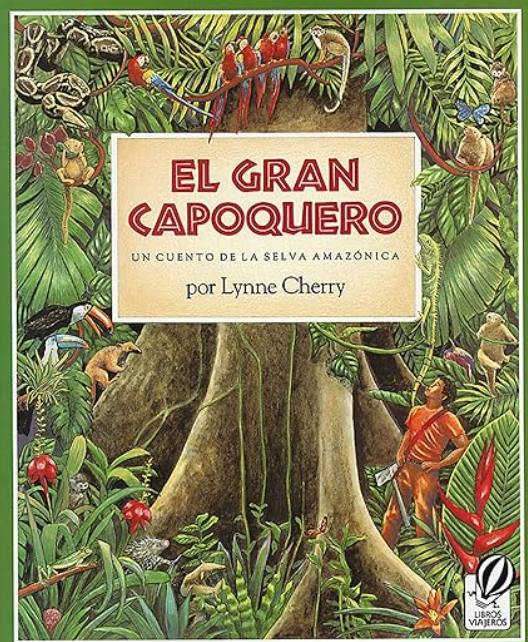
Once, when third, fourth and fifth graders were reading The Great Kapok Tree by Lynne Cherry in English class, I found that this book was also written in Spanish, its name is El Gran Capoquero (translated by Alma Flor Ada), so I decided to create a unit with the message of this book for each grade. I ran my interest in reading this book in Spanish by the Homeroom teachers while they were reading it in their English classes. The first step was to read the story aloud in Spanish and show the beautiful pictures of the Amazon rainforest. The exciting part for the kids was to see that the book they were reading in English had the same pictures! Then, students, through the pictures as a medium for understanding, found the meaning of the words in Spanish. Since they had a lot of INSIGHTS while I read, I did not need to translate any words into English. 

We talked about the people from the Amazon rainforest, their language and culture in the three grades. The activities in class were different but always connected. Students loved to learn and research about the animals in the rainforest, the people who live there, and the geography. 

Students recognized cognates in both languages, enriching their vocabulary base, and helping them to use more specific language when communicating.

Third and fourth grades focused on describing the animals and shared other interesting facts they found. The students loved to describe the appearance and behavior of the animals living in the Amazon rainforest.

Fifth graders described the four layers of the amazon rainforest, labeled and explained the habitat and environment of the animals. Through whole class discussions, small groups, and pair work, they realized that a rainforest is more than just a forest of trees. It provides shelter, food, and oxygen to all kinds of living creatures. They also researched and brainstormed about the reasons for deforestation and the consequences of deforestation. They found ways to help preserve the environment by linking the themes to the 17 UN Sustainable Development Goals. 

In connection to the story, students learned about Chico Mendez, an environmental activist who gave his life in order to preserve the rainforest through Mana’s song Cuando los angeles lloran

Interdisciplinary Connections Value

This experience made students’ learning meaningful, memorable, and long-lasting. Interdisciplinary teaching allows students to learn about a topic through language and use language to learn more about a topic.


Resources:

El Gran Capoquero – As an Amazon Associate LTL earns from qualifying purchases