Una lengua con cuerpo II (in Spanish)

by Ramón Clavijo (LTL Contributor)

Modismos con partes del cuerpo II

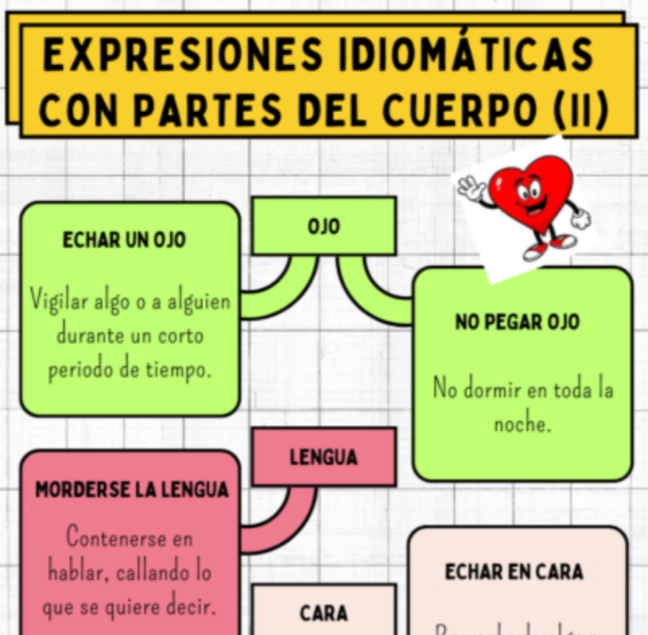
No queremos que tus estudiantes te echen en cara que no les has enseñado suficientes modismos relacionados con las partes del cuerpo, así que hoy te traemos una nueva entrega, la segunda de Una lengua con cuerpo.

Te traemos también una nueva infografía, que les podrá ser de utilidad tanto a los alumnos aplicados y motivados como a aquellos que prefieren rascarse la barriga (ay, todos hemos tenido estudiantes de este tipo 🤦‍♀️🙄, aunque ahora preferimos mordernos la lengua para no desviarnos del tema 🗯❌️). 

Seguro que será un material útil tanto para tus alumnos más callados, a los que les da vergüenza hablar en clase 😳, como para aquellos que hablan por los codos y no callan ni debajo del agua 🗣🗣🗣.

Estamos convencidos de que estas expresiones serán de gran ayuda tanto a los estudiantes que atienden en clase 😊👂 como a aquellos alumnos a los que tienes que vigilar con frecuencia 👀, echándoles un ojo cada dos por tres para asegurarte de que trabajan durante las clases.

No tenemos duda de que será un material provechoso tanto para los estudiantes más nerviosos 🫨, que no pueden pegar ojo el día antes de un examen, como para aquellos más despreocupados, que duermen a pierna suelta incluso el día anterior a un examen final 😴🤤.

Podrán usarlas tanto tus alumnos más imaginativos y creativos, quizás un tanto despistados 🙃, como aquellos más realistas y que prefieren tener los pies en el suelo 🤔.

En suma, nos alegrará saber que estas expresiones serán mano de santo 😇🤚 cuando tu alumnado quiera expresarse con más fluidez en español. Al fin y al cabo, los modismos son un recurso muy habitual que ayudará a tu estudiantado a lograr más confianza en su producción 👩‍🎓👨🏾‍🎓😌.

Nota: En esta entrada hemos hablado de muchos tipos de estudiantes. Sean como sean, de lo que estamos seguros es de que todos ellos son todo corazón 🥰🥰🥰.
Prompts and Resources to use AI in World Language Class

Let’s see some prompts and resources for AI use to get you started.

It is easy to get excited with AI! It is everywhere for us teachers to learn and use. In the context of AI, the phrase ‘Building adapting students’ caught my attention while attending “Elevating Innovation Virtual Conference” earlier this month. I would make that phrase ‘Building adaptive students and teachers’ as for many teachers, this is a new arena. I pondered on this topic of ‘adaptability’ related to innovation.

In sum, how can world language teachers foster and cultivate an environment for students and teachers to build, to design and to create with AI? Once you feel the itch for AI use in world language class, it is almost impossible to stop. 

What AI websites for world language teaching are good-to-explore resources?

Some good-to-explore resources are mentioned in the following blogs:

  • Matt Miller has summarized lots of resources for us
  • Maris Hawkins did a great job putting resources into action in her latest post 
  • Mr. Hooker also brought us great ideas in his blog 
  • And some well known resources such as ChatGPT, Claude, Canva, Adobe Firefly, Pressto are also worth investigating

What effective AI prompts may you use?

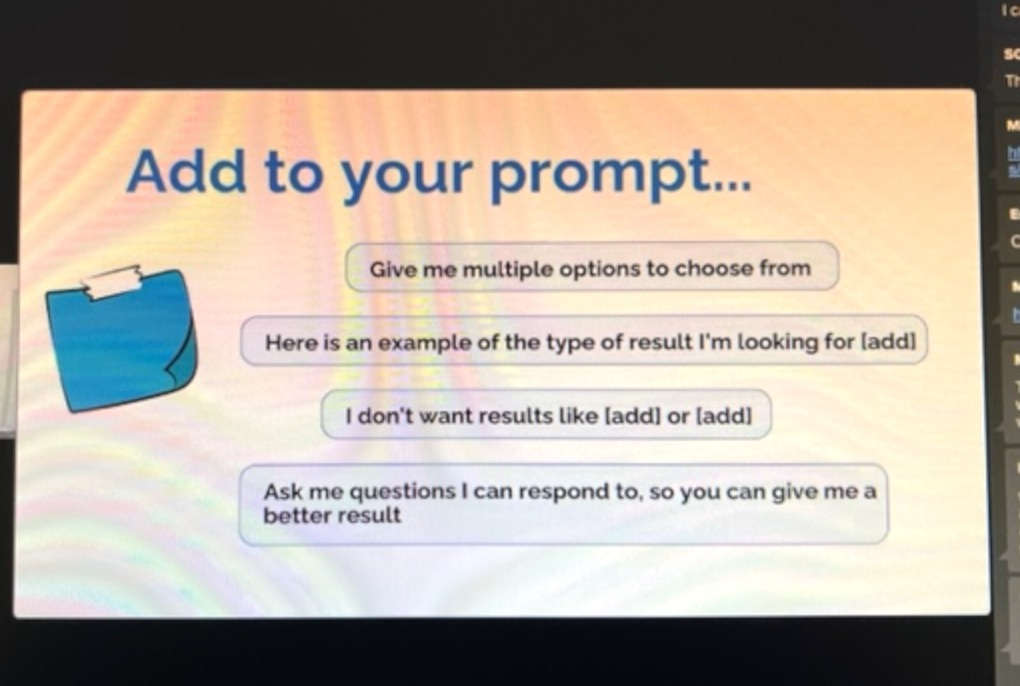
I attended Monica Burns, Ed.D @ClassTechTips during the conference and loved her prompts. For even better results, Burns recommends adding some of the following to your prompts

  • Curriculum goals
  • Learning objectives
  • Standard
  • Grade level
  • Student interest

Some of the examples she presented included,

  • Write [number] open-ended questions for a discussion about [topic] for a group of [grade]. Make sure to incorporate [standard]
  • I am teaching [topic] to [grade] and they love [interests] Make a list of connections that can help them stay engaged and retain knowledge
  • Help me see the connection between [topic] like [specific example] and [what I’m teaching this week]
Photo from Monica Burns’ presentation

I am interested in learning from you. As I heard in the conference, “A key to building culture is having empathy for the ‘hidden stories’ inside others” as innovation will always start and end with people. How do YOU use AI in world language classes? What other prompts and resources have you used effectively? What other tech tools are your go-to ones?