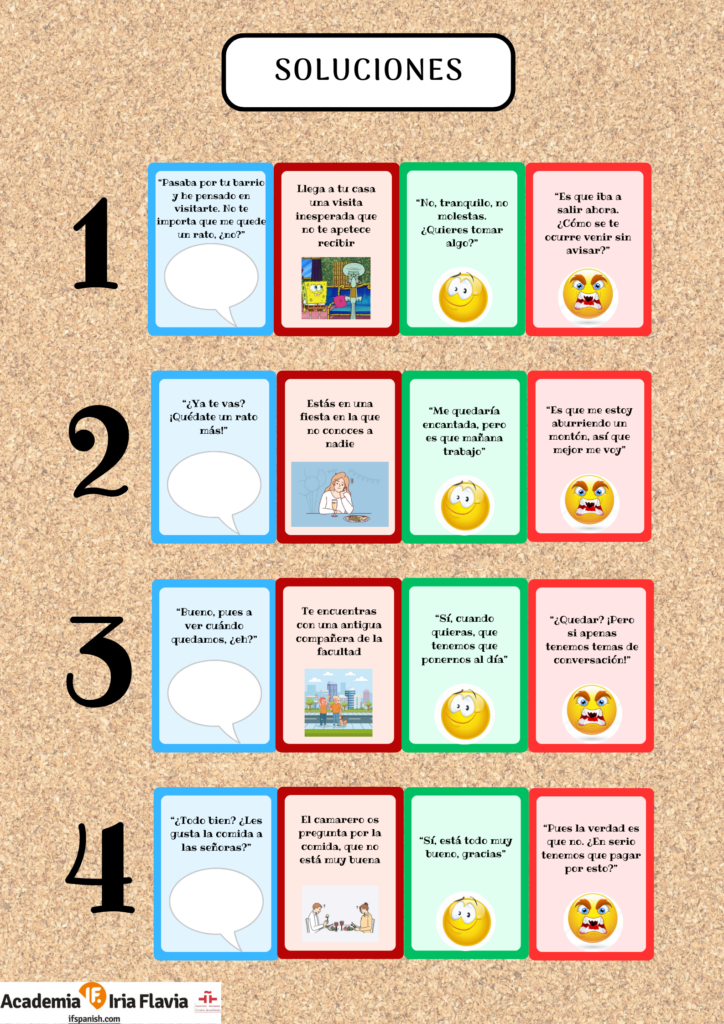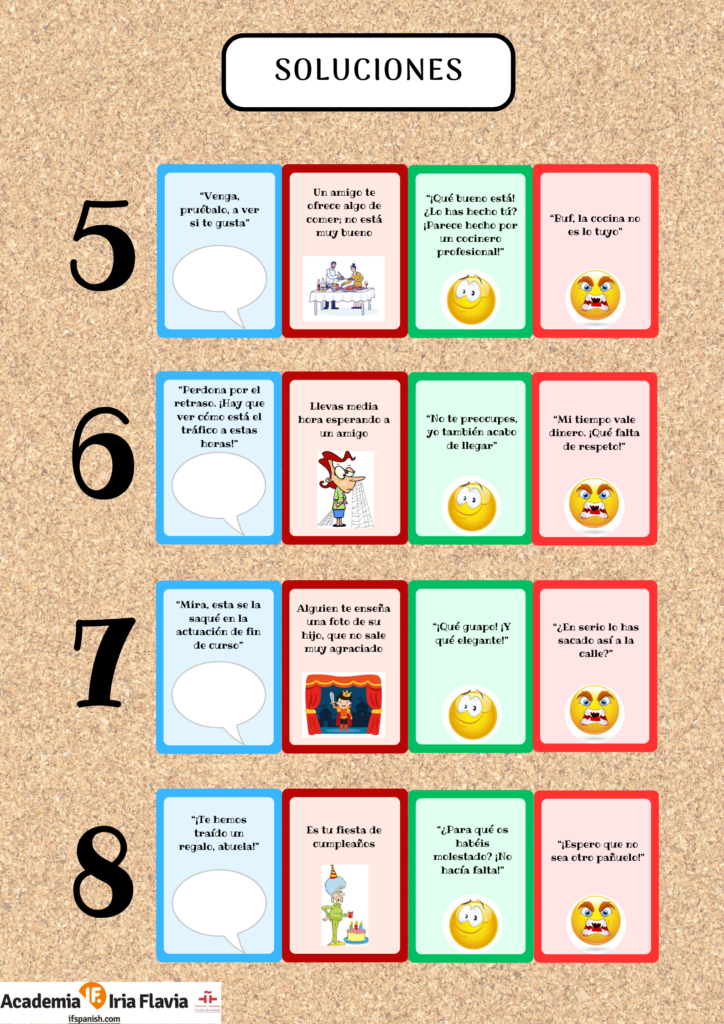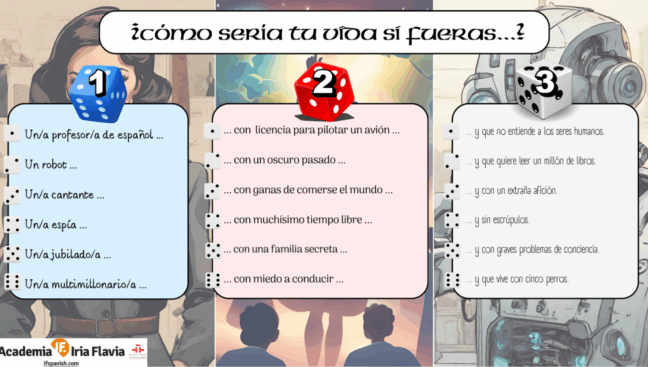
Hipótesis en Serie (Intermediate)

si fueras

by Ramón Clavijo (LTL Contributor)

Hace algunas semanas te hablamos de la manera en la que podrías introducir las oraciones condicionales irreales. Pues bien, una vez que tus estudiantes las conozcan y tengan asimiladas, llega el momento de ofrecerles un input que les permita ponerlas en práctica.

Para ello, te traemos una serie en línea producida por Televisión Española en 2017: Si fueras tú. Su interés se debe a que, al final de cada capítulo, se les daba a los espectadores la oportunidad de decidir cómo continuaría la trama 🤔: se les hacía una pregunta con dos opciones de respuesta (cuya estructura era siempre la misma: “Si fueras tú, ¿harías A o harías B?”) y la opción más votada marcaría la continuación de la serie en el episodio de la semana siguiente ⏩️.

La serie cuenta con ocho capítulos bastante breves (duran unos diez minutos, salvo el primero, que dura alrededor de veinte), lo que es un elemento a favor de su uso. Así, lo ideal es ver el primero en clase y después mandarles cada día el visionado de un episodio en casa, para comentarlo al día siguiente en el aula, al principio de cada sesión 🗣🗣 (en dicha puesta en común, deberán llegar a un consenso respecto a qué harían si fueran la protagonista). Podéis dejar el último episodio para su visionado conjunto en el aula, y concluir con una valoración final del argumento.

👉 Puedes acceder a la serie de manera completamente gratuita (y sin limitaciones geográficas) a través de YouTube, en el siguiente enlace:

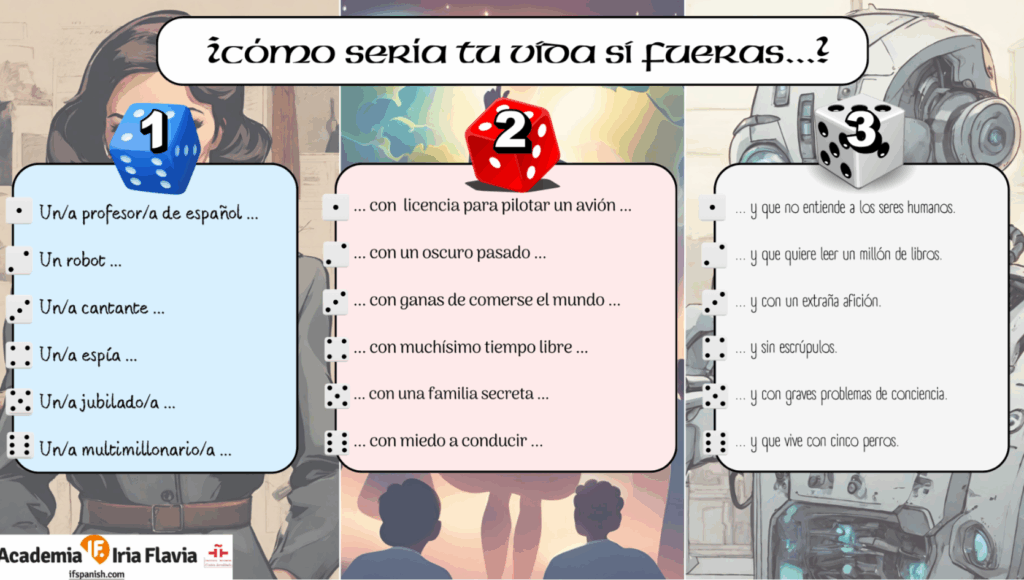
Como actividad final, incluimos una infografía con la que tus alumnos, en pequeños grupos, tendrán que ponerse en la piel de un determinado personaje: deberán tirar tres veces un dado 🎲🎲🎲, y en función del número que salga en cada tirada, se obtendrá como resultado un perfil concreto. Después, deberán imaginar cómo sería la vida de ese personaje, qué cosas harían, de qué forma actuarían, etc. 🤔

Será una manera divertida de empatizar en español… 🤭

si fueras

 As a Language Teaching Lab Contributor, Academia Iria Flavia  offers the following to the LTL community: Get a 20 off discount when you use the code LTL20 at checkout, exceptions may apply

From Input to Interaction: Helping Students Use Their Languages Beyond the Classroom

by María Martínez (LTL Contributor)

As language teachers, we’ve all seen this: Students who can understand so much more than they dare to say.

They follow along in stories, laugh at jokes, and pick up vocabulary from songs and videos… but when it’s time to speak, they freeze. Or they default to their “stronger” language, even when they could already communicate in the target language.

The challenge is not a lack of input, but the need for support in turning listening and reading into authentic communication.

Today, with the rise of AI and global online interaction, this transition matters more than ever. Students need guidance on using languages in real contexts—at home, in their communities, and online.

This reflection is inspired by my recent collaboration and interview with Sabrina Sánchez from Ms Sabrina’s Bilingual Playtime. Our conversation reminded me of the emotional and human side of language learning: identity, belonging, confidence, and connection.

bilingual

Helping Students Move From Passive Input to Active Use

Start With Low-Pressure Interaction

Instead of jumping from listening straight into a full speaking task, build micro-moments of participation:

  • Thumbs-up/down reactions
  • Predict-what-comes-next
  • Simple call-and-response routines

These tiny steps help students feel like active participants long before they produce full sentences.

Use Guided Output Before Free Speech

Small scaffolds create big confidence:

  • Sentence frames
  • “Repeat and add one word”
  • Matching visuals with short phrases

Guided output makes risk-taking less intimidating and builds a natural bridge toward
spontaneous communication.

Give Students a Real Audience

Speaking becomes meaningful when it has a purpose.

Some ideas:

  • Record short audio notes for younger students
  • Teach a topic to a partner class
  • Create bilingual slides to present at home

When communication is purposeful, students shift from “using language for school” to using language for life.

How Families Can Encourage Authentic Use at Home

One of the most beautiful themes in my conversation with Sabrina was how families
can nurture languages gently, without pressure.

Give Each Language a Purpose

Mini rituals make languages come alive:

  • “Buenos días” at breakfast
  • Naming ingredients while cooking
  • Counting down in the target language before starting a video or game

These small habits build a meaningful, emotional connection.

Create Safe Language Zones

Children speak more when they feel safe:

  • “No corrections, just support” during certain times
  • A weekly family language evening
  • Letting children choose the song, game, or video

Safety builds confidence, and confidence builds language.

Make Content a Shared Experience

Instead of: “Watch this for homework.”
Try: “Let’s watch this together—teach me one word!”

Resources from Bilingual Cerebros and Ms Sabrina’s Bilingual Playtime are intentionally designed for shared learning, so children can guide their families, not just follow instructions.

How Bilingual Cerebros Supports the Input → Output Journey

In my own content, I always ask: “How will this help a student use the language with someone else?”

Some ways I design for that:

  • Stories paired with meaningful speaking tasks
  • Bilingual printables that travel between school and home
  • Slides and visuals that invite comparison, retelling, and explaining
  • Activities that promote conversation, not just comprehension

My goal is to help students turn input into interaction—gently, confidently, and joyfully.

A Heart-Warming Reminder From My Conversation With Sabrina

What stayed with me most from talking with Sabrina was not a list of strategies, but the shared belief that:
Every child’s languages are a gift.
Every attempt—imperfect or hesitant—is progress.
Languages grow strongest in relationships, not just in classrooms.

Parents sometimes worry they’re not doing enough. Teachers sometimes wonder if students will ever really use the language outside school. Students often fear mistakes more than lack of understanding.

Our message, together, is simple:

You are doing more than you think.
Connection matters more than perfection.
Every small moment counts.

And when a student uses a phrase at home, online, or with a friend—even if the sentence isn’t perfect—that is the magic of input becoming interaction.

That’s where languages truly come alive.

Want to Dive Deeper? Watch the Full Collaboration with Sabrina Sánchez

If you’d like to hear more practical ideas, heartfelt stories, and advice for parents, teachers, and students, I warmly invite you to watch our full collaboration interview.

We recorded two versions, so you can enjoy it in the language you prefer—or share
it with your students and families:

Both conversations are filled with insights, encouragement, and real-life reflections on raising, teaching, and supporting multilingual learners. We hope they bring you inspiration, reassurance, and a few smiles along the way.

Meet the guests

Let’s keep the conversation going! Share your questions or tips about raisin
bilingual kids in the comments below.


De la Comprensión a la Interacción: Ayudando a los Estudiantes a Usar sus Lenguas Más Allá del Aula

Como docentes de lenguas, todos hemos visto esto: estudiantes que entienden muchísimo más de lo que se atreven a decir.

Siguen las historias, se ríen de los chistes y reconocen vocabulario en canciones y vídeos… pero cuando llega el momento de hablar, se bloquean. O recurren automáticamente a su lengua más fuerte, aunque ya podrían comunicarse en la lengua meta.

El reto no es la falta de input, sino la necesidad de ayudarles a convertir lo que escuchan y leen en comunicación auténtica.

Hoy, con el auge de la IA y la interacción global en línea, esta transición es más importante que nunca. Los estudiantes necesitan orientación para usar las lenguas en contextos reales: en casa, en sus comunidades y en los espacios digitales donde participan.

Esta reflexión surge de mi reciente colaboración y entrevista con Sabrina Sánchez de Ms Sabrina’s Bilingual Playtime. Nuestra conversación me recordó el lado profundamente humano del aprendizaje lingüístico: identidad, pertenencia, confianza y conexión.

Cómo Pasar de Input Pasivo a Uso Activo

Empieza con Interacciones de Baja Presión

En lugar de pasar directamente de escuchar a una tarea de expresión oral completa, crea pequeños momentos de participación:

  • Reacciones con pulgar arriba/abajo
  • Predecir lo que sucederá
  • Pequeñas rutinas de llamada y respuesta
    Estos gestos ayudan al estudiante a sentirse participante, mucho antes de producir
    frases completas.

Utiliza Output Guiado Antes de Habla Libre

Pequeños andamiajes o apoyos linguísticos con modelos pueden generar gran confianza:

    • Oraciones modelo
    • “Repite y añade una palabra”
    • Relacionar imágenes con frases cortas

    El output guiado reduce la ansiedad y crea un puente natural hacia la comunicación espontánea.

    Ofréceles una Audiencia Real

    Hablar cobra sentido cuando hay un propósito. Algunas ideas:

    • Grabar mensajes de audio para estudiantes más pequeños
    • Enseñar un tema a otra clase
    • Crear diapositivas bilingües para presentar en casa

    Cuando la comunicación tiene un destinatario real, los estudiantes pasan de “usar la
    lengua para la escuela” a usar la lengua para la vida.

    Cómo las Familias Pueden Fomentar un Uso Auténtico en Casa

    Uno de los temas más bonitos de mi conversación con Sabrina fue cómo las familias
    pueden nutrir las lenguas de manera suave, sin presión.

    Darle un Propósito a Cada Lengua

    Pequeños rituales hacen que las lenguas cobren vida:

    • “Buenos días” durante el desayuno
    • Nombrar ingredientes mientras cocinan
    • Contar en la lengua meta antes de empezar un vídeo o un juego
      Estos hábitos generan una conexión emocional significativa.

    Crear Zonas de Lengua Segura

    Los niños hablan más cuando se sienten seguros:

    • “Sin correcciones, solo apoyo” en ciertos momentos
    • Una noche familiar dedicada a la lengua
    • Dejar que ellos elijan la canción, el juego o el vídeo

    La seguridad genera confianza, y la confianza genera lenguaje.

    Convertir el Contenido en una Experiencia Compartida

    En lugar de decir: “Mira esto para los deberes.”
    Prueba: “Veámoslo juntos—¡enséñame una palabra!”

    Los recursos de Bilingual Cerebros y Ms Sabrina’s Bilingual Playtime están diseñados para un aprendizaje compartido, donde los niños pueden guiar a sus familias, no solo seguir instrucciones.

    Cómo Bilingual Cerebros Acompaña el Camino de Input → Output

    Cuando creo contenido, siempre me pregunto: “¿Cómo ayudará esto al estudiante a usar la lengua con otra persona?”
    Algunas maneras en que diseño pensando en esta transición:

    • Historias acompañadas de tareas orales significativas
    • Materiales bilingües que funcionan tanto en casa como en el aula
    • Diapositivas visuales que invitan a comparar, volver a contar y explicar
    • Actividades centradas en la conversación, no solo en la comprensión

    Mi objetivo es ayudar a los estudiantes a convertir el input en interacción—de manera suave, segura y feliz.

    Un Recordatorio de Mi Conversación con Sabrina

    Lo que más me quedó de nuestra charla no fue una lista de estrategias, sino una creencia compartida:
    Las lenguas de cada niño son un regalo.
    Cada intento—imperfecto o dudoso—es progreso.
    Las lenguas crecen más en las relaciones que en los libros.

    Los padres a veces sienten que no hacen lo suficiente.
    Los docentes se preguntan si los estudiantes realmente usarán la lengua fuera del aula.
    Los estudiantes temen cometer errores más que no entender.

    Nuestro mensaje, juntas, es sencillo:
    Estás haciendo más de lo que crees.
    La conexión importa más que la perfección.
    Cada pequeño momento cuenta.

    Y cuando un estudiante usa una frase en casa, en línea, o con un amigo—aunque
    no sea perfecta—ahí es donde sucede la magia del input convirtiéndose en
    interacción.
    Ahí es cuando las lenguas realmente cobran vida.

    ¿Quieres Profundizar? Mira la Colaboración Completa con Sabrina Sánchez

    Si te gustaría escuchar más ideas prácticas, historias sinceras y consejos para
    familias, docentes y estudiantes, te invito a ver nuestra entrevista completa.

    Grabamos dos versiones, para que elijas tu lengua preferida o la compartas con
    tus estudiantes y comunidades:

    Ambas conversaciones están llenas de ideas, ánimo y experiencias reales sobre cómo criar, enseñar y acompañar a aprendices multilingües.
    Esperamos que te inspiren, te reconforten y te hagan sonreir.

    Conoce a las invitadas:

    ¡Sigamos la conversación! Comparte tus preguntas o consejos sobre cómo criar
    niños bilingües en los comentarios.

    Verbalizando hipótesis – Gramática (Intermediate)

    gramática

    by Ramón Clavijo (LTL Contributor)

    La gramática no consiste en otra cosa que seleccionar, ordenar y jerarquizar los elementos necesarios para verbalizar las ideas que tenemos en nuestra cabeza. Dicho de otro modo, primero tenemos que tener algo que expresar 🤔💭 y después debemos saber cómo expresarlo 🗣 usando la gramática correctamente.

    Por eso, si necesitas presentarles a tus alumnos las oraciones condicionales irreales (es decir, las de segundo tipo), tal vez sea buena idea plantearles, en primer lugar, una serie de situaciones hipotéticas, cuyo desenlace tengan que imaginar 💭 (pero que todo eso ocurra, de momento, solo en su cabeza).

    Para ello, pon música relajante 🎶, apaga las luces 💡❌️, pídeles que cierren los ojos 🙈 y, con voz tranquila, exponles las situaciones que te traemos en la infografía 👇 que publicamos: qué harían si les tocara la lotería 🤑, si pudieran volar 🪽, si llegara el fin del mundo…☄️ Eso sí, hazlo usando solo el presente y evitando por el momento las estructuras condicionales (por ejemplo, puedes decir frases del tipo “imagina que te toca la lotería y piensa en todo lo que puedes hacer a partir de ahora”).

    Después, ya será el turno de la explicación gramatical 👩🏻‍🏫, y una vez que ya sepan cómo hacer este tipo de oraciones, también serán capaces de verbalizar las imágenes que antes habían creado en su mente 🗣✅️. Dicho de otra manera, podrán expresar con la estructura gramatical recién aprendida las situaciones hipotéticas que previamente habían imaginado.

    Una de las mejores sensaciones que tiene el aprendiente de un idioma es ver que puede exponer, en la lengua meta, ideas o emociones que antes no podía expresar. Y esta actividad puede ayudar a tus estudiantes a ser conscientes de ello 😌.

    How to Bring Real-World Context into Your Curriculum

    real-world

    by Carmen Reyes (LTL Contributor)

    This article is based on one section of my presentation Embedding Real-World Context in Curricular Design, delivered at the Back to School ’25 Conference for Klett World Languages.

    World language teachers everywhere share the same challenge: how do we make language authentic, relevant, and motivating for our students? While grammar drills and vocabulary lists may help students memorize forms, they rarely inspire them to use the language beyond the classroom walls.

    One powerful solution is teaching through real-world contexts—placing students in situations where language is a tool for solving problems, connecting with others, and creating meaning. Instead of approaching language from the outside as a system of forms and rules, learners experience it from the inside out. 

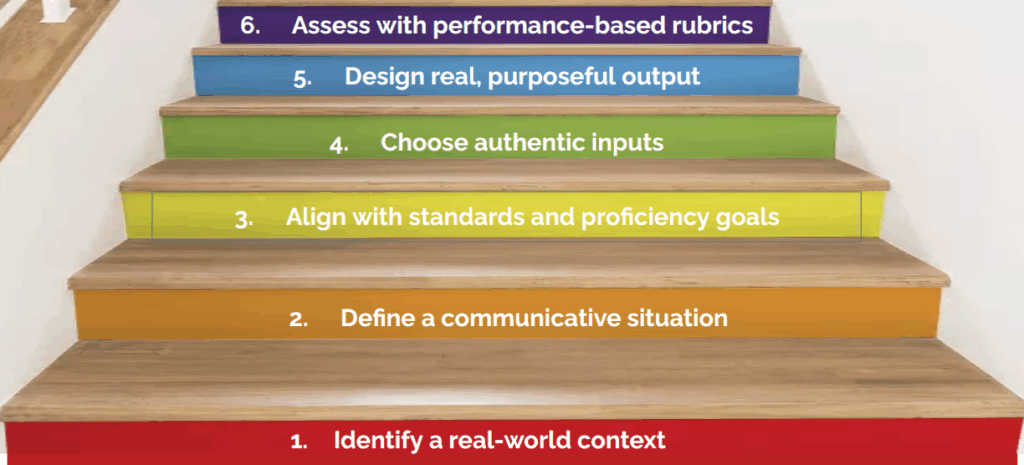
    Based on my own experience designing curriculum, I have found that bringing real-world context into the classroom works best when I follow a clear process. Over time, I have designed six practical steps that help connect language learning to authentic situations while keeping lessons structured, engaging, and aligned with proficiency goals.

    Let’s explore these six steps for bringing real-world context into your curriculum, using a concrete example: planning and shopping for a party at a grocery store.

    Step 1. Identify a Real-World Context

    Choose contexts that mirror life beyond school walls. A grocery store is a perfect fit: it’s universally familiar, culturally rich, and loaded with communicative possibilities.

    Leverage authentic materials such as supermarket websites:

    By working with authentic grocery websites, students see real products, real prices, and even cultural differences in shopping habits and food choices

    Step 2. Define the Communicative Situation for a Real-World Context

    Rather than passively learning vocabulary, students are placed inside a real-world problem:

    “You and your classmates are planning a party. Using a budget, you must buy groceries in Spanish. What will you buy? How much can you spend? How do you ask for help at the store?”

    This transforms the classroom into a simulation of real life where students:

    • Ask and answer questions about prices, quantities, and items.
    • Negotiate choices in pairs or small groups.
    • Use polite expressions (por favor, gracias, quisiera, necesito) to interact respectfully.
    • Manage a budget, reinforcing numbers and currency vocabulary.

    The task is social, practical, and full of meaningful opportunities for language use.

    Step 3. Align with Standards and Proficiency Goals

    ACTFL Proficiency Guidelines (Novice–Intermediate):

    • Interpersonal Communication: Requesting grocery items, asking about prices.
    • Presentational Speaking: Performing a role-play or presenting a shopping plan.
    • Interpretive Reading/Listening: Understanding flyers, labels, or website content.
    • Grammar/Vocabulary in Context: Food, numbers, currency, verbs like querer and necesitar, and polite requests.

    World-Readiness Standards for Learning Languages:

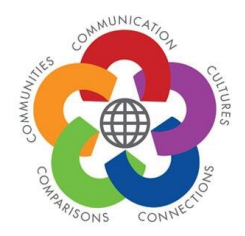
    • Communication: Real exchanges of needs and information.
    • Cultures: Understanding cultural practices of grocery shopping and celebrations.
    • Connections: Using authentic websites and media to link the classroom with the real world.
    • Comparisons: Seeing how shopping practices in the target culture differ from the students’ own.

    Step 4. Choose Authentic Inputs for Real-World Context

    Students thrive on real input because it shows them the living language, not a textbook version. Some ideas include:

    • Grocery websites with product images and prices.
    • Flyers or supermarket ads.
    • Photos/videos of open-air markets.
    • Party menus or packaging from authentic products.

    These resources not only build vocabulary but also expose students to cultural perspectives—like why Peruvian markets might sell dozens of potato varieties or why French stores feature cheeses and wines.

    Step 5. Design Real, Purposeful Output

    Language acquisition sticks when learners produce something with meaning. In this case, students can:

    • Create a grocery list with items for a chosen type of party (birthday, picnic, holiday).
    • Write a short dialogue simulating a shopping interaction.
    • Role-play buying groceries, practicing questions and polite requests.
    • Present their “party plan” orally or in writing, justifying food choices.

    Example:
    “Para la fiesta de cumpleaños necesitamos un pastel, tres refrescos, y frutas. Compramos en Wong porque los precios son buenos.”

    This output is purposeful, contextual, and fun—students are not just learning words, they’re planning a celebration in another language.

    Step 6. Assess with Performance-Based Rubrics

    Rather than focusing on grammar accuracy alone, measure success through communicative effectiveness. Criteria may include:

    • Use of target vocabulary (food, numbers, polite expressions).
    • Ability to ask/answer basic questions.
    • Collaboration and participation in the role-play.
    • Clarity in presenting their shopping plan.

    A simple rubric with categories like Interpersonal Communication, Vocabulary Use, and Cultural Understanding keeps assessment meaningful and aligned with ACTFL.

    Why This Works

    When students learn through real-world contexts, they begin to see the target language as a living, breathing tool for communication. They gain confidence because they know what to say in a situation that feels real. At the same time, they’re exploring cultural practices and making connections to their own lives.

    The grocery-store project illustrates how purpose, culture, and communication can come together in one unit:

    • Purpose: Plan and purchase for a real event (a party).
    • Culture: Explore food practices in Spanish- or French-speaking countries.
    • Communication: Use the language actively to solve problems and share ideas.

    As teachers, our challenge is to open the classroom door to the world beyond, giving students the gift of authentic communication and the confidence that comes with it.

    Juegos reunidos – Intermediate

    juegos

    by Ramón Clavijo (LTL Contributor)

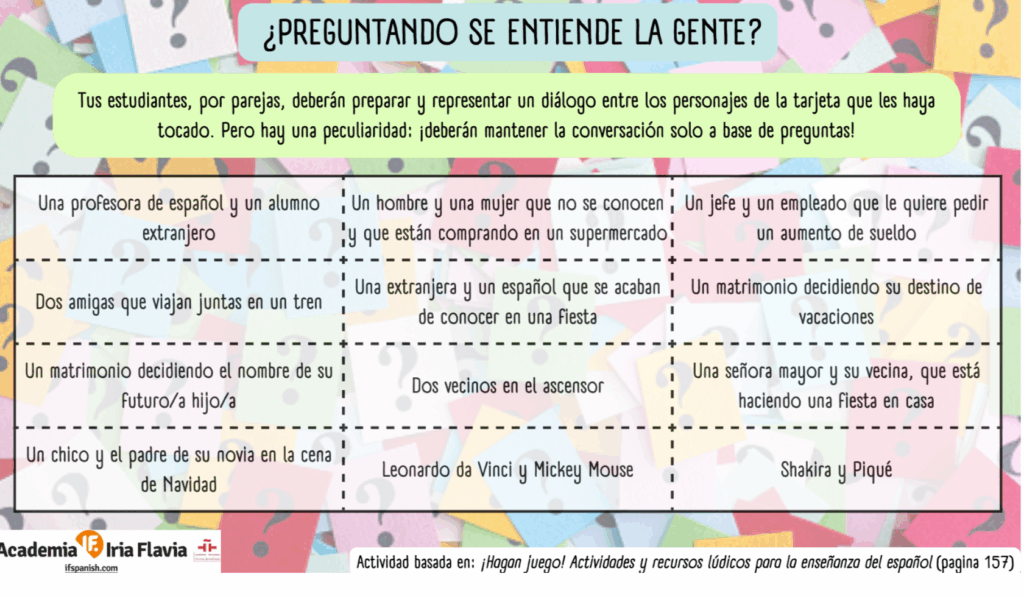
    No siempre es fácil llevar el componente lúdico a clase. Como bien sabes, son muchas las variables que se deben combinar adecuadamente para garantizar el máximo aprovechamiento de los juegos en el aula: el número de estudiantes, los contenidos lingüísticos que se quieren reforzar, las destrezas comunicativas que se pretenden practicar, la propia producción de los alumnos, los contenidos colaterales que puedan ir surgiendo…

    Para ayudarte en esta tarea, te presentamos un libro 📚 que tiene ya sus años pero cuya utilidad pedagógica no se ha resentido con el paso del tiempo: ¡Hagan juego! Actividades y recursos lúdicos para la enseñanza del español, de Edinumen.

    Uno de los aspectos reseñables del libro es la variedad de propuestas lúdicas, a lo que hay que añadir la introducción de variantes que ofrecen la posibilidad de adaptar el juego a diferentes circunstancias. Igualmente, hemos de destacar el hecho de que las dinámicas aparezcan clasificadas por competencias, así como la existencia de un índice de objetivos gramaticales y otro de objetivos comunicativos, lo cual agiliza la búsqueda. Por último, también debemos reseñar la sencillez de las actividades, lo que reduce el tiempo de explicación y el estrés derivado de la no comprensión de las instrucciones.

    Posiblemente ya conozcas un buen número de los juegos incluidos en el libro, y estamos seguros de que ya has llevado varios de ellos al aula, por lo que su novedad no radica en las actividades en sí mismas, sino en su presentación sistematizada y ordenada, lo que hará de él un auténtico vademécum que no debe faltar en tu biblioteca de departamento. 

    Nota: con esta entrada, te ofrecemos una infografía 👇 en la que hemos adaptado y ampliado uno de los juegos del libro. Se trata de una dinámica divertidísima que sacará a relucir la creatividad de tus alumnos.

    juegos

    ¡Qué Barbaridad de Noticia! – in Spanish -Intermediate

    noticia

    by Ramón Clavijo (LTL Contributor)

    Estamos rodeados de noticias: buenas, malas o regulares. La aldea global, la era digital, las nuevas vías de acceso al conocimiento y la diversificación de las fuentes de información tienen como resultado que nos encontremos, diariamente, ante noticias o rumores que actúan como estímulos ante los que reaccionar.

    Dichas noticias pueden provocar en nosotros sorpresa, alivio, indignación, incredulidad, rechazo, indiferencia, abierta repulsión, escándalo, risa… Sea como fuere, nunca faltará una opinión respecto a algún titular llamativo, ni la valoración de alguna noticia de impacto.

    Por eso, te proponemos estimular a tus estudiantes para que reaccionen ante una serie de titulares 📰, expresando qué les parece injusto, qué encuentran lógico, qué entienden como vergonzoso, qué les parece una barbaridad… En fin, ante qué se rasgan las vestiduras 😱 o con qué están completamente de acuerdo 😀. Ello les permitirá poner en práctica el contraste entre el indicativo y el subjuntivo para la expresión de opinión y valoración.

    Además, puedes plantear la actividad como una dinámica de roles, a modo de debate, asignándoles a tus alumnos diversos perfiles, que deberán usar para reaccionar en consecuencia ante tales noticias. Puedes pensar, por ejemplo, en un ecologista, una empresaria, una pareja con hijos o una profesora 🗣🗯🗨👥️.

    Pero si hay una figura que puede superar en el debate a todas las demás, esa es, sin duda, el cuñado. Efectivamente, en los últimos años se ha popularizado en España el uso del término cuñado como sabelotodo 😌: alguien capaz de sentar cátedra sobre cualquier tema, ya sea política, economía, vulcanología y, por supuesto, fútbol.

    Con la infografía que te dejamos 👇, estamos seguros de que tus estudiantes podrán sacar al cuñado que todos llevamos dentro.

    Titulares de periódico (infografía)

    Infografía basada parcialmente en Aula 4, nueva edición

    No pases de esta entrada (Interpersonal Communication)

    pases

    by Ramón Clavijo (LTL Contributor)

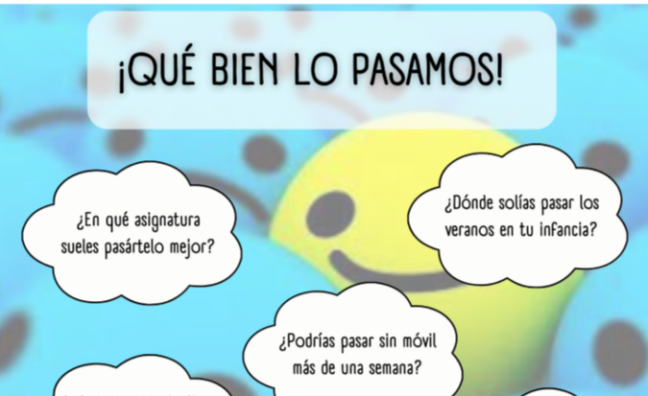
    En la entrada anterior hablamos de cómo expresar ayuda y cooperación, así que, aprovechando que el Pisuerga pasa por Valladolid, no podemos dejar pasar la ocasión de pasarte algunos de los usos más habituales del verbo pasar. Y es que tus estudiantes no pueden pasar sin conocerlos.

    Para que no pases tanto tiempo buscando significados y ejemplos, ya nos hemos pasado nosotros por las 64 acepciones que la RAE le otorga a este verbo. Ahora bien, no queremos pasarnos de prolijos (y que acabes pasando de leer esta entrada), así que hemos pasado por alto muchos de ellos.

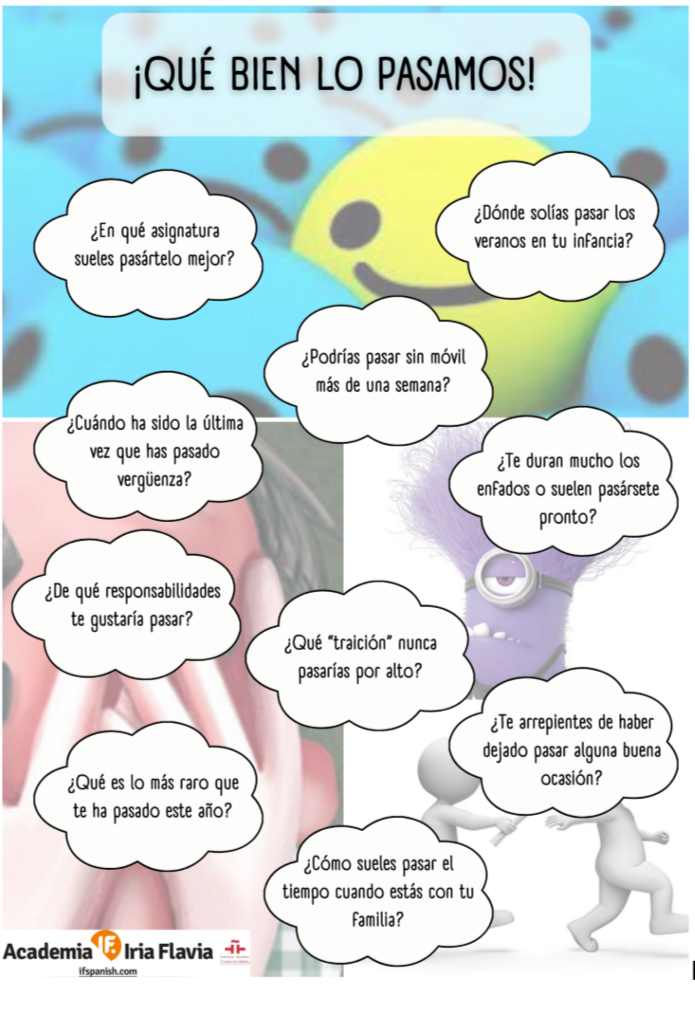
    Sin más dilación, pasamos a explicarte en qué consiste la 👉 infografía que incluimos con este post: se trata de una serie de preguntas para fomentar la conversación entre tus estudiantes, permitiéndoles usar dicho verbo en un ambiente desenfadado.

    Descárgate la infografía, úsala en tus clases… y a ver qué pasa 🤔.

    pases

    Conversations Through Social Media

    social media

    by Victoria Berasaluce Guerra (LTL Contributor)

    Why use social media in the WL classroom?

    A way to engage students today is planning our lessons and class conversations around the social media they navigate. This will evolve from time to time and platforms available and trending topics will change (the evolution from Facebook, to Instagram, to Twitter or Snapchat, etc. makes a point). Teachers need to be aware of what is relevant and current and adapt the resources they use accordingly.

    One of the reasons I wanted to talk about social media in a world language classroom became apparent after reflecting on my own practices. I realized that I am drawn not only to use language related to our curricula but also about life in general and topics that might interest students or that might expand our lessons beyond the scope of the material we always use.

    So…how to go about this?

    The beauty of social media today is that you can find examples of almost everything online. From funny videos, to memes, to quotes…, the possibilities are endless.

    You may choose to use social media at any stage of your lesson delivery, either as a warm up activity, as the main part of your lesson, as a springboard or end of a unit, or extra practice to reinforce content knowledge.

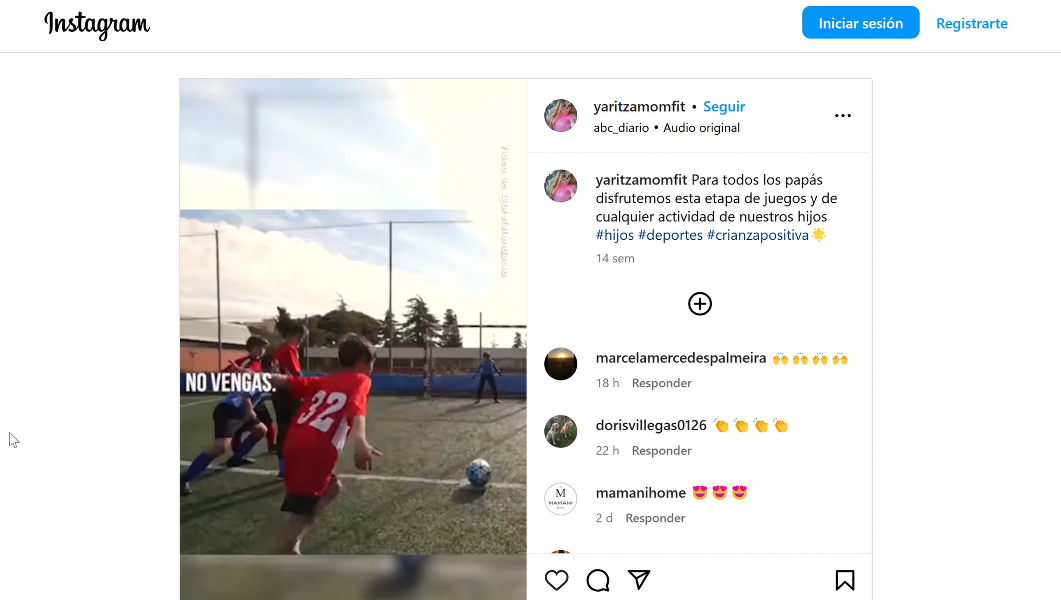
    Take as an instance the following social media examples:

    Videos

    Before introducing the video…

    • You can have the students complete an introductory guided activity, frontloading some of the vocabulary they will encounter. 
    • As a class, you may discuss beforehand students’ opinions on the topic that will be covered and tap into their background knowledge to dissipate doubts.  
    • If you are using the video as a warm up activity, you might prefer to let them discover the content gradually to have some surprises regarding the message. 
    • Listen to students to hear what they are bringing to the table, their ideas many times can lead to interesting conversations you might not have considered, or they might choose to share some personal story. 
    • After the discussion, you can opt to go deeper by creating a mini project related to what students just watched.
    A screenshot of a social media post

Description automatically generated

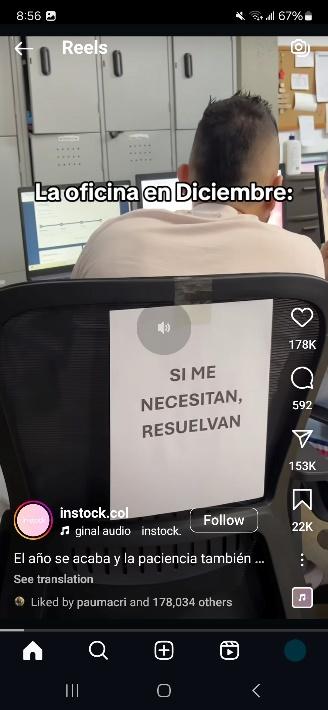
    Jokes or Quotes

    Social media jokes or quotes can be used to practice grammar and decipher meaning, seeing the language in use by different speakers around the world. For example, you can play with pronunciation posts, dialects, famous personalities or to explain idioms.

    A person sitting in a chair with a sign on the back

Description automatically generated

    Conversations around cultural topics

    To delve into cultural comparisons, you can choose a specific social media post introduced in class and give more examples of cultural products, practices and perspectives for students.

    A person in a purple dress

Description automatically generated

    Some tips and questions to consider when using social media

    #1 Screenshots and Videos

    Because of the nature of these platforms, it is always good to take screenshots of pictures and screen record videos; to avoid pitfalls such as unwanted comments or images appearing in front of students. That way you get better control over the material and no surprises.

    #2 Questions and Questioning 

    Think about how the material connects to what you are teaching.

    • What questions could the students have? 
    • What questions would you use to guide the students in understanding the language and topics covered?
    • What other resources could you use to complement the social media content chosen?

    #3 Paratext

    Don’t disregard the paratext that accompanies the media posts since it enriches the students’ experiences around common vocabulary and expressions. For example, common textual and visual elements that surround the posts, such as comments, can serve as a starting point to expand the discussion into what people think of the publication.

    In conclusion, using social media to promote conversations in the classroom can be a powerful tool to engage students and help them connect what they are learning within the classroom with the outside world. It is a unique opportunity for teachers to take advantage of making their scrolling productive and reignite their passion for language and culture.

    Hagamos que la Gramática Fluya

    gramática

    by Ramón Clavijo (LTL Contributor)

    Es probable que hayas removido Roma con Santiago para que tus estudiantes dejen de confundir ser y estar o para que sepan combinar correctamente el imperfecto y el indefinido, recurriendo para ello a múltiples manuales, adaptando y creando materiales o echando mano de recursos de Internet.

    Pero no solo de grandes cuestiones gramaticales vive el profesorado de ELE. Nuestros alumnos también tienen problemas para usar correctamente muy y mucho, saber cuándo usar qué y cuándo utilizar cuál o diferenciar entre más que y más de.

    Uso correcto de la gramática

    Estos son contenidos que no suelen ocupar un lugar central en las unidades de los manuales, por lo que la mayoría de las veces nos tenemos que contentar con recurrir a gramáticas de referencia que, si bien son útiles, suelen reducir estas cuestiones a una breve explicación y a unos pocos ejercicios de refuerzo.

    Por eso, hoy nos gustaría hablarte de un libro 📚 que puede cubrir estas carencias. Nos referimos a Diagramática. Curso de gramática visual (A1/B2), en el que se reúnen algunas de las dudas gramaticales más frecuentes entre los estudiantes de español.

    Diagramática

    Una de sus novedades es que cada contenido es introducido a partir de una muestra de lengua acerca de algún tema de actualidad 🌍 (uso y abuso del móvil, inmigración, bulos en prensa, cuestiones ambientales, lenguaje inclusivo, obsolescencia programada…), lo cual lo distingue de las gramáticas de referencia al uso, permitiendo, además, el fomento del debate en clase 🗨👥️.

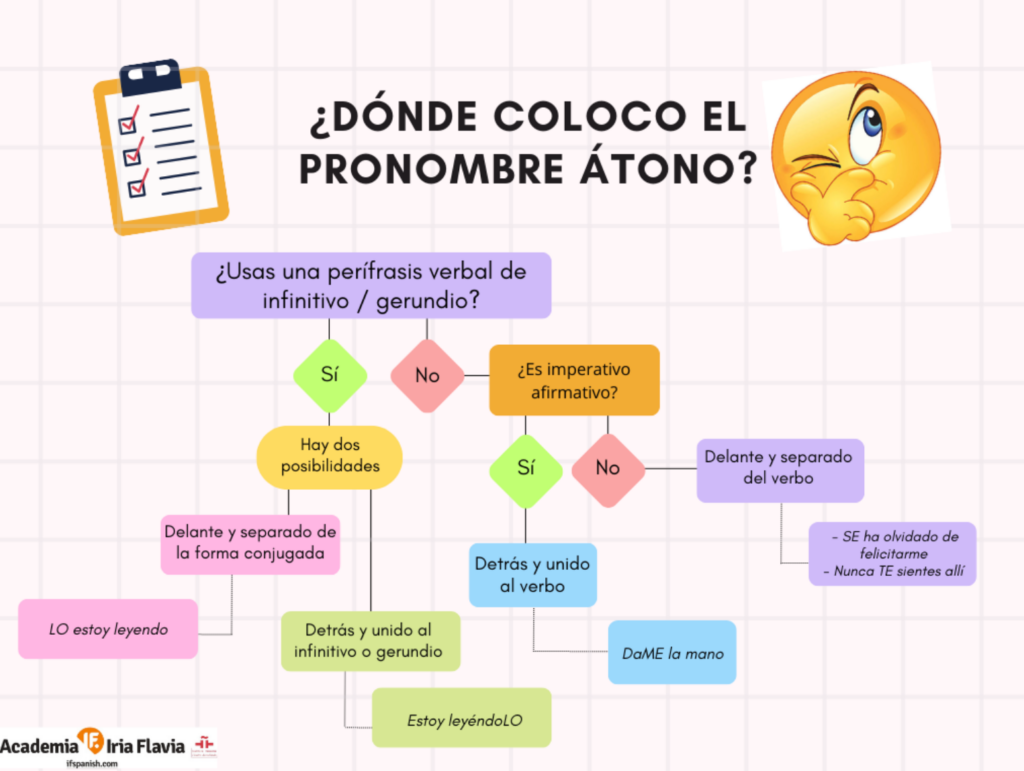
    Otra de sus aportaciones es el uso de diagramas de flujo, herramientas visuales orientadas a la resolución eficaz de las dudas y confusiones que nuestros estudiantes suelen tener respecto a estos contenidos.

    Un diagrama de flujo

    Precisamente, con esta entrada te ofrecemos un diagrama de flujo 👇 sobre uno de los pocos temas que no se incluyen en el libro: la colocación de los pronombres. Esperamos que te sea de utilidad y que te permita hacer que la gramática fluya en tus clases.

    T.A.L.K. Is Interpersonal Mode of Communication and More

    Interpersonal

    Many years ago (actually, 2015!) I read an article on T.A.L.K. by Mme. Blouwolff (Thank you!) which made me change how I implemented interpersonal communication in my classes. I loved the task she presented and the rubric she created, so I had to try it! 

    What is T.A.L.K.?

    T.A.L.K. is an acronym that stands for Talk, Accuracy, Listen, Kindness.

    • T is for Talk in the language for all the Time given. Try to communicate in the Target language. Stay on Topic. Prepare yourself by Thinking: 
    1. What vocabulary words can I use for this topic? 
    2. How do I communicate about this topic in full sentences? 
    3. What questions can I ask?
    • A is for Accuracy when using old and new language functions and structures and old and new vocabulary. A is also for Accountability
    • L is for Listen carefully to others’ answers and comments and build on them
    • K is for Kindness to all group members by contributing to the conversation without interrupting and by inviting others to participate. Be inclusive!

    Use the Rubric

    At the beginning of the year, I explicitly (and intentionally) use the rubric Mme. Blouwolff created for the first couple of T.A.L.K. ‘practices’ for students to self-evaluate themselves. They find it easier to start this new way of practicing interpersonal communication. It also helps them to understand the expectations of this task.

    Explain the ‘Why’ of Interpersonal Communication

    When I explain T.A.L.K. and what we are doing to my students I see an immediate positive change in their attitude towards speaking. They are not answering MY questions, they are answering questions their peers ask… They are in control of their interpersonal communication. They own it! T.A.L.K. empowers!

    Preparing for T.A.L.K.

    T.A.L.K. does not happen in a vacuum. Students practice having interpersonal communication in class every day. I use different resources, such as Amy Lenord’s Chat Mats or conversations based on art, a reading, or a clip they watch. I also vary the pairings using different classroom groupings such as, ‘Table for…’,  two rows, or four corners. 

    Two things become apparent when I start T.A.L.K. in my classes. On the one hand, students need to learn how to ask questions, not just memorized phrases, but questions you would normally ask in a ‘real’ conversation. On the other hand, students realize that they need ‘connectors’ to express what they want to say more cohesively. To help them, I create a ‘world wall’ with some ‘connectors’ such as, because, so, when, however, although, etc., and ‘question words’ my students need to use in their conversations.

    Interpersonal Communication: Pre, During, and Post T.A.L.K.

    Before we start the T.A.L.K. assessment I use some T.A.L.K. routines to help students ease into the conversation:

    • ‘what are we TALKing about today?’ 
    • ‘tips for an amazing T.A.L.K.’, 
    • ‘follow one student’ during the conversation, and 
    • a ‘reflection’ after the T.A.L.K.

    In my class, T.A.L.K. is a class activity in which we gather in a circle with a small group in the center and the rest of the students are placed around them (like ‘fishbowl’).

    Pre-T.A.L.K.

    Before we begin, I make sure students know the topics expected in the conversation by asking them ‘What are we TALKing about today?’ This way, we focus our brains on the vocabulary and functions we need to retrieve from our working memory. 

    I continue with ‘tips for an amazing T.A.L.K.’ on how to have T.A.L.K. conversations. Doing this just before starting, also reminds students of the task expectations and helps them lower their affective filter. They might say,

    • If somebody is stuck or does not understand the question you are asking, give options, for example, if you ask ‘What do you do on the weekends?’ and the other student does not know the word ‘weekends’, you might say ‘Saturday? Sunday?’ That way, you are kind and it helps continuing the conversation without an odd silence
    • Invite all to be part of the conversation by asking a question to all the members in the group
    • Talk about things that you know but if you do not remember or do not know a specific word, use words to describe it so a friend can help you
    • Don’t repeat the same questions (‘What do you like?’ ‘How are you?’). Instead, try to ask new questions for the conversation to flow
    • Have three good questions ready in your head in case suddenly everybody is silent
    • Think that the T.A.L.K. assessment is a T.A.L.K. practice 

    During T.A.L.K.

    While the students in the center would be the ones talking, the ones in the outer circle have to ‘follow one student’ and jot down in their notebooks what he/she says. I can check students’ listening and spelling skills with this and realize who needs more practice on one or both. 

    Post-T.A.L.K.

    After students have done the T.A.L.K., the other component is a ‘reflection’ about their performance that can be written in their notebooks or using a form. I ask questions such as, 

    • What are you proud of? 
    • What went well for you today?
    • What did you learn about yourself? about your peers?
    • How are you going to prepare yourself for the next T.A.L.K.?  What is one thing that you would do differently next time we have a T.A.L.K.?
    • If you had to give yourself a grade on Talking. Accuracy, Listening, and Kindness about your performance, which would that be?
    • In your opinion, which level of proficiency did your reach for the most part during T.A.L.K.? What evidence do you have to support your self-assessment? What can you do to achieve the next level?
    • How can the teacher help you be more successful next time?

    I love reading students’ deep thoughts and reflections on their performance! I learn a lot about them and it gives me hints on what I can do to help each of them.

    Give T.A.L.K a Try!

    Learning about each other while talking in another language is very satisfying for students. It provides an unimaginable sense of authenticity and pride. Give it a try in your classes!