Professional and Personal Experiences Inform My Language Curriculum

Have you ever wondered why we teach what we teach? I realized that my professional and personal experiences inform my language curriculum in more ways than I have imagined. 

It all started when a few years ago, in the educational and pedagogical arenas, there was a big emphasis on culturally responsive teaching. That is when I decided to revisit my curriculum. Among all the units, I started by digging deeper into the typical ‘get to know students’ one at the beginning of the school year. Yes, it is important to know what students’ preferred name is and learn about their favorites, and I do not underestimate this, but to me that was not enough. I wanted my students to learn about themselves, who they are and who they want to become as language learners. 
Https://languageteachinglab.com

A children’s book, a trip to a museum, and a fellowship are three examples that informed my unit on identity. I developed, tweaked, and grew this unit throughout the years.

A Professional and Personal Experience: A Children’s Book

I had the privilege of meeting Rafael Lopez in person when he received the Americas Award for illustrating Pat Mora’s Yum! MMMM! Que Rico!. Lopez made an imprint on me that day. I bought most of his titles from then onwards (all worth it!).

When I read Rafael Lopez’s, El dia en que descubres quien eres, I knew I had to introduce it to my students. This book reminds us not to forget how you feel when you are new to a place. It reminds us of the importance of making connections and sharing stories among each other. It touches upon the identifiers of race, ethnicity, gender, class, ability, origin, and age and at the same time it develops empathy. I use the Project Zero Thinking Routine CSI – Color, Symbol, and Image – to have students show understanding of the story.


A Personal Experience: A Trip to a Museum 

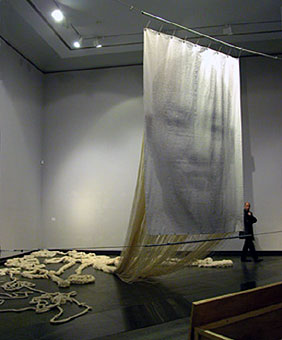
I make a big emphasis throughout the identity unit on the importance of learning about the ‘invisible’ side of people, of others and of our own. Students discover and explore this by walking the same steps I walked many years ago when I saw ‘Braiding’ by Lin Tianmiao while visiting a Chicago museum.

Lin Tianmiao massive installation made a huge impact on me back then. I decided to add this work of art into the identity unit. It seemed the appropriate way of helping students understand how much of what we see and perceive influences what we think about others. 

Students use the simple (but powerful) Project Zero Thinking Routine “I see, I think, I wonder” to describe the installation. As a first entry to the art, I only show students the face in the artwork. Once students share what they have written about what they see, think, and wonder, I show them the complete piece of art. In their own words they express what I intended them to understand.
http://sites.asiasociety.org/arts/past_future/images/lin_tianmiao.jpg

A Professional Experience: A Fellowship 

I want to show students that we cannot stop at the visible part of human beings to learn about others. Introducing them to Caja de Memoria Viva II: Constancia Colón Clemente by Adrián Viajero Román seemed the way to go. The following materials are based on the collections developed when Marcela and I participated in the Smithsonian Fellowship

Students use personal memories to recall what songs or sounds, what smells, what artifacts, and what tastes we associate with home or a special place for us. Only then we analyze the art.

Students observe and analyze the three dimensional work of art first. Then they describe both its exterior and interior. I usually start by showing students some photographs of the visible cube representing the head of a person. The installation is of a black Puerto Rican woman who migrated to the United States in the 1940s. 

After they observe the photos from the outside, I have them observe photos of the inside of the piece of art. Students see lots of different objects hanging in the inside walls of the cube.

We continue by using the Project Zero Thinking Routine ‘Layers.’ This routine provides learners with a structure for looking analytically at creative works through its narrative, aesthetic, mechanical, dynamic, and connections.

Example questions for using ‘Layers’ 

-Who do you think is this person? 

-How old do you think she is? 

-Where do you think she lives? 

-How does this installation make you feel? 

-What do you see? 

-What is unique in this piece? 

-How does it connect with your personal experiences?  

The installation helps students concretely see the connection between the ‘visible’ and ‘invisible’ sides of a person. One important aspect about this art piece is the fact that you can hear the voice of Constancia Colon Clemente when you are under the installation. It feels you really are in her head!

Future Professional and Personal Experiences

The examples mentioned above – a children’s book, a trip to a museum, and a fellowship – informed my unit on identity. I will surely keep on developing and tweaking this unit in the years to come.

Though usually unexpectedly, my professional and personal experiences will keep on influencing my language curriculum. Therefore, I wonder where my next inspiration will come from.
The Importance of Professional Learning Communities

I can’t stress enough the importance of professional development, as once we do not feel that need, it might indicate that it is time to move forward. What attracts me to professional development (workshops, webinars, book clubs, or conferences) is two-fold. On the one hand I attend professional development for student learning (for a student-centered approach to education). On the other hand, as teachers, we are master learners (as we read in Innovate Inside the Box): We seek instances to learn. 

Value of PD and PLC

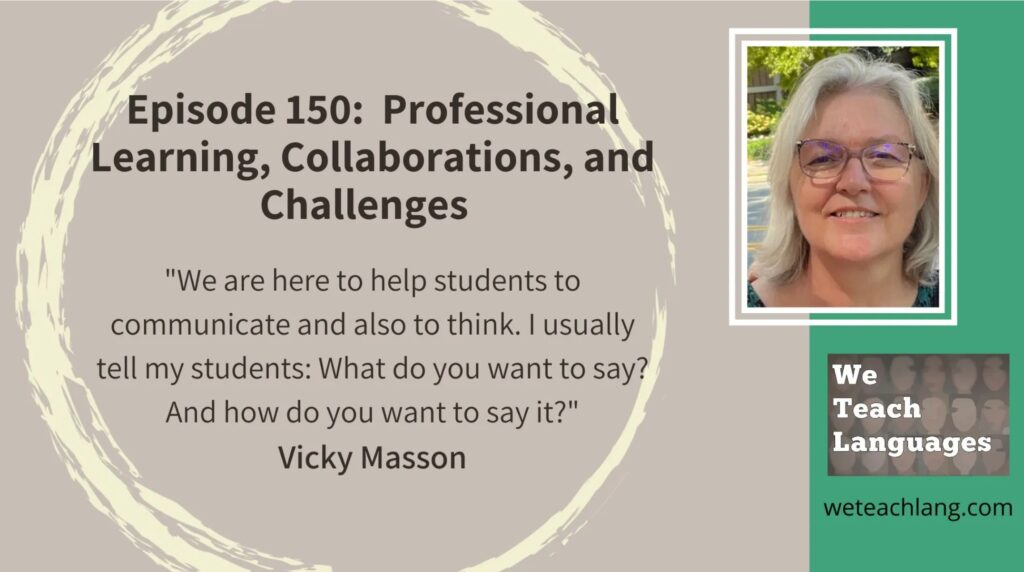
Throughout my teaching career, I have not only sought professional development but I have humbly presented as well. Lately, I appeared in We Teach Language Episode 150 (who doesn’t like round numbers?).

It made me think how much I cherish and value professional development but even more so, I value Professional Learning Communities.

What are Professional Learning Communities?

Professional Learning Communities are groups of people who get together in person or virtually with a purpose. We all share something in common and we care about it. For example, we might all share the passion of teaching with technology (or want to learn more about it). We might share the need to connect with a diverse group of educators from our state, our nation, or the world. We have different perspectives and we all learn together.

Being part of PLCs opens doors to new avenues for growth, learning, and development. It usually moves us out of our comfort zone and gives us, at times, unexpected instances of leading, both in small and in big projects. Language Teaching Lab, was a seed planted in one of these PLCs. 

The PLC I Have Been the Longest with

I especially want to mention the PLC that I have been the longest with: GWATFL. I attended GWATFL for many years before becoming more involved in the organization. Since 2017, I have grown together with GWATFL. Now I have the fortuity of giving back with the GWATFL Member Action Program.

https://gwatfldc.org

The GWATFL MAP started as a project looking “for ways to create more opportunities to connect with and impact our community of language educators.” GWATFL MAP gives its members a chance to participate, lead, and act on GWATFL initiatives. It also gives its members a voice in the organization. A community of like-minded educators has begun and little by little, the program is growing and the impact of its members is becoming more palpable. 

Professional Learning Communities: Bigger than Ourselves

In PLCs, we belong to a group bigger than ourselves. We count on and push each other to advance the mission and vision of such an organization, as well as our own. What are you waiting for to begin your own journey in a PLC? Attend professional development opportunities and join a professional learning community. You will not regret it.

‘P’ is for Project in World Language Classes

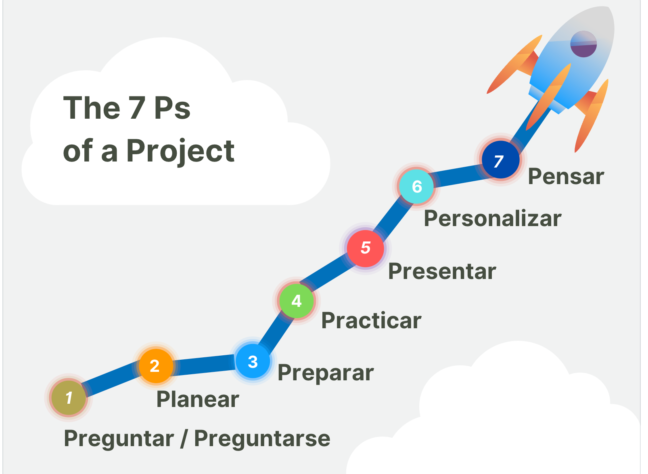
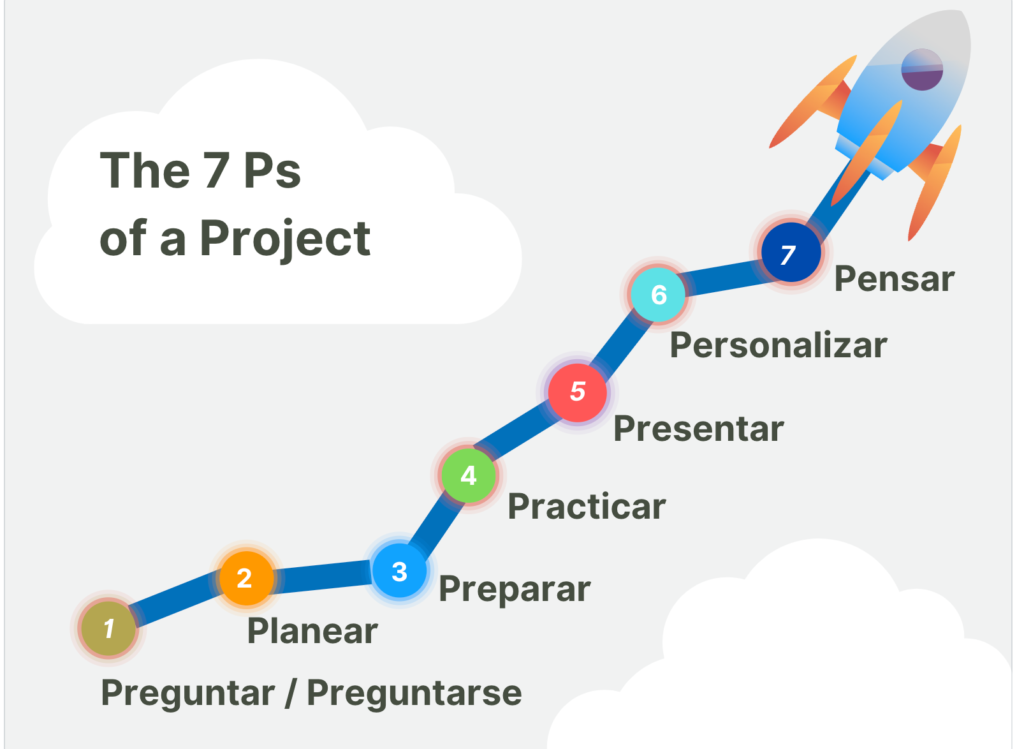
“’P’ is for Project” is one of the frameworks that I usually use to help students complete a project successfully in my Spanish language classes. This framework uses words in Spanish that begin with ‘P’, guiding students to identify and follow the different steps of the process while gaining independence. In Spanish, the 7 Ps of a project include: Preguntar / Preguntarse, Planear, Preparar, Practicar. Presentar, Personalizar, Pensar.

‘P’ is for Project

In English, most of the names for the steps use the word ‘P’ except for the very first one, which stands for ask yourself or questions. The framework includes: ask myself/questions, plan, prepare, practise, present, personalize (give feedback) and ponder (think and reflect).

Needless to say, there are other frameworks that guide students when they do projects, such as Challenge-Based Learning, Project-Based Learning, Project-Based Language Learning, Global Competence, etc. I have used these frameworks apart from the 7 Ps for Project with good results as well.

Having a consistent path when doing projects helps students know where they are and what comes next, which lowers their affective filter. It also focuses them on the task at hand and helps them stay in the language! 

In my classes the best learning has happened when students follow all the steps. I am going to show you the path my students – in elementary and early middle school – follow when doing a project in my Spanish classes. You can adapt these steps to use in Early Elementary or in High School. 

‘P’ in Preguntar / Preguntarse

We usually start our projects with questions. Questions usually bring more questions. The word for questions in Spanish is ‘preguntas’ and ‘preguntarse’ is the action of wondering.  It is the perfect way to start our ‘P is for Project’ framework.

I read the following “If we’re willing to ask the questions, we can begin changing things.” (Turning to One Another: Simple Conversations to Restore Hope to the Future, page 71). Though not all projects in my Spanish class lead to substantial change, students might change their way of seeing the world, their understanding of themselves, and their knowledge of other cultures. 

‘P’ in Planear

What may ‘Planear’ include?  It may include making a drawing, creating a simple outline, chunking what we need to do into daily doables, getting the materials needed, choosing what technology to use, investigating a topic, etc. Before we jump in, it is better to step back and think about what resources you need and what you need to do to achieve your goal. 

‘P’ is for Project: Preparar

‘Preparar’ may include creating a graphic organizer, writing the first draft, preparing a PowerPoint or using another presentation edtech tool. My students have realized that usually this step is the one that takes the longest and after doing a couple of projects, they take their time to complete this step thoughtfully. 

‘P’ in Practicar

‘Practicar’ is a key part of any project. Usually, in the first project of the year, my students skip this step. Students immediately get to understand that they should have practiced more before presenting in Spanish. When it is a presentational writing, they realize that they should have gone over, edited, and proofread their writing before turning in their final draft. Some students benefit from doing this step consciously as they realize that practicing compensates their effort. 

‘P’ is for Project: Presentar

Once students complete Preguntar/Preguntarse, Planear, Preparar, and Practicar, ‘Presentar’ becomes an easy part of their projects. They are proud and ready! They feel accomplished and it often helps develop their self-esteem. 

At the beginning of my career, I would have stopped after their presentation, either speaking or writing, was complete. Now I include two more steps: give feedback and reflect on their work. Why do I do this? 

‘P’ in Personalizar

‘Personalizar’ has become my students’ favorite part of any project. It is the time in which they give feedback and celebrate their accomplishments and their friends’. If students created a Flip as a presentational speaking assignment, for example, they give personal compliments on each other’s successes. If students created a ‘gallery walk,’ they proudly give their feedback on other students’ work by posting stickers or post-it notes. 

‘P’ is for Project: Pensar

‘Pensar’ has become my favorite part of any project. I get to hear students’ reflections on the process and as well as the product. I get to know how they feel and what they think. Interestingly enough, I also get to know how the project has opened their eyes to new products, practices, and perspectives, how it has transformed the way they see the world, and what personal connections they have made. It also gives me a chance to make changes to the project to help the following group of students. I usually use a form to capture their pondering on the project but other times, I prepare a set of questions and discuss them as a class.

So, to me, the ‘P’ is for Project because in my Spanish classes, following these steps -’Preguntar/Preguntarse (to ask questions), Planear (to plan), Preparar (to prepare), Practicar (to practice), Presentar (to present, in writing and / or speaking), Personalizar (to personalize and give feedback), and Pensar (to ponder, think, and reflect on their learning)’- help students engage in their learning by giving them a choice on what they want to learn about, investigate, communicate, and many times act upon. 


Books by Margaret J. Wheatley

‘Mi día típico’ By Amy Lenord: A One Page Jewel

You know you have found ‘a jewel’ for a unit when you discover ‘Mi día típico’ by Amy Lenord through Twitter: https://twitter.com/alenord/status/1479988461264416777 

It is only one page but it lets you dive into so many topics while personalizing it for each of your students. 

Many ways to use ‘Mi día típico’ by Amy Lenord

This one page can be used to review many topics already studied, such as clothing, food, time, sports, meals and food, school, chores and other activities, and grammar structures, such as prepositional phrases, adverbs of quantity, sequencing words, besides the conjugation of verbs in the 1st person singular of regular, stem-changing, and reflexive verbs.

It also gives the perfect context to review the verbs ‘desayunar, almorzar, merendar & cenar’ for the specific meals of the day, as opposed to repeating ‘comer’. This is something quite confusing to language learners as these verbs are used differently in English and in Spanish.

Another application of this great resource is to make comparisons and explore new topics.

How I used ‘Mi día típico’

Reading for understanding

Initially, students read the page, it was easy for them to understand the meaning of the statements by looking at the images Amy Lenord included as a clue, plus my acting out, and drawing when necessary. 

Later, I used this page for Interpersonal Speaking, Presentational Writing, and Presentational Speaking. 

Interpersonal Speaking 

After my fifth grade students read the page multiple times and were familiar with the meaning of each statement, I moved to having them ask and answer questions about themselves. They quickly realized that they needed to change the endings of all the verbs and the pronouns from ‘me’ (about me) to ‘te’ (about you) when asking their partner. There were some giggles when they made the questions without making this change, e.g.: ‘Do you brush ‘my’ teeth in the morning?’ instead of asking ‘Do you brush ‘your’ teeth in the morning?’ 

Scaffolding in Preparation to Present ‘Mi día típico’

Using the resource for presentational writing and presentational speaking needed some scaffolding. The following are some activities and tasks that my students did prior to presenting. 

  • Draw the activities

I had students use this ‘jewel’ to also think about their typical days. I handed a booklet with three pages with the days of the week on each page. The first page read ‘Por la mañana’ (In the morning). The second read ‘Por la tarde’ (in the afternoon) and the third one had ‘Por la noche’ (at night), Students drew what they do during each part of the day on the specific days of the week. This booklet, along with the page ‘Mi día típico’, were our anchor for the rest of the tasks and activities. Students used both as guides all along.

  • Self-checking competition 

I asked students to study the ‘Mi día típico’ verbs and the next day we played a competition. Each student would say a verb and everybody had to write it down. Students numbered the verbs and wrote them down until they thought they had named them all. Then they self-checked their writing against the ‘Mi día típico’ page for spelling and completion of all verbs. To my surprise, not only had they included all the verbs, but they had also added a few more!

  • Level up the phrases

Then, students chose one of the drawings from their booklet and wrote a sentence in their notebook that later read aloud to share it with their peers. I have to say that they came up with excellent phrases! To push them a little bit more, I asked them to ‘level up’ the phrases, so we discussed ideas on how to do it. Finally, students practiced ‘leveling up’ their phrases into emerging sentences by writing two more sentences and adding some details. They were very proud to share them in class.

  • Topic and conclusion sentences 

The next class, We discussed which could be a good topic and a conclusion sentence for a presentational writing assignment and we jotted down several possible sentences. We used OneNote so everybody knew where to find the topic and conclusion sentences to study.

  • “We are in RLA,” they said

For reference, RLA is Reading Language Arts. I asked students if they had written paragraphs in Language Arts and they all said ‘Yes’, and we talked about what makes a good paragraph. I asked them to look at their drawings and circle those which they thought could be good illustrations to write about in Spanish. They could choose up to six pictures from any part of their booklet. While they were planning what to write, I told them they should answer: What can I write that will make an impact on Sra.? That way,I would see complete and original thoughts when I read their paragraphs. In other words, their writing had to catch my attention as a reader. 

I also told them that we would be writing a presentation in class only using the booklet with the drawings and it would be an assessment. They practiced with different partners until they had a better idea of what they could write about and how they would write it.

Presentational Writing Assessment

It is imperative that I know what students are able to do. It helps me understand what I need to do to move students along the proficiency levels. Using their drawings as the only resource, most of my students included at least a Novice High sentence, evidence that they have already started creating original thoughts in Spanish. As a teacher, I felt accomplished! 

Presentational Speaking & Reflection

For the Presentational Speaking they would be recording ‘Mi día típico’ in Flipgrid the following class. In preparation, they chose what to say, they practiced with friends, asked me questions, and shared strategies on how to do it. Then, they completed a reflection about the following: 

  • What went well for you?
  • What was challenging?
  • What did you learn about yourself? 
  • What would you do differently next time?

For the most part, students’ responses showed that the presentational writing was better than the presentational speaking because when writing, you can proofread your text, but when speaking, you have to come up with what to say on the spot. For the most part, they said that they could write and speak in Spanish much better than they could have ever imagined. I was proud of their work, effort, and growth. 

I find that ‘Mi día típico’ by Amy Lenord is a resource that helps my students accomplish communication. Thank you, Amy!

A Few Resources for Language Class to Teach about Summer

Teach about Summer in your language class. It can be fun!

It is so near the end of the school year that Summer is in the air!

As teachers, there is so much you can do on the topic of summer that a blog would not be enough. Here are a few resources to help you dive into summer! My favorite is Papa Topo’s song. Which is yours?

Check other resources according to seasons: Spring, Winter, and Fall.

As an Amazon Associate LTL earns from qualifying purchases

Books

Entonces llega el verano

From the Bellybutton of the Moon: And Other Summer Poems / Del Ombligo de la Luna: Y Otros Poemas de Verano

Frutas de verano

Qué hacen los animales en verano

Ideas & Blogs

Summer Road Trip, a Smithsonian at home activity guide

Actividades para recordar el verano

Actividad para dar consejos en español sobre el verano para adultos

La canción del verano para aprender vocabulario para adultos

Poems

From the Bellybutton of the Moon: And Other Summer Poems / Del Ombligo de la Luna: Y Otros Poemas de Verano

Poemas de verano para niños y adultos

Songs

Lo que me gusta del verano by Papa Topo and lyrics

Vocabulary

Vocabulario de verano

Fichas de infantil

Dibujos para colorear

YouTube & Videos

El verano

Intercultural Conversations in Middle School Spanish Class

What do intercultural conversations look like in your language class?

Depending on the age of the students, intercultural conversations can take many different shapes and forms. For the purpose of this blog, I’ll talk about the experience of bringing a native Spanish speaker to my middle school class. This person was from Spain. Why from Spain? We were getting ready to read “Agentes secretos y el mural de Picasso” by Mira Canion and I wanted to introduce them to Spain in a different way. My first impression was that (in general), my students knew little about Spain and had misconceptions about this country. Off to an interesting start!

How might you prepare students to have intercultural conversations?

I am sure that there are many ways to have students get ready for intercultural conversations but I decided to go with questions, facts, and maps.

Asking Questions:

I asked my students what they wanted to know about Spain and wrote each one of their questions. I could see how their minds fed from each other’s ideas, and I was impressed with the array of questions they had. We created a long list of questions. 

Categorizing questions:

Next class, I asked them to work in groups of three. They had to read the questions generated in our previous class, find connections among them and group them in categories. They also had to come up with the names for the categories. When they finished, I asked one group to tell me a category and read the questions that were in it. If others disagreed, they would have to explain why and what they would do differently. When all the questions were classified and everybody was in agreement, we paused for a second and re-read all the questions in each category.

Delving Meaning:

Now, it was time to think deeper and discuss how the visitor would feel or react to the questions. We wanted to avoid questions that sounded too direct or even unintentionally offensive, i.e. ‘Why did you come to America?’ We rearranged the questions and tweaked some of them so that they would provoke a positive response in our speaker. When we finished, we re-read the questions once more and … finally, we all liked how they sounded! 

This step of the process proved to be a fundamental part of the experience, it sparked empathy and kindness. Students could see that the way we ask questions is as important as what we ask. 

Finding Facts:

Now that the questions were ready, students had to investigate and find three to five facts about Spain.The next day, they came excited about their findings. “Quite interesting facts, Sra!” they said. “Did you know that the Spanish anthem does not have lyrics? Did you know that Spain has many World Heritage Sites?” 

Reading Maps:

We found Spain and its islands on a world map and also read a couple of simple articles that explained Spain’s location and regions. Students were surprised to find out that Spain is similar to Texas in size. Now, I felt students were ready to meet our guest speaker.

Time to meet our guest speaker

Finally, the day to meet our guest speaker had come! I had sent her the questions in advance so she could prepare for our meeting. She had made a short presentation with images based on the questions my students had asked. As I had anticipated, students were intrigued by all she had to show them about Spain but she did not stop there. She also asked students personal questions such as, favorites, sports, and traveling, to compare their experiences with hers and so that they could relate to what she was talking about. They gave her a round of applause when she finished.

Time to reflect on the learning of intercultural conversations

As my guest speaker spoke practically all in Spanish (really! the 90% suggested by ACTFL) I was curious to know how much my students had understood. I decided to have them do a short reflection using the PZ Thinking Routine: I used to think … But now I think / I know. I added “I learned” and “I liked” for those that needed to express more concrete thinking. I was amazed at how much students had understood and learned through this experience. 


In sum, I was happy to see the growth in my students’ thinking and learning. Moreover, I felt very accomplished to have facilitated a successful intercultural conversation.

Engaging Language Learners with Global Views

global views

Presenting global views connects language students to the experiences of others. It engages their minds, hearts, and hands. There are wonderful resources that help language students broaden their perspective of the world, not necessarily limited to the people in the countries that speak the language they are learning. Why wait until they are at an intermediate level? You may start with novice learners. It all depends on what you show them and what you do with it, i.e. how you use the resource, as well as why you are using that specific resource. 

Why global views?

I part with the idea that we live in one world and the more that we learn from each other, the better. As a Spanish teacher myself, I moved from showing only things related to the Spanish-speaking world to showing my students the whole world. Of course, a big part of what we do in class is related to the Spanish world, but I intersect resources that go beyond that.  Learning about others helps break down stereotypes, expands our worldviews, and helps us become aware of our interconnectedness and common humanity. In sum, it is about helping my students become globally competent. 

How do we use photographs as global views ?

To successfully reach the minds, hearts, and hands of language learners, it is necessary to think through how we introduce, develop, and conclude each lesson. It is also important to think about what background knowledge students need in order to understand the topic and what prior knowledge they bring to class. Using resources thoughtfully is key. 

Many times I choose to use photographs to do this type of work because they are potent visuals. They tell stories and we can all relate to stories. Photographers have a unique eye as their lens captures a precious moment in time. It is up to us to show these global views and choose how to do it.

The following are some ways in which I have presented global views to my students. 

When I taught elementary school, my students particularly enjoyed when I showed them photographs of classrooms around the world and they had to compare and contrast those with their own classroom. As an added benefit, I learned about students’ prior experiences and their families’ history. 

My students love when they can choose. When presenting them with several photographs, I let them choose one that talks to them and ask them to do different activities, from simply describing the photograph to creating a story to only asking and answering questions. Other times, I present them with two photographs and we compare them to find similarities and differences. These types of activities propel great conversations.  

The National Portrait Gallery has many classroom resources to use when describing portraiture, and some of them can be applied to analyzing photographs successfully. I especially enjoy:

Unveiling Stories

Seeds for Storytelling

Jump in!

Compare and Contrast: Top Hat

There is no doubt that using the Project Zero Thinking Routines makes perfect sense when analyzing photographs. For this type of work, I would go with the Global Thinking Routines ones.

The Library of Congress has a special tool when it comes to analyze photographs that differs from the tools used to analyze other media. It is a wonderful way to start a conversation about photographs. Check it out!

Source: Library of Congress

The LOC also has an online analysis tool for students to download and work directly there. 

You may also want to read our blog “Authentic Resources with the Smithsonian Learning Lab,” where we give examples of integrating art into the curriculum.

There are so many ways to go when it comes to introducing global views to students. Of course, the images per se are key in making it a powerful experience.

What resources can we use to engage learners with global views ?

The following are some resources based on photographs. Some of these photographs include the topics of school, food, identity, and landscapes and I have used some of them with my novice students. What is important is to choose what to show and how to present it to students. 

As an Amazon Associate LTL earns from qualified purchases.

Food

-In her kitchen

Menzel’s photographs

Article on Menzel’s work in Spanish

What I Eat (Menzel)

Hospital Food

School Lunches

Galimberti’s work on what children play with

-An article in Spanish

Photographs

Esther Honig’s photos on beauty

Article on Honig’s photos in Spanish

-Article on Honig’s photos in Spanish

Webpage

School

Schools around the world – The Guardian

Schools around the world – Boston

House

Menzel’s photographs

Landscapes, Ecology, Social issues

Overdevelopment, Overpopulation, Overshoot (OVER)

Each time I present global views to students, their engagement is palpable as global views engage language learners’ minds, hearts, and hands. If you haven’t already, give it a try and let me know how it goes in your classes.

Ideas for Teaching Poetry in World Languages

by Vicky Masson

April is National Poetry Month. Here are some ideas I have used and I always come back to when teaching poetry in my world language class. 

Acknowledgement and Credits

I love professional development and I have attended many amazing workshops all throughout the years. I got inspired and felt refreshed after each one of these experiences. Although many of the workshops were not specifically geared to world language teaching, I borrowed ideas to use in my classes. Unfortunately, I cannot tell exactly from which workshop I adapted each idea. I can say that the ideas come from workshops I attended at the National Gallery of Art, the Portrait Gallery, the Phillips Collections, the Kennedy Center, and other Smithsonian museums. 

How I teach poetry in a world language class

I love words and poetry highlights each word and makes words come alive.

Let’s briefly talk about a few examples on how I teach with poems in Spanish class,

– I read poems aloud to my students, 

– I have them recite poems from memory, and 

– I invite them to write their own poems. 

The ideas below can be easily transferred to other languages. 

Read aloud poems

Some poems are fun to read, some are long, and some others say so much in a few words. The following two poems are great examples for making interdisciplinary connections. 

The book Yum! MMMM! Que Rico! Los brotes de las Américas by Pat Mora and illustrated by Rafael López is a collection of haiku and a springboard for teaching a combination of poetry, science, and geography. Get to know the origin of some of your favorite fruits while enjoying illustrations that are sublime! This book is a wonderful way of introducing students to the art of haiku to appreciate words to the fullest. It never ceases to amaze me how a few words can say so much!

Los zapaticos de rosa by José Martí and illustrated by Lulu Delacre creates the perfect ambience to teach about plot in language arts. This poem also includes other topics to explore such as, social justice, empathy, and kindness. The illustrations are as beautiful as the words in the poem. 

Reciting poems

Through Poetry off the Page based on Glenis Redmond‘s workshop at the Kennedy Center,  students learn how to best recite poems using their whole body through

-positioning themselves to recite by planting their feet on the ground

-projecting their voice to be heard

-personalizing a poem (make it theirs through movement and gestures), and

-doing it with purpose

The poems ‘Paisaje en el tintero’ by Juan Carlos Martín Ramos in Las palabras que se lleva el viento andEl triunfo’ by Marjorie Agosín in Red hot salsa: bilingual poems on being young and Latino in the United States, helped me implement Poetry off the page successfully. I encourage you to give it a try!

Writing poems

Blackout Poetry

I wrote about the collaboration with another school in Barcelona, España as part of #SingleVoicesGlobalChoices to write blackout poetry both in the post Empowering Language Learners with Powerful Learning and in the article Connect, Adapt, Try New Things in Best Practices of Online Learning in COVID-19. Basically, blackout poems can be created using the pages of old books or articles. Students, as poets. isolate and then put together single words or short phrases from these texts to create something totally new. 

Poetry from Art

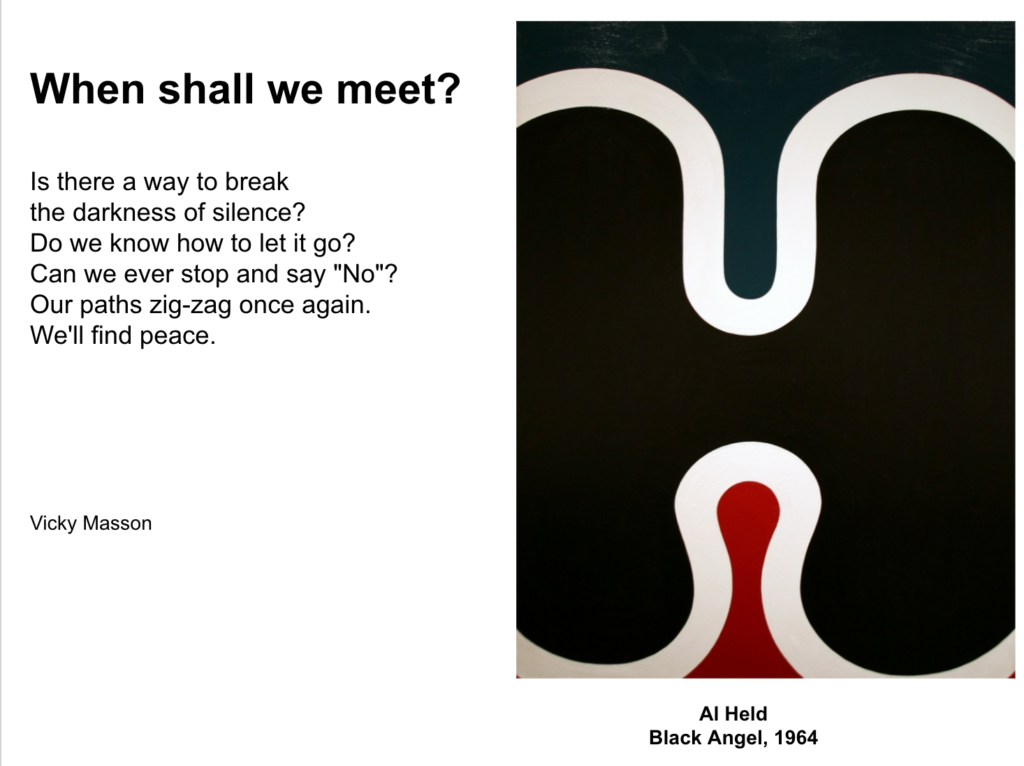
I remember vividly the day that docents at the National Gallery of Art walked a group of teachers through different ways of creating poetry based on an art piece. I even wrote one myself! And in English! After brainstorming using a web organizer, I created a poem based on an art piece that is still meaningful to me. I am sharing it below. 

After this experience, I learned more about the connection between art and poetry. It is fascinating! The following three books keep on being great inspirations to me:

  1. The Tree is Older than You Are – a bilingual gathering of poems and stories from Mexico with paintings by Mexican artists – selected by Naomi Shihab Nye
  2. Celebrate America in Poetry and Art – National Museum of American Art Smithsonian Institution
  3. Side by Side – New Poems Inspired by Art from Around the World – Edited by Jan Greenberg 

Poema sensorial

In the PD session, I learned that the following activity is based on “Walk into a Picture” from a booklet provided by Carol F. Peck. In sum, it is about using your senses to express what you see, hear, smell, touch, and taste when confronted with an art piece. 

Follow these steps all while enjoying the process:

  1. Look at the art and based on it, answer each question with words or phrases 

Line 1. What do you hear? 

Line 2. What do you smell? 

Line 3. What do you see? 

Line 4. What does it taste like? 

Line 5. What do you feel on your skin? and 

Line 6. How do you feel inside? 

  1. Once you have answered each question with words and phrases, circle only one word or phrase from each line
  2. Choose only ONE of the circled words and copy it out on an index card
  3. If the word that you chose belongs to the first line, place it where the teacher tells you
  4. Once all students have placed the words from the first line, proceed to follow the same procedure for second, the third, etc. until you reach the last line
  5. When all the lines are complete, students read the poem together.
  6. If students like the poem, great! If students do not like how the poem sounds, students can move a few words or phrases around
  7. Students read the poem again in silence and if everybody likes it, students read it all together again
  8. (optional) Students can record themselves reading aloud the poem

It seems like a long process, but once you do it, it makes total sense. Trust me!

See an example done by my 5th grade class based on an illustration from the book Gathering the Sun by Alma Flor Ada and illustrated by Simon Silva. 

from the book Gathering the Sun

La sartén, el palo de amasar, un jarrito,

Yo huelo la comida, café, libro, café, libro, pan

Las montañas, el campo, las cortinas, la mesa

Familia,

Calor, 

Juega feliz.

Poema corto 

I had so much fun creating poems using the ‘poema corto’ technique during a PD workshop some time ago. Then, I loved seeing my students’ faces when they created theirs and read them aloud to their friends. 

Creating the ‘poema corto,’ which literally means ‘short poem’ is quite a long process, but it is totally worth it! Try it yourself or with your students and let me know in the comments how it went.

This is the graphic organizer in Spanish that I provided my students to make it easier to follow the steps of writing their ‘poema corto’

Abstracto (no lo puedes ver) Interno Colores Concreto (lo puedes ver) Externo Verbos (lo que ___ puede hacer)

1.
2.
3.

1.
2.
3.

1.
2.
3.

1.
2.
3.

Steps to follow:

  1. Write three abstract words, three colors and three concrete word
  2. Write three verbs that describe each of the concrete words
  3. Circle one of the abstract words
  4. Circle the color that best describes it
  5. Circle the concrete word that best describes the abstract word
  6. Below the graphic organizer write the abstract word followed by the verb that best describes it
  7. Continue writing the sentence by adding a comparison (a metaphor or a simile) using the three words that you had chosen. Complete your idea
  8. Once you choose a word, you may not use it again. You may not need to use colors
  9. Create two more sentences following the same process
  10. Read the sentences aloud to a friend and choose one to share with the class
  11. (optional) illustrate the sentence and record yourself reading aloud using Flipgrid, for example

Below are some examples written by my 5th grade Spanish students as a second language. As I teach Spanish, the poems were written and later recited, in Spanish. I was so proud of my students’ work. Enjoy!


El odio corre 

como un lobo enojado. 


Las emociones van y vuelven

como un jaguar enjaulado.


Los pensamientos viven 

en una casa 

porque los pensamientos viven en mi cabeza. 


Los pensamientos leen 

en mi cabeza 

como yo leo libros. 


Los sueños abrazan como un oso de peluche rosado.


Los sentimientos dan vueltas como un globo en el espacio.


Los sentimientos se divierten como un parque de muchos colores.


Los sentimientos comunican como palabras.

Sharing poems and poetry resources

If you know of other Professional Development opportunities for learning other ways to get students excited to learn poetry or other poetry resources, please share about them in the comments. 


Other resources by Pat Mora and Rafael López

As an Amazon Associate LTL earns profits from qualified purchases

Spring List of Resources for World Language

by Gabriela Barbieri – Marcela Velikovsky – Vicky Masson

Spring is in the air! or we wish it were… Continuing our tradition of bringing classroom resources for language teaching, we want to share with you a list of resources that we hope will inspire you in your teaching during the months of Spring. Enjoy!

Art

-Francisco de Goya – Spring

Around the World in Spring Through Paintings

10 Spring Paintings To Celebrate The End Of Winter

Articles

How To Teach a Cultural Comparison of the Return of Robins & Swallows in the Spring in the TL

Actividades de STEAM para la primavera

Datos del Día de la Tierra – National Geographic

Pascua en la clase de español – Laclasedeele

Books

As Amazon Affiliates LTL earns from qualifying purchases

El Jardín Mágico · Lemniscates · Editorial Ekaré 

Laughing Tomatoes: And Other Spring Poems / Jitomates Risuenos: Y Otros Poemas de Primavera (The Magical Cycle of the Seasons Series) (Cycle of Seasons)

La oruga muy hambrienta

Lee & Low books

Crafts

5 Manualidades de flores para recibir la primavera

27 manualidades de primavera bonitas y fáciles para hacer con los niños

Lesson Plans and Ideas

Rockalingua

La primavera

March in Spanish Class – Mis clases locas

-Reading: Primavera

Actividad interactiva

Websites

Lead with Languages – Advocacy Month

Spring Teaching Ideas for Language Learners

Zambombazo

Spanish Playground

Spanish Profe

Woodward

Earth Day – In many languages

-International Women’s Day – different languages

What resources do you use?

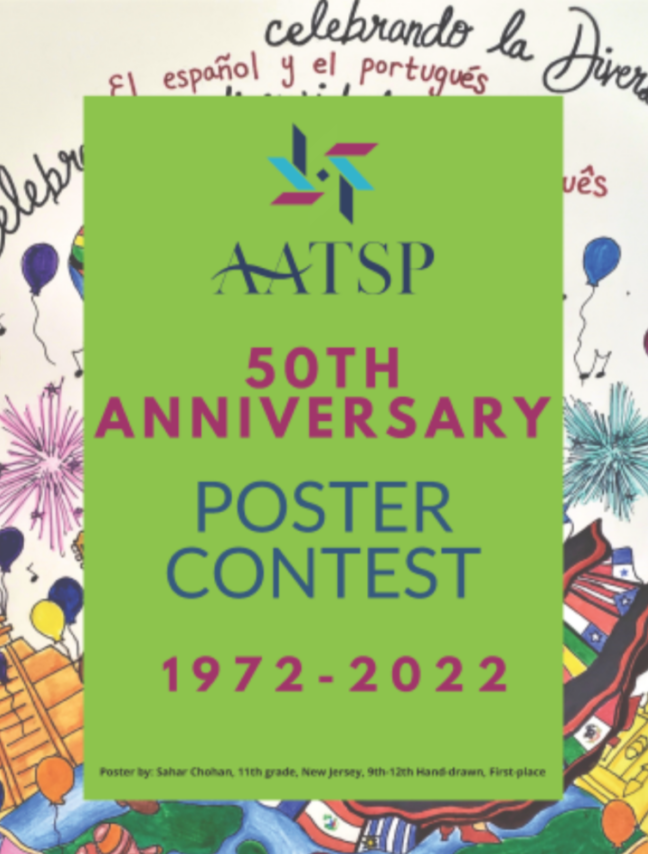
4 Cs and More with the AATSP Poster Contest

by Vicky Masson

Interdisciplinary Connections” is a column of Language Teaching Lab to show specific examples of connections between world language teaching and other subjects at school

What is the AATSP Poster Contest?

The AATSP Poster Contest is an art contest sponsored by the American Association of Teachers of Spanish and Portuguese. It is open to K-12 Spanish and Portuguese students whose teachers are current AATSP members.

https://www.aatsp.org/page/postercontest

I already participate in AATSP Sociedad Hispánica de Amistad. SHA is a society for Pre-K through 8th grade students of Spanish or Portuguese and it encourages young students to study languages as well as promoting ambassadorship, service to community, and service to school. I was excited to also participate in the AATSP Poster Contest 2022.

AATSP Poster Contest 2022 Theme

The theme for this year’s poster contest struck me the moment I read it. It is “Valorando nuestras raíces y construyendo nuestro futuro” (Valuing our roots and building our future). Maybe what struck me the most was the present implication in the balance between past and future, moreover in the uncertain times that we live in.

Why did I choose to do it this year?

Apart from loving the theme for the year “Valuing our roots and building our future”, 2022 is a big anniversary for the AATSP Poster Contest – it’s its 50th anniversary!

I chose to have my students participate this year because the poster contest: 

  • Encourages cross-curriculum collaboration (social studies, art, Spanish, and technology)
  • Verbalizes appreciation for other languages and cultures
  • Promotes creative thinking

AATSP website suggests some other reasons to have our students participate in the contest. 

The message aligns with the message to the school community from the head of school where I work. He constantly talks about creativity, critical thinking, communication, collaboration, and perseverance as essential skills to develop in education. I think that all these skills are present when creating the poster and when preparing for the presentational speaking and writing about it we do in class.

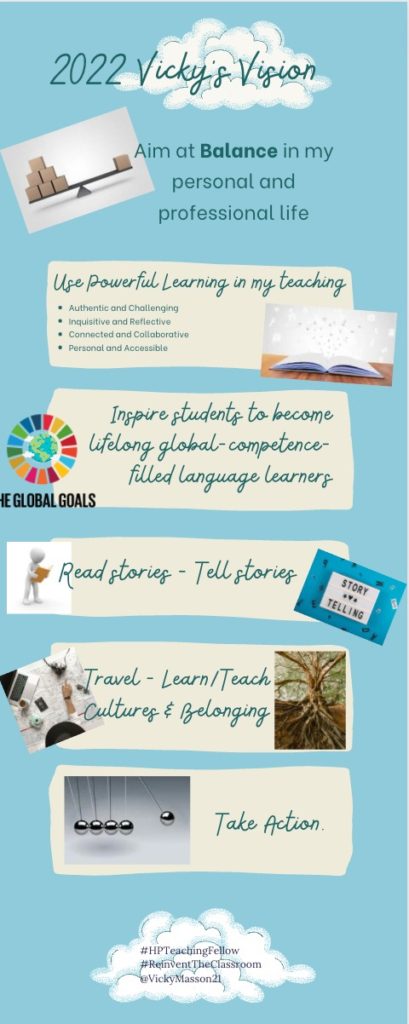
Another reason why I chose to have my students participate in the AATSP Poster Contest was to help achieve my goal of including #Powerful Learning principles in my teaching. This project includes the principles of personal and accessible to all students as each student brought their own experiences and abilities to the table. It is authentic and challenging as it is a contest where students of all the United States could participate. It motivates my students “to persist in overcoming learning challenges.”

This project is also collaborative as in many instances, students have to share their progress with each other in my class. Many students reported that listening to others’ ideas prompted new insights into their own learning and for their own project. Students also reflect on their learning at the end of the project as well.

As part of the #ReinventTheClassroom and HP Teaching Fellowship, I created my 2022 Vicky’s Vision Board. Having my students participate in the AATSP Poster Contest aligns with my vision. 

How did I do it?

My students knew from day one that the art teachers at school would help with the selection of the three posters from 5th grade, for the 4th and 5th grade category, and the three from 6th grade, for the 6th to 8th grade category. They knew that I would assess their ability to describe their posters orally and in writing.

Students would draw their pictures at home and we would describe them at school. For two weeks they were to draw 10 minutes each night and document their journey with a few photos that they would insert in ClassNote, part of our Learning Management System.

In class, students brainstormed words and phrases for the theme. They also explained what the words and phrases represented. For ‘valuing’ they mentioned words such as, life, family, culture, sports, graduation, and other things that were important to them. They mentioned trees, soil, nature, as well as flags, culture, music, food, religion to represent ‘our roots.’ It was harder for them to come up with symbols for the word ‘building’ that did not include cranes, puzzles, and bricks.

The words ‘our future’ prompted tons of futuristic ideas and topics. They included space, planets, flying cars, UFOs, spaceships. Students also included portals and doors. The greatest challenge for them was to think from a hispanic/latino point of view and consider that lens in their drawings. The project helped them grow in their understanding of  ACTFL Standards of Communication, Comparison, Connections, Communities and Culture as well as the Investigate Proficiency Benchmark on Intercultural Communications.

After unpacking the meaning of the theme and ways in which they could represent it through drawing, students immersed themselves into how to describe the drawing in Spanish, orally and in writing. That is where language structures and vocabulary emerged. The need to express ideas helped pinpoint important and necessary sentence starters such as, 

  • The drawing is about…
  • There is/ are … in the poster
  • The … is + color because
  • To the right / To the left / In the background / On the front
  • The … represents…

Students also used beginning sentences that they had learnt in previous units, such as,

  • I like / I love 
  • In my opinion / To me
  • My drawing has 
  • … person … has / is / wants to / prefers …

This project gave me the opportunity to introduce students to topic and conclusion sentences. We brainstormed them as a class and we came up with a few examples of each. Students could possibly memorize and use them in their presentational assessments. Many students included at least a short and brief statement at the beginning and at the end of their speaking and writing. I am proud of students’ progress and language development that occurred during this project. 

The collaborative piece in their daily interactions helped them become more confident in their language skills. They would describe orally their poster to a friend or they would read what they had written in small groups. Students knew, though, from the start that they would only be able to use their drawings in their presentational speaking and in their presentational writing. When it came the time they had to speak and write about their drawing without any other support than the drawing, for the most part, they were ready. The project would not have been complete without reflecting about it. 

Students’ Reflection Questions and Answers

Students had to answer a few questions in English about their experience. I inserted some of their answers to the questions provided below. 

What are you proud of? What went well for you? 

  • I am proud of my presentational writing because it went well for me.​
  • I learnt that I am capable of writing paragraphs in Spanish.
  • I am proud that after hours of working hard, I finally pulled off a very good drawing for the contest. I think something that went well for me was how I had some good ideas from the beginning, and I expanded it into one good drawing. 
  • I think the Poster Contest was a fun assignment because I got to learn more about Spanish while I had fun drawing the poster and making creative ways to represent the themes in my poster. 
  • I think that I am proud of the work that I put into this project and that all though I am not necessarily the best artist I like how my poster turned out.
  • I’m proud of my word choices, I took risks with words and overall I think I did well. I think I was good at describing my thinking.​
  • I think that the poster contest went well, because I could write/speak about my poster with some amount of fluency.
  • I am proud of how I made my poster and how I could explain it with a basic level of fluency. 
  • I think that what went well for me was being able to apply the theme to what I was drawing on my poster. 

What was challenging? Making of the poster? Describing your poster in speaking? Describing your poster in writing?  

  • Describing my poster in writing was really hard and challenging because sometimes you didn’t know how to say something and you had to improvise.​
  • It was challenging thinking of an idea and how to add onto it. 
  • What was challenging for me was making the poster because some of the little details were hard​
  • I think it was hard speaking all about the drawing, but it got easier as I did it more.
  • Overall, I think I did a good job on my writing. I think I could have improved on my speaking, but I tried my best.
  • I think that one thing challenging was how we had to draw based off of a theme, and I had to think for some time on what I was going to draw.
  • It was challenging making an idea for the drawing/design of the poster related to the title.​

What did you learn about yourself? 

  • I learned something spiritual I’m not sure how, but I felt different when I was drawing
  • I learned that I had a lot of fun with drawing projects and want to do some in the future.​
  • I think one thing I learned about myself is that even if you are a bad drawer, with some effort you can have an amazing drawing.
  • I learned that if I study enough, I can talk and write about something I drew.​
  • I think I need to trust myself more because I make the right decision more often than not. 
  • I learned about myself that if I rest after writing and then reread [my writing] it will help​
  • I think I can explain my ideas better

Has this project in any way transformed the way you see the world? How?

  • This project showed me that there are many ways to make a difference no matter your race, no matter your gender, no matter how other people look at you.
  • I see all the roots and future that Americans and Spanish have.
  • Yes, this project has transformed I see the world because now I see how the roots and future of Spanish and Portuguese can come together.​
  • This project made me realize how the world can change in many ways.
  • It has changed my perspective on other people’s posters getting inspired and seeing new ideas
  • This project did transform the way I see the world. I used to not really think about my roots or my future, but now I realize that they’re more important than they sound. The future is still unknown, but it’s still important to think about it.
  • I think this project has transformed how I see the world because looking at my picture I see the Spanish culture and the lively and happy future ahead.
  • It helps me see the world in the past and then in the future.
  • It has by when looking at buildings I can see my future and when I look at a tree, I can see my family’s roots.​
  • This project has made me proud of where I come from and made me value my family more.​
  • Because I know that every [person] must work together to construct our future

I am happy to have asked my students to participate in the AATSP Poster Contest. As an added benefit, it helped me get to know my students better.

Resources

Digital Promise Powerful Learning

-AATSP Poster Contest

-#ReinventTheClassroom Vision Board

-Proficiency Benchmarks

Plan: AATSP Poster Contest 2022

VideoAsk: Get Almost Face-to-Face Interpersonal Speaking with Video

by Vicky Masson

“EdTech” is a column of Language Teaching Lab where we highlight the use of educational technology in the world language class

What is VideoAsk?

VideoAsk allows you to build stronger relationships with students by getting a personal almost face-to-face response from them. A wonderful way of capturing all your students’ thoughts and ideas at once, in video! Start video asking with your students right away. 

Why is it essential for language teaching and learning?

The VideoAsk widget lets you get a personal almost face-to-face response from students on day one and keep on building it. With VideoAsk you welcome students every day, every week, or every semester. It allows you to start an authentic dialogue with each student and add a more personal touch to any assignment. It engages your students with its welcoming and easy to use interface. Students get to know YOU better as well. 

Best of all, students do not need an account to answer your questions or give you feedback. In one click, they respond to your video and you get their answers by video, audio, or in writing. You decide. As an added value, you can organize the answers in different folders, name the folder and the video response and much more.

How could VideoAsk be used in a language class?

There are many ways that you can use VideoAsk in a language class. The following are some ideas to get you started.

  • Respond to questions and ask questions, building connections from day one, even before your course starts
  • Use interactive video to communicate with your students in a personalized way. It’s almost like you’re face-to-face
  • Record your questions and share them with students so that they receive them on their own devices.
  • Evaluate students’ responses and track their progress.
  • Customize to only accept video, audio or text as an answer to your questions. You can also add a multiple choice option
  • Embed your VideoAsk on any web page and bring more life to your assignments
  • Connect VideoAsk to many apps you are already using 
  • Use VideoAsk in your own language with Multi-language support
  • Download your students’ videos and have them include them in their portfolios
  • Choose which steps go to which student. VideoAsk allows branching
  • Show students different follow-up videos based on their answers
  • Reply to your students from the VideoAsk inbox
  • Personalize instruction! Convert into text all video/audio recordings to find key points

If you want to have an almost face-to-face interpersonal speaking with your students, try VideoAsk. Connect, build relationships and trust!