My Favorite GEM of ALL: Storybook!

storybook

by Noemí Rodríguez Grimshaw (LTL Contributor)

We know from research and classroom experience that language is acquired through meaningful, comprehensible input. I know I am not alone when I share that language educators are constantly looking for ways to make input more comprehensible, more personalized, and more engaging. When used thoughtfully, Storybook Gem can support comprehensible input, storytelling, literacy development, and creative output in so many powerful ways.

Let’s break down using Gemini’s Storybook Gem

First, you’ll need access to Gemini by Google. Many schools are adopting Gemini as their preferred Large Language Model, especially if you are using Google for Education. If that’s the case, you’ve probably already noticed little bits of generative AI sprinkled into your email replies, slide decks, and spreadsheets.

Once opening Google Gemini, you should see a Gems icon on the left hand side of your screen. When clicking on the Gem icon, there are several pre-made Gems by Google. You are welcome to create your own Gem (same concept as a Custom GPT in ChatGPT) or pursue the options made available by Google. 

Once you locate the Storybook Gem, you will already want to have your text written & ready to be used for the Gem’s storybook creation purposes. I prefer this since I am keeping in mind my novice or intermediate learners – I want the text to feel familiar and use vocabulary and structures they are familiar with. 

If you have used Generative AI to help you write a story, have your own original text, have co-created stories with students or wish to have students create their own text to be used in these storybooks, the possibilities are endless with writing and promoting creativity with the use of this incredible tool! Check out this previous blog post highlighting how to build literacy in the language classroom with more tips and ideas! 

Here is a sample prompt for the Storybook Gem to help guide you: 

Create an illustrated storybook using ONLY the original story provided, DO NOT MAKE ANY CHANGES TO ANY TEXT – KEEP THE STORY TO MATCH WITH WHAT IS PROVIDED ONLY, so the ORIGINAL TEXT here is reflected EXACTLY within the illustrated story with ZERO CHANGES. 

Here is the original text: ________________. 

In the above prompt, where we highlight create an illustrated storybook, you can certain include different styles and elements to make your storybook more engaging for your students.

  • You can include artistic styles such as watercolor illustration, soft pastel children’s book style, bold comic book style, minimalist line art, collage style with mixed media textures, hand-drawn sketch style, digital flat illustration, Pixar-inspired 3D animation style, Studio Ghibli-inspired whimsical style, vintage storybook illustration, realistic portrait style, surrealist dreamlike art, impressionist painting style, folk art style, mural-inspired street art style, paper cut-out style, stop-motion clay animation aesthetic, graphic novel noir style, bright pop art style, and textured oil painting style or
  • fun twists connected to pop culture such as Pixar-style 3D animation, Studio Ghibli whimsical fantasy worlds, Disney classic fairytale illustration, Marvel or DC comic book panels with bold action frames, anime or manga style with expressive eyes and dramatic emotion, graphic novel noir style like Batman, Tim Burton-inspired gothic whimsical style, The Simpsons-style cartoon exaggeration, Spider-Verse dynamic comic style with layered textures, LEGO movie-style block animation, Minecraft pixelated block art, Fortnite vibrant digital action style, Taylor Swift music video aesthetic with cinematic color palettes, Billie Eilish moody neon dreamscape style, Wes Anderson symmetrical pastel cinematic style, Barbie-core bright pink pop aesthetic, retro 80s synthwave neon style, vintage 90s Nickelodeon cartoon vibe, graffiti street-art style inspired by urban murals, or K-pop music video inspired bold color fantasy styling

After your very well written prompt is provided to the Storybook Gem, the output will look like a digital book and the Gem can read the story out loud for your students to follow along! When using this tool to create  comprehensible readings for my students, we also do several pre-during and post reading activities – with the intention of repeating and recycling this language often and ultimately, demonstrating their own use of the structures through story retellings. 

Some reading strategies to consider: 

  • Predict the theme.
  • Identify repetition.
  • Retell in pairs.
  • Compare characters.
  • Discuss the message.
  • Connect to larger social themes.
  • Adapt the ending.
  • Create their own version.

Repetition + personalization + creativity = acquisition.

One last great feature is the stories are downloadable as PDF files – so if you wanted to print the teacher or student created stories, you can extend the reading through a gallery walk to read one another’s printed stories, small group sharing by comparing & contrasting their creations,  and showcase their stories with your school community. 

Digital storytelling and digital story creation can serve your classroom community in so many different ways! *A previously recorded workshop on Youtube also highlights the steps to digital storytelling and some helpful ways to get started, if this is your first time! 

Storybook Gem within Gemini gives language teachers something powerful: The ability to generate meaningful, illustrated, personalized stories in minutes. It’s about stories. We all have stories to tell. And with Storybook Gem, those stories come to life — beautifully, creatively, and accessible — for both you and your language learners. ✨ And that might just be my favorite GEM of all.
The Power of “No” as Language Educators: Reclaiming Joy through Boundaries

no

by Noemí Rodríguez (LTL Contributor)

As a Spanish language educator and supervisor, small business owner, and mother to an active toddler, I often feel like I’m living three very full lives at once. I move from school meetings to connection calls to wiping cream cheese off very tiny fingers—all before lunch. And while I do enjoy each hat I wear, I’ve learned that I can’t show up fully in any of them unless I set one powerful boundary: I choose to say “no”.

No” has become a valuable word for me but it hasn’t always been easy. As educators and caretakers—it sometimes feels easier to say “yes” to avoid the guilt of saying no. Yes to helping a fellow language educator. Yes to taking on an extra workshop at that conference. Yes to a last-minute invitation knowing you just don’t have the time or energy.  When yes becomes a default word, as it sometimes was for me, we can sometimes lose ourselves and a cycle of exhaustion and over commitment begins.

Saying no has become an act of mindfulness. It’s a pause, a breath, a moment of clarity where I check in with myself and ask: Does this bring me joy? Will this bring me peace? Will this decision leave space for the people and priorities I love the most?

Learning to say no is not selfish—it’s self-preservation. It’s self-awareness. It’s how I’ve created space to enjoy slow mornings with my toddler, to be present in my school, and to invest my limited time and energy into the parts of my business that feel aligned and sustainable.

Boundaries Are Bridges

Too often, we think of boundaries as walls—rigid and isolating. But I’ve come to believe that boundaries are actually bridges. They connect us to what matters most by filtering out what drains us. They protect our peace. They allow us to choose joy over obligation, presence over performance.

When I say no to a weekend obligation that does not bring me joy, I’m saying yes to a Sunday afternoon yoga class. I’m saying yes to watching my toddler giggle on the swings. I am saying yes to spending precious time with family and friends.

Saying no to perfectionism means I get to let go of the pressure to do everything all of the time—whether it’s teaching, parenting, or entrepreneurship. And that’s where the power of no continues to teach me how to set better boundaries.

Mindfulness, Movement, and that Strong Inner Voice

I’ve noticed that my “no” becomes stronger when I listen more carefully—to my breath, to my body, to that wise voice within. Yoga has been one of the greatest gifts in that process. On the mat, I return to myself. I notice where I’m holding tension, where I’m gripping too tightly—physically and metaphorically.

In mindfulness practice, I observe my thoughts without judgment. I catch myself when I begin to spiral into guilt for saying no or fear of disappointing others. I remind myself: These thoughts do not serve you.

Choosing Joy

The “Power of No” is really the power to choose. It’s the power to reclaim time, energy, and attention for the things that light us up. I still get it wrong. I still overbook myself or forget to pause. I am human and I make mistakes. But each time I choose no with intention, I get a little closer to balance—and a lot closer to joy.

I’ve learned that you can’t do it all well and every now and then, you have to check in with yourself and reclaim that time for joy. I invite you to try this simple practice: the next time someone asks something of you, pause. Breathe. Ask yourself, Does this yes come from love or from fear? And know this: every “no” you give sets you up to say “yes” to many other things that better fill your cup with joy. Reframing the word no so it doesn’t indicate rejection but instead it’s a powerful redirection back to yourself.


Language Teaching Lab Community: Take advantage of these two options with LoLogramos!

  • Get a $5 off each month for the AI Innovator Monthly Subscription by using code: ltl5month
  • Get a $5 off of ANY of the online courses, including the latest: Canva, Your One Stop Shop! by using code: team5

Chatbots in Your Classrooms

by Noemí Rodríguez (LTL Contributor)

After several months of highlighting different Generative AI Tools for the language classroom, the most exciting has been using conversational chatbots. The idea that students can practice their language skills in a low-stakes, non-judgmental way, available at any time and personalized to fit their language level is quite revolutionary. AI has the power to enhance our students’ language learning experience and also provide limitless opportunities to practice speaking in the target language.

As with any AI tool, educators must design prompts that are specific to the task and adhere to the intended learning outcome. Within your prompt design, it is important to share who the chatbot IS, the language students are learning, language proficiency targets and specific key phrases/vocabulary you would like the chatbot to use. You can also set up your chat bot to be engaging, kind, funny, creative, etc. For example, with your novice learners, tell the chatbot to limit the questions and responses to a certain number of words for a student who is learning another language, repeat & recycle high frequency vocabulary and be supportive & helpful in the replies provided.

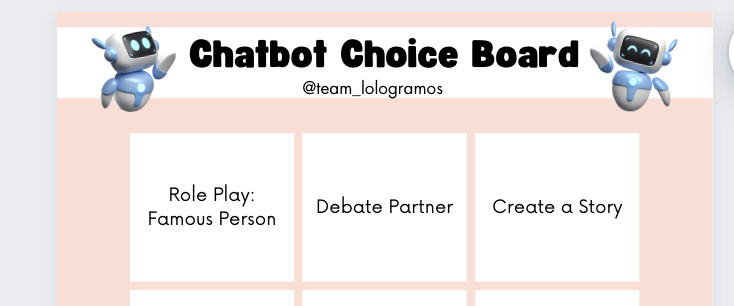
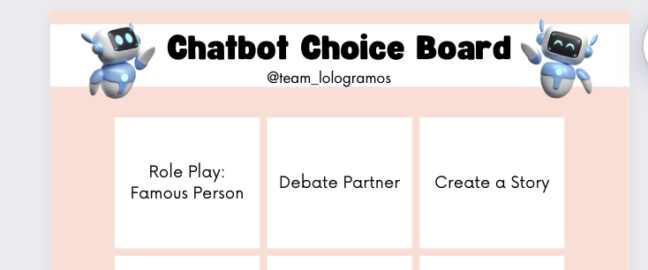
In what ways can our students practice their language learning? Here are a few scenarios, prompts and a Chatbot Choice Board for you to copy and share with your language colleagues (or students!).

Chatbot Uses & Sample Prompts

Language Tutor – Consider designing a tutor for your students to practice their conversational skills or be provided with direct feedback given your language class, level and current unit of study.

Sample Prompt – You are a friendly Spanish tutor, ‘Srta Bot’. Engage the student in a simple dialogue in Spanish and discuss what the student is like, characteristics about themselves, family members, basic greetings, foods, preferences in activities, clothing items and weather conditions. Limit your questions and responses to simplistic, no more than 30 words. Repeat and recycle frequently used vocabulary in Spanish. Be funny and engaging. 

Role Play – A chatbot can be anyone….no, really….ANYONE! Who would your students like to speak in the target language with? Anyone from the past, present or even future can “come to life” as an interactive chatbot. Or how about a particular professional to interact with like a nutritionist, an astronaut or a climate change activist? You can also transform your chatbots into animals – imagine what your dog may say to you if they could?

Sample Prompt – You are Greta Thunberg, climate activist, engaging in a discussion about the Amazon rainforest’s climate crisis with a novice French learner / student. Use simple sentences and questions to discuss the climate change effects on the rainforest and its inhabitants. Repeat and recycle cognates from the Spanish language related to the Amazon rainforest such as desforestation, climate change, animals.

Debate Partner – Having students engage in a lively discussion about a topic that is relevant to your unit of study can be exciting and the chatbot can point out some important points that students may have not considered before!

Sample Prompt – You are engaged in a debate about education. You will play the part of a debater who supports the opinion: not everyone should have access to public education. The student, who is learning Spanish, will play the part of a debater who supports the opposite opinion: everyone should have access to education regardless of age or gender. State your opinion and ask simple follow up questions, limit your questions and answers to an A2 or Novice High proficiency level.

Design A Story! – Students can work one on one with a chatbot to come up with a story together! A creative way for language learners to design a story about any topic of study, create an engaging story for an intended audience and consider questions as well – to design their own adventure within a story!

Sample Prompt – You are co-writing a narrative story with a student who is learning the Spanish language and has an A1 or Novice Mid proficiency level. The story involves three to four characters, a plot, conflict, rising and falling action and a conclusion that resolves the conflict. Be creative and original in storytelling. Provide helpful feedback to help correct grammar and/or spelling mistakes.

Assessment Prep/AP Lang Practice – Before an upcoming performance assessment, design a chatbot to serve as a conversational buddy to review essential questions and unit performance objectives.

Sample Prompt – You are a teacher of Spanish who is assisting a student practice their language skills before an upcoming integrated performance assessment. You review the following essential questions by engaging in a dialogue to help the student practice respond and share their thoughts about: What makes up a balanced lifestyle? How do you define wellness in your community? What routines, habits and foods contribute to healthy living? Be sure to keep the conversation all about a balanced lifestyle and how we maintain wellness in our daily lives. Repeat and recycle key vocabulary that involve cognates from the Spanish language. Be supportive and provide feedback related to the student’s use of grammar and spelling when appropriate.

With these different chatbot uses in mind, there are two current platforms that I have used which allow language teachers to generate these bots for students and they do not require any identifiable personal information from the student, such as emails or full names. The student is an anonymous participant but perhaps uses their initials only or an assigned numerical code, so the teacher can later review the conversation on their end once completed.

Chatbot Design Platforms & Resources

Mizou – It allows teachers to design their own chatbots, search within a community of available chatbots, set their own to “public” or “private” and students are provided with a link to access the session, once the teacher has made it “live”. You can view tutorials on their site.

SchoolAI – This AI tool has MANY capabilities, as they are considered an “all-in-one” platform for educators. The site has “spaces” available for teachers to set up for students to practice their language skills.

*For both of the above tools and many others, I have created and shared simple five minute or less tutorial videos on the Lo Logramos Youtube Channel, be sure to subscribe to stay connected to future AI Tools tutorial videos for language educators & language instruction!

*To learn more about how to transform your language classroom with AI, you can check out my newly launched asynchronous course: The AI Tools Institute for Language Classrooms to assist language teachers of any language! A seven session journey with guiding slideshows, resources, guides, helpful reflective questions and many videos, all in one space!

Chatbot Choice Board

To receive your own copy of the handy Chatbot Choice Board, please head over to the private Team Lo Logramos Facebook Community. There you will be able to request to join our community and later, access the Chatbot Choice Board for use in your language department or with your language students!

Thank you for reading! I hope that you keep experimenting, sharing and learning about how Generative AI can help transform your language classroom and your students’ language learning experience! I do hope we stay connected and feel free to reach out with any questions, wonderings or comments! @team_lologramos


LoLogramos – Get a $5 off discount when you use the code LTL5 at checkout, exceptions may apply