Teaching Bilingual Learners: What Neuroscience Confirms from the Classroom

bilingual

by Maria Martinez (LTL Contributor)

Teaching Bilingual Learners: What Neuroscience Confirms from the Classroom

For more than twenty years, I have worked with bilingual learners across different countries, education systems, and age groups — from children growing up with two languages at home to GCSE and A-Level students preparing for high-stakes exams. One concern comes up repeatedly, especially from families and sometimes even from teachers: “Is my child confusing their languages?”

What neuroscience now confirms is something I have observed consistently throughout my teaching career: bilingual learners are not confused. Their brains are doing something far more complex.

Research shows that in bilingual individuals, both languages remain active in the brain, even when only one is being used. Switching between languages, translating, or occasionally mixing them is therefore not a sign of weakness, but of cognitive flexibility. In my classrooms and online teaching, I have seen again and again that students who are allowed to process meaning bilingually develop deeper understanding and stronger long-term retention.

Bilingual Cerebros grew directly out of this reality. The resources, videos, and materials I create are designed to work with the bilingual brain, not against it. Side-by-side texts, bilingual explanations, and clear structural models reflect how bilingual learners actually process language. Neuroscience supports this approach: understanding comes before accuracy, and emotional safety plays a crucial role in learning and memory.

Practical implications for teachers, parents, and students

Understanding how the bilingual brain works should change the way we support learners in very practical ways.

For teachers, this means allowing space for bilingual processing. Translation, comparison between languages, and discussion of meaning should be part of learning — not something to be avoided. Clear structures, repeated language patterns, and familiar frameworks reduce cognitive load and allow students to focus on analysis and expression.

For parents, it is important to know that correcting every mistake or discouraging language mixing can increase anxiety rather than progress. Encouraging communication, meaning, and confidence — even when both languages appear — supports long-term development. Progress in bilingualism is rarely linear, and moments of mixing are often signs of growth, not regression.

For students, struggling does not mean you are failing. It often means your brain is managing two linguistic systems at once. Using both languages strategically — to plan ideas, clarify meaning, or revise key vocabulary — is not a weakness, but a learning tool. Confidence comes first; precision follows.

Neuroscience and Teaching

Neuroscience does not replace good teaching — it explains why good teaching works. Long before research caught up, bilingual learners were already showing resilience, adaptability, and creativity through language. My role as a teacher has always been to support that process with clarity, structure, and reassurance — and that continues to be at the heart of Bilingual Cerebros.

Bilingual Cerebros Resources

If you would like to explore these ideas in a practical way, you’re very welcome to visit the new sections on Bilingual Cerebros, where I’ve recently added dedicated areas for GCSE and A-Level Spanish, including novels, films, essay guidance, and model answers — all designed to support learners step by step. You’ll also find bilingual stories and resources created to build confidence, understanding, and a positive relationship with language learning.

And remember, if you ever need the PDF resources mentioned in my videos or posts, you’re always welcome to email me at bilingualcerebros@gmail.com. I’m always happy to help.

La enseñanza bilingüe: lo que la neurociencia confirma desde la práctica docente

Durante más de veinte años he trabajado con alumnado bilingüe en distintos países, sistemas educativos y etapas — desde niños que crecen con dos lenguas en casa hasta estudiantes de GCSE y A-Level que se preparan para exámenes de alta exigencia. Hay una preocupación que aparece una y otra vez, especialmente entre las familias y, en ocasiones, también entre docentes: «¿Mi hijo se está confundiendo con los idiomas?»

Lo que hoy confirma la neurociencia es algo que he observado de forma constante a lo largo de toda mi trayectoria docente: los alumnos bilingües no están confundidos. Sus cerebros están haciendo algo mucho más complejo.

Las investigaciones muestran que, en las personas bilingües, ambas lenguas permanecen activas en el cerebro, incluso cuando solo se está utilizando una. Por eso, cambiar de idioma, traducir o mezclar lenguas ocasionalmente no es un signo de debilidad, sino de flexibilidad cognitiva. En mis clases presenciales y online he comprobado una y otra vez que los estudiantes a los que se les permite procesar el significado de forma bilingüe desarrollan una comprensión más profunda y una retención a largo plazo mucho más sólida.

Bilingual Cerebros nace directamente de esta realidad. Los recursos, vídeos y materiales que creo están diseñados para trabajar con el cerebro bilingüe, no en contra de él. Textos en paralelo, explicaciones bilingües y modelos estructurales claros reflejan cómo procesan realmente el lenguaje los aprendices bilingües. La neurociencia respalda este enfoque: la comprensión va antes que la corrección, y la seguridad emocional desempeña un papel clave en el aprendizaje y la memoria.

Implicaciones prácticas para docentes, familias y estudiantes

Comprender cómo funciona el cerebro bilingüe debería cambiar la manera en que apoyamos a los alumnos, también en aspectos muy concretos.

Para los docentes, esto implica dejar espacio al procesamiento bilingüe. La traducción, la comparación entre lenguas y la reflexión sobre el significado deberían formar parte del aprendizaje, no ser algo que se evite. Las estructuras claras, los patrones lingüísticos repetidos y los marcos familiares reducen la carga cognitiva y permiten que el alumnado se concentre en el análisis y la expresión.

Para las familias, es importante saber que corregir cada error o desanimar la mezcla de lenguas puede generar ansiedad en lugar de progreso. Fomentar la comunicación, el significado y la confianza — incluso cuando aparecen ambos idiomas — favorece el desarrollo a largo plazo. El progreso en el bilingüismo rara vez es lineal, y los momentos de mezcla suelen ser señales de avance, no de retroceso.

Para los estudiantes, tener dificultades no significa que estén fallando. A menudo significa que su cerebro está gestionando dos sistemas lingüísticos al mismo tiempo. Utilizar ambas lenguas de forma estratégica — para organizar ideas, aclarar significados o repasar vocabulario clave — no es una debilidad, sino una herramienta de aprendizaje. La confianza llega primero; la precisión viene después.

La neurociencia y la enseñanza

La neurociencia no sustituye a una buena enseñanza: explica por qué la buena enseñanza funciona. Mucho antes de que la investigación lo demostrara, los alumnos bilingües ya mostraban resiliencia, adaptabilidad y creatividad a través del lenguaje. Mi papel como docente siempre ha sido acompañar ese proceso con claridad, estructura y tranquilidad — y eso sigue siendo el núcleo de Bilingual Cerebros.

Recursos de Bilingual Cerebros

Si te apetece explorar estas ideas de forma práctica, te invito a visitar las nuevas secciones de Bilingual Cerebros, donde recientemente he añadido áreas específicas para GCSE y A-Level de Español, con novelas, películas, orientación para ensayos y modelos de respuesta, todo diseñado para apoyar al alumnado paso a paso. También encontrarás historias y recursos bilingües creados para reforzar la confianza, la comprensión y una relación positiva con el aprendizaje de idiomas.

Y recuerda: si en algún momento necesitas los PDF mencionados en mis vídeos o publicaciones, siempre puedes escribirme a bilingualcerebros@gmail.com. Estaré encantada de ayudarte.
Social Emotional & Mindfulness Bilingual Resources for Kids: Supporting Language Learning with Calm, Confidence, and Connection

mindfulness

by Sabrina Sanchez (LTL Contributor)

Education is most effective when children feel emotionally supported. By combining social emotional learning, mindfulness, calm routines, and practical communication in English and Spanish, families and educators can help children grow into confident, capable learners.

As a bilingual educator and children’s author, my motto is Bilingual Education with Heart. This means honoring children’s emotional well-being while supporting real, practical communication in English and Spanish through calm videos, fun activities, and bilingual books.

Our content focuses on:

  • Practical communication in English and Spanish
  • Social emotional learning, including feelings, empathy, and self- regulation
  • Life skills, routines, healthy habits, and confidence
  • Environmental awareness and care for the world
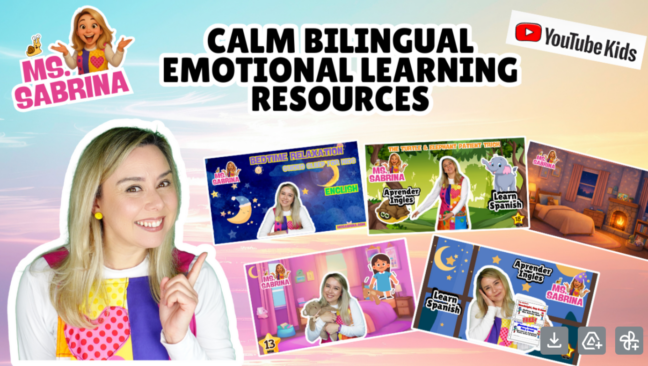
    This month, Ms. Sabrina’s Bilingual Playtime surpassed 500,000 views on YouTube and is now available on YouTube Kids, showing that families around the world are choosing calm, low stimulation, heart centered, inclusion based bilingual learning for their children.
  • To support children’s emotional well-being, I created a special YouTube playlist called Mindfulness Moments with Ms. Sabrina: SEL & Calm Routines:

This bilingual playlist includes:

  • The Turtle & Elephant Patience Trick for frustration and self-regulation
  • Positive affirmations for building confidence
  • Videos on bedtime routines and helping children feel safe at night
  • Tools for when children feel scared
  • Three guided meditations (one in English and two in Spanish, including versions for girls and boys)
  • A bedtime routine book and routine chart
  • A children’s bedtime fireplace video with one hour of calm relaxing music

I hope families enjoy these resources as much as I enjoyed creating them.
All free printable PDFs connected to the videos are available at MsSabrina.com.


Recursos Bilingües de Aprendizaje Socioemocional y Mindfulness para Niños:
Apoyando el Aprendizaje de Idiomas con Calma, Confianza y Conexión

La educación es más efectiva cuando los niños se sienten emocionalmente acompañados y seguros. Al combinar el aprendizaje socioemocional, el mindfulness, las rutinas tranquilas y la comunicación práctica en inglés y español, las familias y educadores pueden ayudar a los niños a crecer seguros y capaces.

Como educadora bilingüe y autora infantil, mi lema es Educación Bilingüe con el
Corazón por Delante.
Esto significa cuidar el bienestar emocional de los niños mientras se fomenta una comunicación real y práctica en inglés y español a través de videos tranquilos, actividades divertidas y libros bilingües.

Nuestro contenido se centra en:

  • Comunicación práctica en inglés y español
  • Aprendizaje socioemocional, incluyendo emociones, empatía y autorregulación
  • Habilidades para la vida, rutinas, hábitos saludables y confianza
  • Conciencia ambiental y cuidado del mundo
    Este mes, Ms. Sabrina’s Bilingual Playtime superó las 500.000 visualizaciones en YouTube y ahora está disponible en YouTube Kids, lo que demuestra que familias de todo el mundo están eligiendo un aprendizaje bilingüe tranquilo, de baja estimulación, centrado en el corazón e inclusivo para sus hijos.
  • Para apoyar el bienestar emocional de los niños, creé una playlist especial en YouTube llamada Mindfulness Moments with Ms. Sabrina: SEL & Calm Routines:

Esta playlist bilingüe incluye:

  • El Truco de la Tortuga y el Elefante para la frustración y la autorregulación
  • Afirmaciones positivas para fortalecer la confianza
  • Videos sobre rutinas de sueño y cómo ayudar a los niños a sentirse seguros por la noche
  • Herramientas para cuando los niños sienten miedo
  • Tres meditaciones guiadas (una en inglés y dos en español, incluyendo versiones para niñas y niños)
  • Un libro de rutina para dormir y una tabla de rutinas
  • Un video de chimenea para niños con una hora de música relajante y calmante

Espero que las familias disfruten estos recursos tanto como yo disfruté crearlos.

Todos los PDFs imprimibles gratuitos relacionados con los videos están disponibles en
MsSabrina.com.

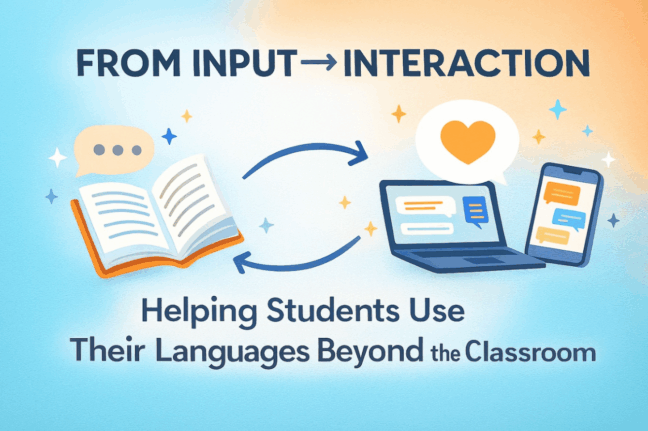
From Input to Interaction: Helping Students Use Their Languages Beyond the Classroom

by María Martínez (LTL Contributor)

As language teachers, we’ve all seen this: Students who can understand so much more than they dare to say.

They follow along in stories, laugh at jokes, and pick up vocabulary from songs and videos… but when it’s time to speak, they freeze. Or they default to their “stronger” language, even when they could already communicate in the target language.

The challenge is not a lack of input, but the need for support in turning listening and reading into authentic communication.

Today, with the rise of AI and global online interaction, this transition matters more than ever. Students need guidance on using languages in real contexts—at home, in their communities, and online.

This reflection is inspired by my recent collaboration and interview with Sabrina Sánchez from Ms Sabrina’s Bilingual Playtime. Our conversation reminded me of the emotional and human side of language learning: identity, belonging, confidence, and connection.

bilingual

Helping Students Move From Passive Input to Active Use

Start With Low-Pressure Interaction

Instead of jumping from listening straight into a full speaking task, build micro-moments of participation:

  • Thumbs-up/down reactions
  • Predict-what-comes-next
  • Simple call-and-response routines

These tiny steps help students feel like active participants long before they produce full sentences.

Use Guided Output Before Free Speech

Small scaffolds create big confidence:

  • Sentence frames
  • “Repeat and add one word”
  • Matching visuals with short phrases

Guided output makes risk-taking less intimidating and builds a natural bridge toward
spontaneous communication.

Give Students a Real Audience

Speaking becomes meaningful when it has a purpose.

Some ideas:

  • Record short audio notes for younger students
  • Teach a topic to a partner class
  • Create bilingual slides to present at home

When communication is purposeful, students shift from “using language for school” to using language for life.

How Families Can Encourage Authentic Use at Home

One of the most beautiful themes in my conversation with Sabrina was how families
can nurture languages gently, without pressure.

Give Each Language a Purpose

Mini rituals make languages come alive:

  • “Buenos días” at breakfast
  • Naming ingredients while cooking
  • Counting down in the target language before starting a video or game

These small habits build a meaningful, emotional connection.

Create Safe Language Zones

Children speak more when they feel safe:

  • “No corrections, just support” during certain times
  • A weekly family language evening
  • Letting children choose the song, game, or video

Safety builds confidence, and confidence builds language.

Make Content a Shared Experience

Instead of: “Watch this for homework.”
Try: “Let’s watch this together—teach me one word!”

Resources from Bilingual Cerebros and Ms Sabrina’s Bilingual Playtime are intentionally designed for shared learning, so children can guide their families, not just follow instructions.

How Bilingual Cerebros Supports the Input → Output Journey

In my own content, I always ask: “How will this help a student use the language with someone else?”

Some ways I design for that:

  • Stories paired with meaningful speaking tasks
  • Bilingual printables that travel between school and home
  • Slides and visuals that invite comparison, retelling, and explaining
  • Activities that promote conversation, not just comprehension

My goal is to help students turn input into interaction—gently, confidently, and joyfully.

A Heart-Warming Reminder From My Conversation With Sabrina

What stayed with me most from talking with Sabrina was not a list of strategies, but the shared belief that:
Every child’s languages are a gift.
Every attempt—imperfect or hesitant—is progress.
Languages grow strongest in relationships, not just in classrooms.

Parents sometimes worry they’re not doing enough. Teachers sometimes wonder if students will ever really use the language outside school. Students often fear mistakes more than lack of understanding.

Our message, together, is simple:

You are doing more than you think.
Connection matters more than perfection.
Every small moment counts.

And when a student uses a phrase at home, online, or with a friend—even if the sentence isn’t perfect—that is the magic of input becoming interaction.

That’s where languages truly come alive.

Want to Dive Deeper? Watch the Full Collaboration with Sabrina Sánchez

If you’d like to hear more practical ideas, heartfelt stories, and advice for parents, teachers, and students, I warmly invite you to watch our full collaboration interview.

We recorded two versions, so you can enjoy it in the language you prefer—or share
it with your students and families:

Both conversations are filled with insights, encouragement, and real-life reflections on raising, teaching, and supporting multilingual learners. We hope they bring you inspiration, reassurance, and a few smiles along the way.

Meet the guests

Let’s keep the conversation going! Share your questions or tips about raisin
bilingual kids in the comments below.


De la Comprensión a la Interacción: Ayudando a los Estudiantes a Usar sus Lenguas Más Allá del Aula

Como docentes de lenguas, todos hemos visto esto: estudiantes que entienden muchísimo más de lo que se atreven a decir.

Siguen las historias, se ríen de los chistes y reconocen vocabulario en canciones y vídeos… pero cuando llega el momento de hablar, se bloquean. O recurren automáticamente a su lengua más fuerte, aunque ya podrían comunicarse en la lengua meta.

El reto no es la falta de input, sino la necesidad de ayudarles a convertir lo que escuchan y leen en comunicación auténtica.

Hoy, con el auge de la IA y la interacción global en línea, esta transición es más importante que nunca. Los estudiantes necesitan orientación para usar las lenguas en contextos reales: en casa, en sus comunidades y en los espacios digitales donde participan.

Esta reflexión surge de mi reciente colaboración y entrevista con Sabrina Sánchez de Ms Sabrina’s Bilingual Playtime. Nuestra conversación me recordó el lado profundamente humano del aprendizaje lingüístico: identidad, pertenencia, confianza y conexión.

Cómo Pasar de Input Pasivo a Uso Activo

Empieza con Interacciones de Baja Presión

En lugar de pasar directamente de escuchar a una tarea de expresión oral completa, crea pequeños momentos de participación:

  • Reacciones con pulgar arriba/abajo
  • Predecir lo que sucederá
  • Pequeñas rutinas de llamada y respuesta
    Estos gestos ayudan al estudiante a sentirse participante, mucho antes de producir
    frases completas.

Utiliza Output Guiado Antes de Habla Libre

Pequeños andamiajes o apoyos linguísticos con modelos pueden generar gran confianza:

    • Oraciones modelo
    • “Repite y añade una palabra”
    • Relacionar imágenes con frases cortas

    El output guiado reduce la ansiedad y crea un puente natural hacia la comunicación espontánea.

    Ofréceles una Audiencia Real

    Hablar cobra sentido cuando hay un propósito. Algunas ideas:

    • Grabar mensajes de audio para estudiantes más pequeños
    • Enseñar un tema a otra clase
    • Crear diapositivas bilingües para presentar en casa

    Cuando la comunicación tiene un destinatario real, los estudiantes pasan de “usar la
    lengua para la escuela” a usar la lengua para la vida.

    Cómo las Familias Pueden Fomentar un Uso Auténtico en Casa

    Uno de los temas más bonitos de mi conversación con Sabrina fue cómo las familias
    pueden nutrir las lenguas de manera suave, sin presión.

    Darle un Propósito a Cada Lengua

    Pequeños rituales hacen que las lenguas cobren vida:

    • “Buenos días” durante el desayuno
    • Nombrar ingredientes mientras cocinan
    • Contar en la lengua meta antes de empezar un vídeo o un juego
      Estos hábitos generan una conexión emocional significativa.

    Crear Zonas de Lengua Segura

    Los niños hablan más cuando se sienten seguros:

    • “Sin correcciones, solo apoyo” en ciertos momentos
    • Una noche familiar dedicada a la lengua
    • Dejar que ellos elijan la canción, el juego o el vídeo

    La seguridad genera confianza, y la confianza genera lenguaje.

    Convertir el Contenido en una Experiencia Compartida

    En lugar de decir: “Mira esto para los deberes.”
    Prueba: “Veámoslo juntos—¡enséñame una palabra!”

    Los recursos de Bilingual Cerebros y Ms Sabrina’s Bilingual Playtime están diseñados para un aprendizaje compartido, donde los niños pueden guiar a sus familias, no solo seguir instrucciones.

    Cómo Bilingual Cerebros Acompaña el Camino de Input → Output

    Cuando creo contenido, siempre me pregunto: “¿Cómo ayudará esto al estudiante a usar la lengua con otra persona?”
    Algunas maneras en que diseño pensando en esta transición:

    • Historias acompañadas de tareas orales significativas
    • Materiales bilingües que funcionan tanto en casa como en el aula
    • Diapositivas visuales que invitan a comparar, volver a contar y explicar
    • Actividades centradas en la conversación, no solo en la comprensión

    Mi objetivo es ayudar a los estudiantes a convertir el input en interacción—de manera suave, segura y feliz.

    Un Recordatorio de Mi Conversación con Sabrina

    Lo que más me quedó de nuestra charla no fue una lista de estrategias, sino una creencia compartida:
    Las lenguas de cada niño son un regalo.
    Cada intento—imperfecto o dudoso—es progreso.
    Las lenguas crecen más en las relaciones que en los libros.

    Los padres a veces sienten que no hacen lo suficiente.
    Los docentes se preguntan si los estudiantes realmente usarán la lengua fuera del aula.
    Los estudiantes temen cometer errores más que no entender.

    Nuestro mensaje, juntas, es sencillo:
    Estás haciendo más de lo que crees.
    La conexión importa más que la perfección.
    Cada pequeño momento cuenta.

    Y cuando un estudiante usa una frase en casa, en línea, o con un amigo—aunque
    no sea perfecta—ahí es donde sucede la magia del input convirtiéndose en
    interacción.
    Ahí es cuando las lenguas realmente cobran vida.

    ¿Quieres Profundizar? Mira la Colaboración Completa con Sabrina Sánchez

    Si te gustaría escuchar más ideas prácticas, historias sinceras y consejos para
    familias, docentes y estudiantes, te invito a ver nuestra entrevista completa.

    Grabamos dos versiones, para que elijas tu lengua preferida o la compartas con
    tus estudiantes y comunidades:

    Ambas conversaciones están llenas de ideas, ánimo y experiencias reales sobre cómo criar, enseñar y acompañar a aprendices multilingües.
    Esperamos que te inspiren, te reconforten y te hagan sonreir.

    Conoce a las invitadas:

    ¡Sigamos la conversación! Comparte tus preguntas o consejos sobre cómo criar
    niños bilingües en los comentarios.

    Bilingual Book Walks: A Dynamic Tool for Multilingual Learning and Curriculum Enrichment

    book walk

    by Enrique Moras (LTL Affiliate Corner)

    In an era where education thrives on creativity, inclusivity, and hands-on engagement, Bilingual Book Walks are emerging as a powerful resource for schools. These immersive installations transform children’s stories into larger-than-life learning experiences, blending literacy, art, and curriculum-based themes into a single, interactive journey. Let’s dive into how these innovative displays captivate students, support teachers, and unite communities.

    What Exactly are Bilingual Book Walks?

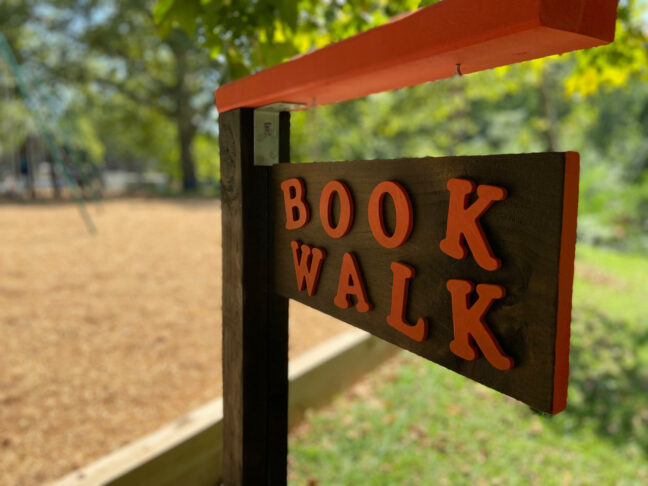
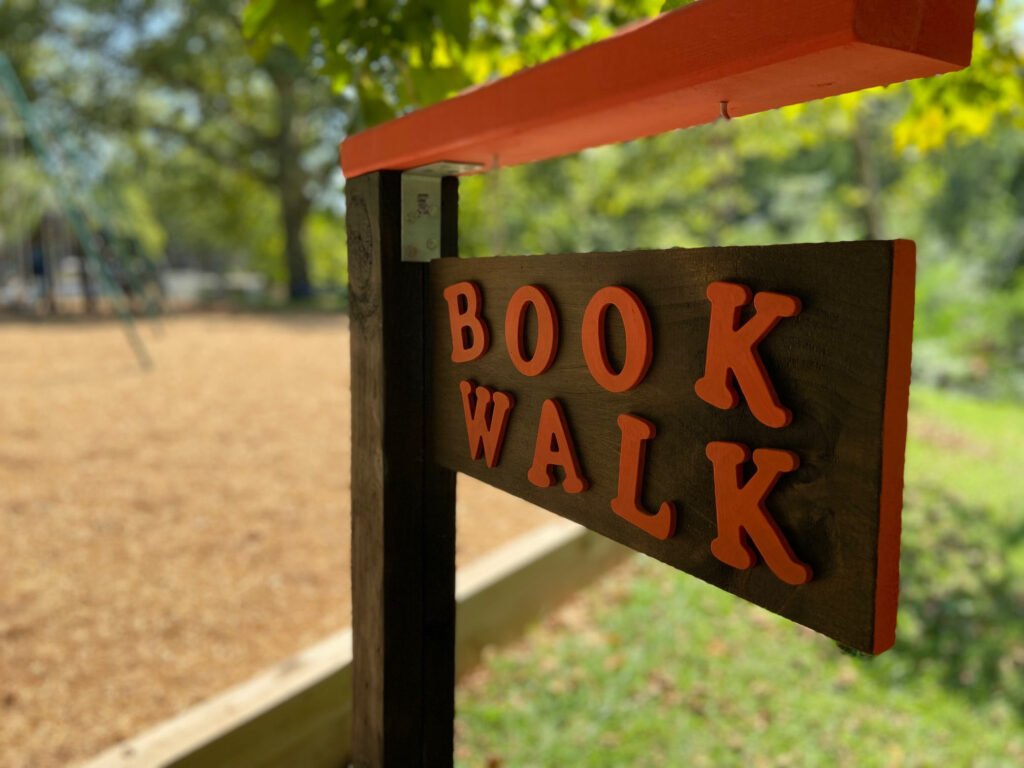
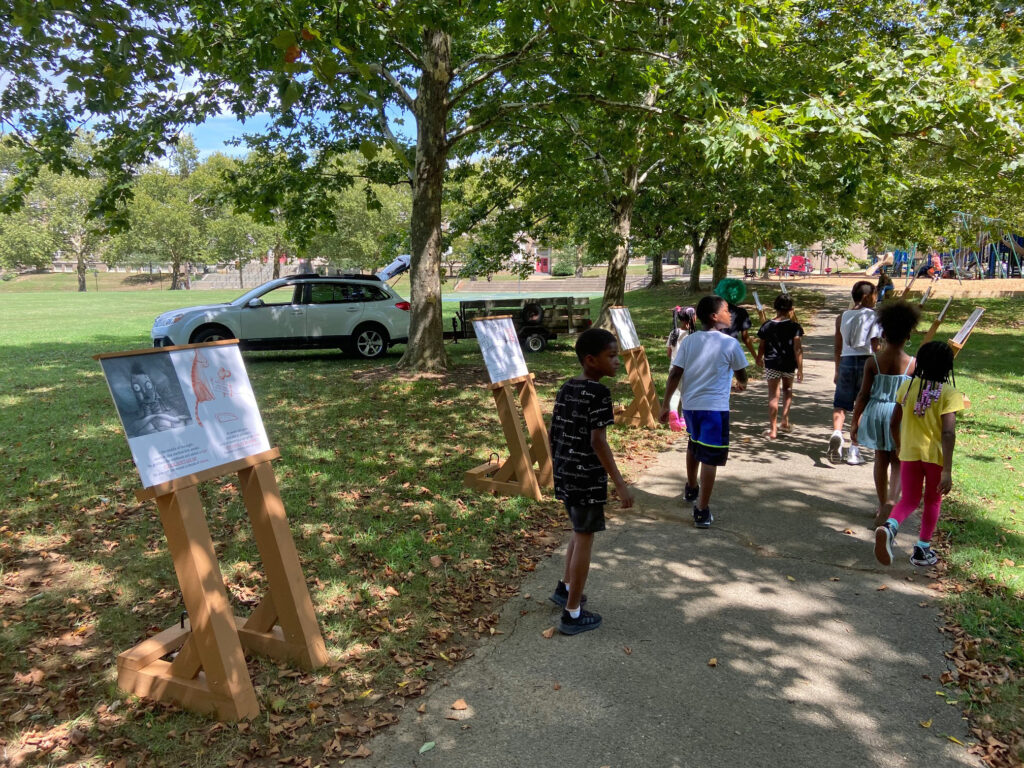
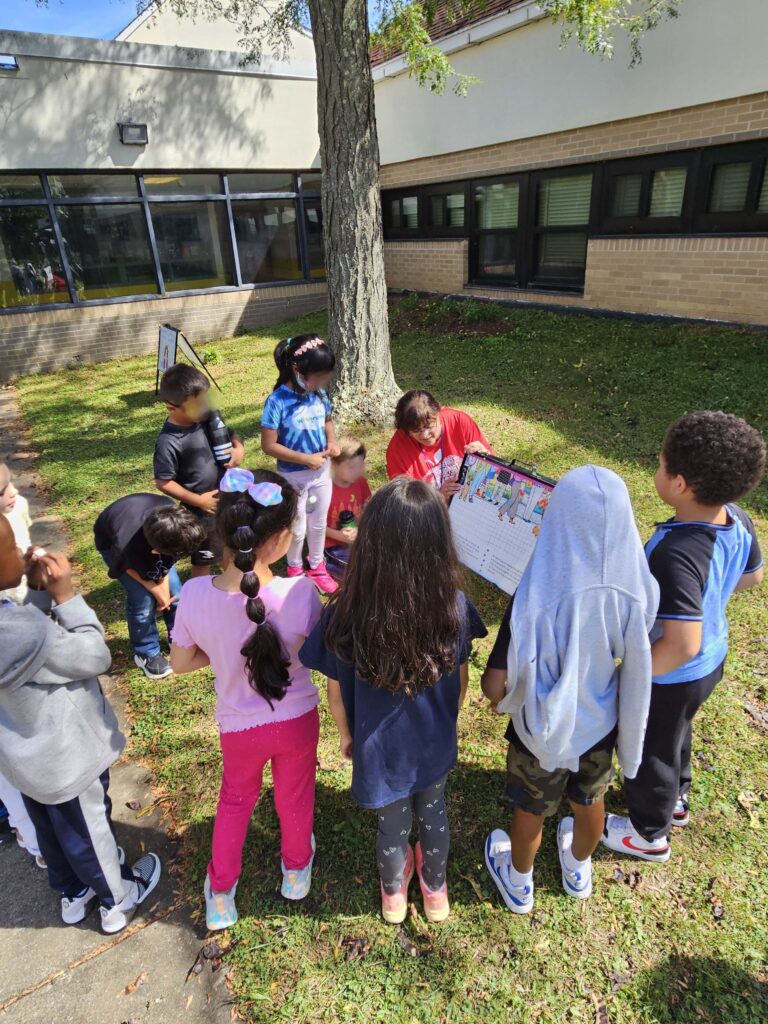
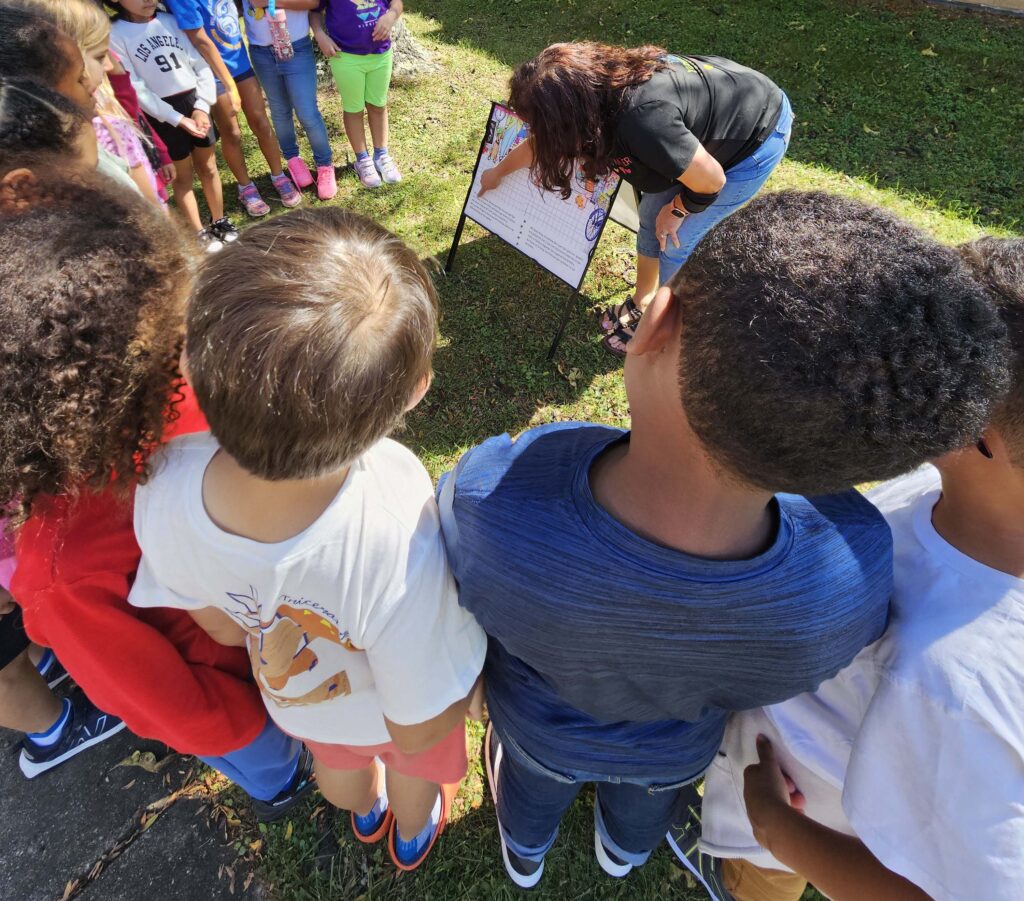
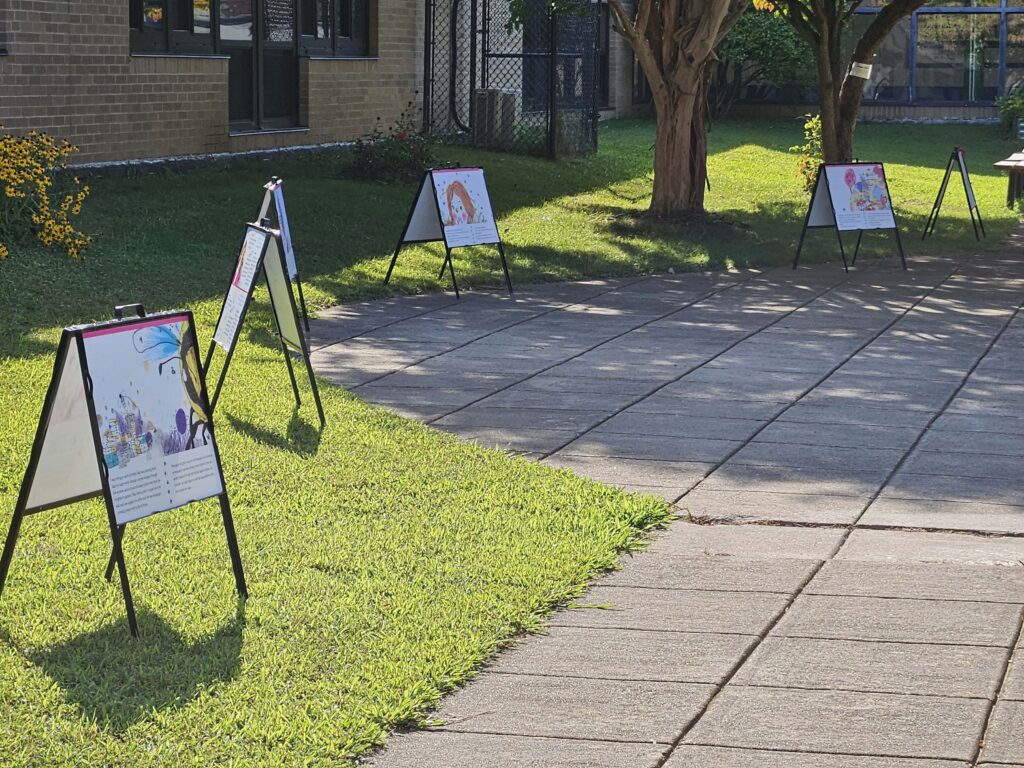
    A Bilingual Book Walk is a curated installation that breaks a children’s book into 16 vibrant panels (each 24”x18”), displayed sequentially on durable wooden or metal stands outdoors or mounted on wall frames indoors. Each panel features:

    • A section of the story in two languages (default: English and Spanish, though they are customizable to any language).
    • Eye-catching illustrations that bring the narrative to life.
    • Optional prompts or questions to spark discussion, critical thinking, or ties to classroom subjects.

    Designed for flexibility, these walks can be set up in school gardens, hallways, libraries, or community spaces, creating a “story trail” that families and students explore together.

    Why Schools Love Bilingual Book Walks

    1. Curriculum Connections Made Easy

    Teachers use Book Walks to reinforce lessons in:

    • Environmental Science: Pair with books about ecosystems or conservation (e.g., bees, habitats, tree ecosystems, recycling, etc.).
    • Social-Emotional Learning (SEL): Choose stories about empathy, resilience, self- awareness, etc.
    • Art & Storytelling: Analyze illustrations or inspire students to create their own bilingual story panels.

    2. Supports Multilingual Learners

    • English Language Learners (ELLs) gain confidence by reading in their native language while practicing English.
    • Native English speakers explore new languages in a low-pressure, visual context.

    3. Engages All Learning Styles

    • Visual learners connect with bold illustrations.
    • Kinesthetic learners thrive while moving between panels.
    • Social learners discuss themes with peers or family.

    4. Fosters Family and Community Involvement

    • Families bond over stories in their home language, breaking down barriers to school engagement.
    • Schools can partner with local artists to design panels or host cultural storytelling events.

    5. Durable and Adaptable

    • Weather-resistant outdoor stands or indoor frames ensure year-round use.
    • Themes and languages rotate to reflect curriculum needs or community diversity.

    Real-World Applications in Schools

    • Science Class: After reading a Book Walk about pollinators, students explore the school garden to spot real-life bees and butterflies.
    • Art Project: Kids create their own bilingual story panels inspired by the walk, displayed in a school-wide exhibit.
    • Family Literacy Night: Parents and children follow the Book Walk together, with teachers providing discussion guides in multiple languages.

    Ready to Launch Your Own Book Walks?

    Bilingual Book Walks are more than just stories—they’re gateways to curiosity, inclusion, and academic growth. Whether you’re highlighting STEM themes, SEL, or cultural heritage, these installations turn school spaces into dynamic, interactive classrooms.

    Next Steps:

    Schedule a meeting with a Book Walk specialist at Syncretic Press. Use the code LTL5% for a 5% discount on a purchase for your school or institution. Agenda items will include:

    • Displays that best adapt to your goals and budget
    • Review purchase and rental options for stories
    • Explore grant opportunities for funding the project

    Transform your school’s corridors, courtyards, and classrooms into bilingual learning adventures. Let’s walk the talk—one panel at a time! 🌟📖🌍