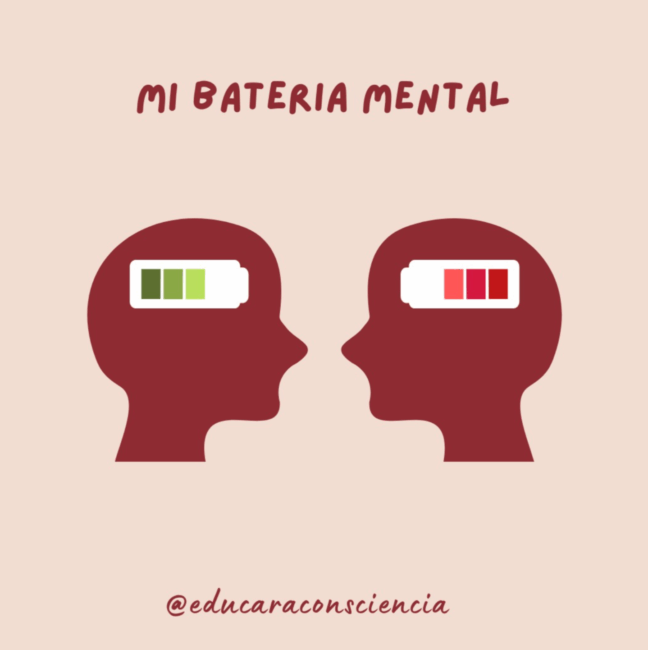
Hay muchos factores que recargan nuestra batería mental… 💛llegar a casa y tomar un cafecito o un mate. 💛un abrazo de tu pareja o un beso de tus hijos. 💛salir un rato con amigas. 💛meditar, caminar, hacer ejercicio. 💛mirar el mar, el lago, o el fuego.
Y también hay otros factores que nos juegan en contra y nos descargan nuestra batería hasta sentirnos que no damos más… 🛑dormir poco 🛑comer mal o apurado 🛑discutir con alguien 🛑manejar un día de mucho tráfico 🛑el estrés
Cómo está tu batería mental hoy?
Lográs recargarla cada día al volver a casa o al arrancar por las mañanas?
Falta poco para las vacaciones de invierno (que espero puedas tomarte unos días!!) y son un buen momento para hacer un alto grande, repensar de manera consciente mi rutina y repartir las cartas para encarar el segundo cuatrimestre del año con energías y baterías renovadas… te parece?
Te hago dos preguntas para que me respondas en comentarios: 1. cómo se te agota tu batería mental? 2. qué hacés para recargarla? Te leo. Te leemos entre todos.
There are many factors that recharge our mental battery… 💛get home and have a coffee or a mate. 💛 a hug from your partner or a kiss from your children. 💛 going out for a while with friends. 💛meditate, walk, exercise. 💛look at the sea, the lake, or the fire.
And there are also other factors that play against us and drain our battery until we feel like we can’t go on… 🛑sleep little 🛑 eating poorly or in a hurry 🛑argue with someone 🛑 handle a day full of traffic 🛑 the stress
How’s your mental battery today?
Will you be able to recharge it every day when you get home or when you get up in the mornings?
Winter break is coming soon (hope you can take a few days off!!) ) and it’s a good time to stop and think, consciously rethink routines and how you are going to face the second quarter of the year with renewed energies and renewed batteries… What do you think?
I ask you two questions that you may want to share the answers in comments: 1. how does your mental battery drain? 2. what do you do to recharge it? I read you. We all read you.
Hace algunas semanas te hablamos de la manera en la que podrías introducir las oraciones condicionales irreales. Pues bien, una vez que tus estudiantes las conozcan y tengan asimiladas, llega el momento de ofrecerles un input que les permita ponerlas en práctica.
Para ello, te traemos una serie en línea producida por Televisión Española en 2017: Si fueras tú. Su interés se debe a que, al final de cada capítulo, se les daba a los espectadores la oportunidad de decidir cómo continuaría la trama 🤔: se les hacía una pregunta con dos opciones de respuesta (cuya estructura era siempre la misma: “Si fueras tú, ¿harías A o harías B?”) y la opción más votada marcaría la continuación de la serie en el episodio de la semana siguiente ⏩️.
La serie cuenta con ocho capítulos bastante breves (duran unos diez minutos, salvo el primero, que dura alrededor de veinte), lo que es un elemento a favor de su uso. Así, lo ideal es ver el primero en clase y después mandarles cada día el visionado de un episodio en casa, para comentarlo al día siguiente en el aula, al principio de cada sesión 🗣🗣 (en dicha puesta en común, deberán llegar a un consenso respecto a qué harían si fueran la protagonista). Podéis dejar el último episodio para su visionado conjunto en el aula, y concluir con una valoración final del argumento.
👉 Puedes acceder a la serie de manera completamente gratuita (y sin limitaciones geográficas) a través de YouTube, en el siguiente enlace:
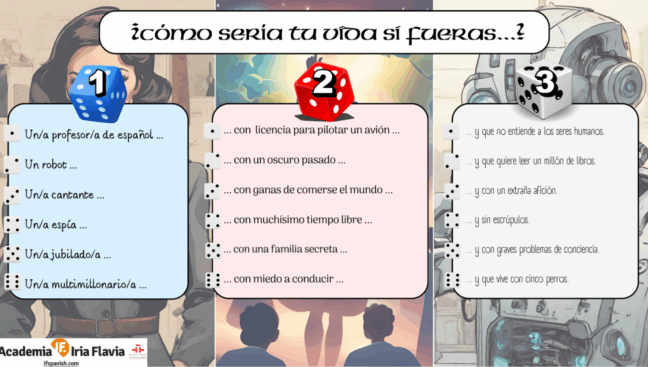
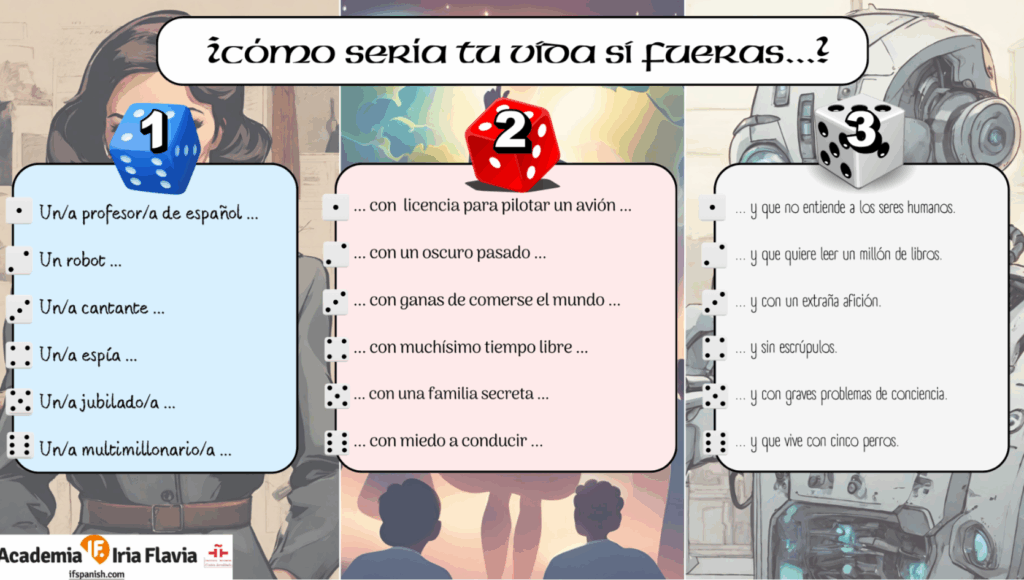
Como actividad final, incluimos una infografía con la que tus alumnos, en pequeños grupos, tendrán que ponerse en la piel de un determinado personaje: deberán tirar tres veces un dado 🎲🎲🎲, y en función del número que salga en cada tirada, se obtendrá como resultado un perfil concreto. Después, deberán imaginar cómo sería la vida de ese personaje, qué cosas harían, de qué forma actuarían, etc. 🤔
As a Language Teaching Lab Contributor, Academia Iria Flavia offers the following to the LTL community: Get a 20€ off discount when you use the code LTL20 at checkout, exceptions may apply
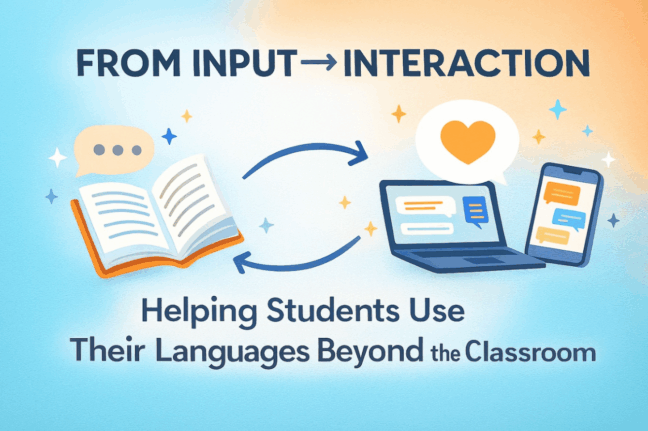
As language teachers, we’ve all seen this: Students who can understand so much more than they dare to say.
They follow along in stories, laugh at jokes, and pick up vocabulary from songs and videos… but when it’s time to speak, they freeze. Or they default to their “stronger” language, even when they could already communicate in the target language.
The challenge is not a lack of input, but the need for support in turning listening and reading into authentic communication.
Today, with the rise of AI and global online interaction, this transition matters more than ever. Students need guidance on using languages in real contexts—at home, in their communities, and online.
This reflection is inspired by my recent collaboration and interview with Sabrina Sánchez from Ms Sabrina’s Bilingual Playtime. Our conversation reminded me of the emotional and human side of language learning: identity, belonging, confidence, and connection.
Helping Students Move From Passive Input to Active Use
Start With Low-Pressure Interaction
Instead of jumping from listening straight into a full speaking task, build micro-moments of participation:
Thumbs-up/down reactions
Predict-what-comes-next
Simple call-and-response routines
These tiny steps help students feel like active participants long before they produce full sentences.
Use Guided Output Before Free Speech
Small scaffolds create big confidence:
Sentence frames
“Repeat and add one word”
Matching visuals with short phrases
Guided output makes risk-taking less intimidating and builds a natural bridge toward spontaneous communication.
Give Students a Real Audience
Speaking becomes meaningful when it has a purpose.
Some ideas:
Record short audio notes for younger students
Teach a topic to a partner class
Create bilingual slides to present at home
When communication is purposeful, students shift from “using language for school” to using language for life.
How Families Can Encourage Authentic Use at Home
One of the most beautiful themes in my conversation with Sabrina was how families can nurture languages gently, without pressure.
Give Each Language a Purpose
Mini rituals make languages come alive:
“Buenos días” at breakfast
Naming ingredients while cooking
Counting down in the target language before starting a video or game
These small habits build a meaningful, emotional connection.
Create Safe Language Zones
Children speak more when they feel safe:
“No corrections, just support” during certain times
A weekly family language evening
Letting children choose the song, game, or video
Safety builds confidence, and confidence builds language.
Make Content a Shared Experience
Instead of: “Watch this for homework.” Try: “Let’s watch this together—teach me one word!”
Resources from Bilingual Cerebros and Ms Sabrina’s Bilingual Playtime are intentionally designed for shared learning, so children can guide their families, not just follow instructions.
How Bilingual Cerebros Supports the Input → Output Journey
In my own content, I always ask: “How will this help a student use the language with someone else?”
Some ways I design for that:
Stories paired with meaningful speaking tasks
Bilingual printables that travel between school and home
Slides and visuals that invite comparison, retelling, and explaining
Activities that promote conversation, not just comprehension
My goal is to help students turn input into interaction—gently, confidently, and joyfully.
A Heart-Warming Reminder From My Conversation With Sabrina
What stayed with me most from talking with Sabrina was not a list of strategies, but the shared belief that: Every child’s languages are a gift. Every attempt—imperfect or hesitant—is progress. Languages grow strongest in relationships, not just in classrooms.
Parents sometimes worry they’re not doing enough. Teachers sometimes wonder if students will ever really use the language outside school. Students often fear mistakes more than lack of understanding.
Our message, together, is simple:
You are doing more than you think. Connection matters more than perfection. Every small moment counts.
And when a student uses a phrase at home, online, or with a friend—even if the sentence isn’t perfect—that is the magic of input becoming interaction.
That’s where languages truly come alive.
Want to Dive Deeper? Watch the Full Collaboration with Sabrina Sánchez
If you’d like to hear more practical ideas, heartfelt stories, and advice for parents, teachers, and students, I warmly invite you to watch our full collaboration interview.
We recorded two versions, so you can enjoy it in the language you prefer—or share it with your students and families:
Both conversations are filled with insights, encouragement, and real-life reflections on raising, teaching, and supporting multilingual learners. We hope they bring you inspiration, reassurance, and a few smiles along the way.
Let’s keep the conversation going! Share your questions or tips about raisin bilingual kids in the comments below.
De la Comprensión a la Interacción: Ayudando a los Estudiantes a Usar sus Lenguas Más Allá del Aula
Como docentes de lenguas, todos hemos visto esto: estudiantes que entienden muchísimo más de lo que se atreven a decir.
Siguen las historias, se ríen de los chistes y reconocen vocabulario en canciones y vídeos… pero cuando llega el momento de hablar, se bloquean. O recurren automáticamente a su lengua más fuerte, aunque ya podrían comunicarse en la lengua meta.
El reto no es la falta de input, sino la necesidad de ayudarles a convertir lo que escuchan y leen en comunicación auténtica.
Hoy, con el auge de la IA y la interacción global en línea, esta transición es más importante que nunca. Los estudiantes necesitan orientación para usar las lenguas en contextos reales: en casa, en sus comunidades y en los espacios digitales donde participan.
Esta reflexión surge de mi reciente colaboración y entrevista con Sabrina Sánchez de Ms Sabrina’s Bilingual Playtime. Nuestra conversación me recordó el lado profundamente humano del aprendizaje lingüístico: identidad, pertenencia, confianza y conexión.
Cómo Pasar de Input Pasivo a Uso Activo
Empieza con Interacciones de Baja Presión
En lugar de pasar directamente de escuchar a una tarea de expresión oral completa, crea pequeños momentos de participación:
Reacciones con pulgar arriba/abajo
Predecir lo que sucederá
Pequeñas rutinas de llamada y respuesta Estos gestos ayudan al estudiante a sentirse participante, mucho antes de producir frases completas.
Utiliza Output Guiado Antes de Habla Libre
Pequeños andamiajes o apoyos linguísticos con modelos pueden generar gran confianza:
Oraciones modelo
“Repite y añade una palabra”
Relacionar imágenes con frases cortas
El output guiado reduce la ansiedad y crea un puente natural hacia la comunicación espontánea.
Ofréceles una Audiencia Real
Hablar cobra sentido cuando hay un propósito. Algunas ideas:
Grabar mensajes de audio para estudiantes más pequeños
Enseñar un tema a otra clase
Crear diapositivas bilingües para presentar en casa
Cuando la comunicación tiene un destinatario real, los estudiantes pasan de “usar la lengua para la escuela” a usar la lengua para la vida.
Cómo las Familias Pueden Fomentar un Uso Auténtico en Casa
Uno de los temas más bonitos de mi conversación con Sabrina fue cómo las familias pueden nutrir las lenguas de manera suave, sin presión.
Darle un Propósito a Cada Lengua
Pequeños rituales hacen que las lenguas cobren vida:
“Buenos días” durante el desayuno
Nombrar ingredientes mientras cocinan
Contar en la lengua meta antes de empezar un vídeo o un juego Estos hábitos generan una conexión emocional significativa.
Crear Zonas de Lengua Segura
Los niños hablan más cuando se sienten seguros:
“Sin correcciones, solo apoyo” en ciertos momentos
Una noche familiar dedicada a la lengua
Dejar que ellos elijan la canción, el juego o el vídeo
La seguridad genera confianza, y la confianza genera lenguaje.
Convertir el Contenido en una Experiencia Compartida
En lugar de decir: “Mira esto para los deberes.” Prueba: “Veámoslo juntos—¡enséñame una palabra!”
Los recursos de Bilingual Cerebros y Ms Sabrina’s Bilingual Playtime están diseñados para un aprendizaje compartido, donde los niños pueden guiar a sus familias, no solo seguir instrucciones.
Cómo Bilingual Cerebros Acompaña el Camino de Input → Output
Cuando creo contenido, siempre me pregunto: “¿Cómo ayudará esto al estudiante a usar la lengua con otra persona?” Algunas maneras en que diseño pensando en esta transición:
Historias acompañadas de tareas orales significativas
Materiales bilingües que funcionan tanto en casa como en el aula
Diapositivas visuales que invitan a comparar, volver a contar y explicar
Actividades centradas en la conversación, no solo en la comprensión
Mi objetivo es ayudar a los estudiantes a convertir el input en interacción—de manera suave, segura y feliz.
Un Recordatorio de Mi Conversación con Sabrina
Lo que más me quedó de nuestra charla no fue una lista de estrategias, sino una creencia compartida: Las lenguas de cada niño son un regalo. Cada intento—imperfecto o dudoso—es progreso. Las lenguas crecen más en las relaciones que en los libros.
Los padres a veces sienten que no hacen lo suficiente. Los docentes se preguntan si los estudiantes realmente usarán la lengua fuera del aula. Los estudiantes temen cometer errores más que no entender.
Nuestro mensaje, juntas, es sencillo: Estás haciendo más de lo que crees. La conexión importa más que la perfección. Cada pequeño momento cuenta.
Y cuando un estudiante usa una frase en casa, en línea, o con un amigo—aunque no sea perfecta—ahí es donde sucede la magia del input convirtiéndose en interacción. Ahí es cuando las lenguas realmente cobran vida.
¿Quieres Profundizar? Mira la Colaboración Completa con Sabrina Sánchez
Si te gustaría escuchar más ideas prácticas, historias sinceras y consejos para familias, docentes y estudiantes, te invito a ver nuestra entrevista completa.
Grabamos dos versiones, para que elijas tu lengua preferida o la compartas con tus estudiantes y comunidades:
Ambas conversaciones están llenas de ideas, ánimo y experiencias reales sobre cómo criar, enseñar y acompañar a aprendices multilingües. Esperamos que te inspiren, te reconforten y te hagan sonreir.
When ChatGPT first appeared on November 30, 2022, I opened it with curiosity. I typed a prompt, watched the screen fill with words, and thought, “This is clever and interesting, but I wonder how it can help in the classroom?” At the time, it felt like a novelty: engaging, imaginative, and sometimes helpful, but not yet reliable or unbiased enough to be a teaching partner. Three years later, it supports differentiation, creates authentic language learning experiences, and helps me make instruction more responsive and inclusive. It even brings ancient voices back to life, in ways my students and I could never have imagined.
ChatGPT Then and Now
ChatGPT today is not the same tool that was launched in 2022. It has grown alongside us. It reacts better, reasons more deeply, and adapts to our goals. One of the most transformative changes has been the ability to create custom GPTs that reflect our curriculum, our students, and our values. These are not just chatbots. They are personalized learning companions.
Custom GPTs in Latin Class
Last year, I created a custom GPT to serve as a Latin reading companion. It only used vocabulary from our current chapter, explained unfamiliar words using simple Latin, and asked students follow-up questions in the target language. As my students interacted with it, they began seeing themselves as language users rather than just language learners. Encouraged by its impact, I built a full library of custom GPTs, one for each lesson. These classroom helpers now offer mini grammar lessons, quiz students on vocabulary, explain cultural references, and answer content questions. My students gradually stopped saying, “I do not understand this” on their homework assignments and started saying, “Let me ask my custom GPT to help me figure it out.” That shift from confusion to curiosity has been one of the most meaningful changes in my teaching.
Perpetua Chatbot
One of the most powerful tools I have created is the Perpetua chatbot. When we study Passio Perpetuae, my students do not just read the text: they talk to Perpetua in Latin! The chatbot responds using text-based evidence, shares context about Roman North Africa, and helps students understand her identity as both a mother and a martyr. Students ask questions (in Latin) such as, “What did it feel like when your father begged you to renounce your faith?” The chatbot responds in Latin, using details drawn directly from the text. Watching students interact with Perpetua as a historical and human figure, rather than just a character on a page, has been extraordinary. The past becomes a conversation, not just content.
Supports Accessibility
ChatGPT has also helped me support accessibility in meaningful ways. When I prepare readings, I can ask it to simplify syntax, create bilingual glossaries, add visuals, or convert passages into audio. It does not just make content easier. It makes it more reachable and supports equity.
ChatGPT for Teachers
The arrival of ChatGPT for Teachers has made all of this work more sustainable. It provides stronger privacy protections, safer student-facing options, and tools that honor the realities of K–12 learning environments. It allows me to work with student objectives, authentic texts, and curriculum-aligned vocabulary without compromising security. It also gives educators a space to share examples, ask questions, and shape how AI shows up in schools.
ChatGPT should not replace thinking
What I have learned is this: when used well, ChatGPT should not replace thinking. It should deepen it and enhance it. In my classroom, it encourages slower, more reflective learning. It helps students revise rather than rush. It can nudge them to explain, question, and build on their own ideas. It should never remove the work of learning or the power of the students’ voices. It invites our students to take ownership of it.
Happy Birthday, ChatGPT.
Three years in, ChatGPT feels less like a digital curiosity and more like a thoughtful learning companion. On its birthday, I am not most impressed by how quickly it generates text. I am most moved by how it helps my students speak with confidence, explore with curiosity, and connect with voices from across time by enhancing their own confidence and comprehension.
This is the kind of learning worth celebrating. Happy Birthday, ChatGPT. Here is to the stories, voices, and connections still to come!
As a Spanish language educator and supervisor, small business owner, and mother to an active toddler, I often feel like I’m living three very full lives at once. I move from school meetings to connection calls to wiping cream cheese off very tiny fingers—all before lunch. And while I do enjoy each hat I wear, I’ve learned that I can’t show up fully in any of them unless I set one powerful boundary: I choose to say “no”.
“No” has become a valuable word for me but it hasn’t always been easy. As educators and caretakers—it sometimes feels easier to say “yes” to avoid the guilt of saying no. Yes to helping a fellow language educator. Yes to taking on an extra workshop at that conference. Yes to a last-minute invitation knowing you just don’t have the time or energy. When yes becomes a default word, as it sometimes was for me, we can sometimes lose ourselves and a cycle of exhaustion and over commitment begins.
Saying no has become an act of mindfulness. It’s a pause, a breath, a moment of clarity where I check in with myself and ask: Does this bring me joy? Will this bring me peace? Will this decision leave space for the people and priorities I love the most?
Learning to say no is not selfish—it’s self-preservation. It’s self-awareness. It’s how I’ve created space to enjoy slow mornings with my toddler, to be present in my school, and to invest my limited time and energy into the parts of my business that feel aligned and sustainable.
Boundaries Are Bridges
Too often, we think of boundaries as walls—rigid and isolating. But I’ve come to believe that boundaries are actually bridges. They connect us to what matters most by filtering out what drains us. They protect our peace. They allow us to choose joy over obligation, presence over performance.
When I say no to a weekend obligation that does not bring me joy, I’m saying yes to a Sunday afternoon yoga class. I’m saying yes to watching my toddler giggle on the swings. I am saying yes to spending precious time with family and friends.
Saying no to perfectionism means I get to let go of the pressure to do everything all of the time—whether it’s teaching, parenting, or entrepreneurship. And that’s where the power of no continues to teach me how to set better boundaries.
Mindfulness, Movement, and that Strong Inner Voice
I’ve noticed that my “no” becomes stronger when I listen more carefully—to my breath, to my body, to that wise voice within. Yoga has been one of the greatest gifts in that process. On the mat, I return to myself. I notice where I’m holding tension, where I’m gripping too tightly—physically and metaphorically.
In mindfulness practice, I observe my thoughts without judgment. I catch myself when I begin to spiral into guilt for saying no or fear of disappointing others. I remind myself: These thoughts do not serve you.
Choosing Joy
The “Power of No” is really the power to choose. It’s the power to reclaim time, energy, and attention for the things that light us up. I still get it wrong. I still overbook myself or forget to pause. I am human and I make mistakes. But each time I choose no with intention, I get a little closer to balance—and a lot closer to joy.
I’ve learned that you can’t do it all well and every now and then, you have to check in with yourself and reclaim that time for joy. I invite you to try this simple practice: the next time someone asks something of you, pause. Breathe. Ask yourself, Does this yes come from love or from fear? And know this: every “no” you give sets you up to say “yes” to many other things that better fill your cup with joy. Reframing the word no so it doesn’t indicate rejection but instead it’s a powerful redirection back to yourself.
Language Teaching Lab Community: Take advantage of these two options with LoLogramos!
Get a $5 off each month for the AI Innovator Monthly Subscription by using code: ltl5month
Get a $5 off of ANY of the online courses, including the latest: Canva, Your One Stop Shop! by using code: team5
The book explains the four types of regret, which in a nut bolt could be summarized as follows,
Foundation Regrets – not fulfilling your basic responsibilities
Boldness Regrets – not taking those rare opportunities in life
Moral Regrets – not acting ethically
Connection Regrets – not acting on keeping connections or relationships
How do these types of regrets connect to language teaching and learning?
Let’s talk about engagement first:
In a language class students need to be engaged in all the following four dimensions for advancing language acquisition,
Behavioral: putting time and effort in learning
Cognitive: being attentive and reflecting on their learning
Affective: lowering the affective filter so students are able to ‘be present’ and learn
Social: interacting and collaborating with others
Learning a language is a dynamic process where students actively engage in the four dimensions mentioned above.
If students are not engaged, they might feel disappointed for not meeting the obligations in class or they may regret not acting ethically in class. They may also miss opportunities of acquiring a language, which they may regret later in life.
How can we help students avoid regret later in life about learning a language?
We do a lot in class to help students acquire a language. We may want to consider teaching about regrets as well, moving forward. Why? To help students make better decisions now that they will not regret in the future. I have heard multiple times from students’ parents that they regret not being able to speak another language for a myriad of reasons. One of the most common ones reported relates to the fact of not taking the risk of speaking the language in class.
What can be done in a language class?
Below are some examples of what can be done in class without reinventing your curriculum. It is simply adding thoughtful ways to using reflection on regrets as feedback.
Teach the emotion of regret. Regret is an emotion. It involves feelings, such as disappointment or sadness of missed opportunities for making decisions that now we wish had been different. Instead of treating this emotion as a negative one, we should see it as a wake up call for personal growth and future decision making
Have students reflect on missing obligations to achieve a balance between dreams and duties through the fable The Grasshopper and the Ant, Encourage students to push themselves out of their comfort zone to speak more in class.
Plan different groupings for students to practice and feel more comfortable with the content. I usually tell my students to think of those practices as assessments and then, think of the real assessments as one more practice. It works!
Have students reflect on the ‘At leasts’ and ‘If onlys’ that happen in class. This will allow students to reflect and to take action to move forward in their academic progress.
Depending on the age of your students, provide opportunities for
Self-disclosure – let it out – talk or write about regrets
Self-compassion – treat yourself with kindness – we all make mistakes
Self-distancing – reflect on the regret from a third-person point of view
Use storytelling in class, depending on students’ age, as it provides an opportunity to imagine different endings
to an action or an inaction,
to doing something wrong, or
to answer the question ‘what now?’
Students will really appreciate the tools you provide them with for personal growth and future decision making.
Regrets move us forward
Regrets can get in the way of learning a language or they can be used to help students move forward in their learning. The idea is that students make better decisions now so that in the future they will not regret not having acquired a language. Looking backwards really moves us forward.
Cookie Consent
We use cookies to improve your experience on our site. By using our site, you consent to cookies.
Cookie Preferences
Manage your cookie preferences below:
Essential cookies enable basic functions and are necessary for the proper function of the website.
Name
Description
Duration
Cookie Preferences
This cookie is used to store the user's cookie consent preferences.